Transcription of Chapter 31: RLC Circuits
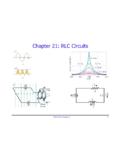
1 PHY2049: Chapter 311 Chapter 31: RLC CircuitsPHY2049: Chapter 312 Topics LC Oscillations Conservation of energy Damped oscillations in RLC Circuits Energy loss AC current RMS quantities Forced oscillations Resistance, reactance, impedance Phase shift Resonant frequency Power Transformers Impedance matchingPHY2049: Chapter 313LC Oscillations Work out equation for LC circuit (loop rule) Rewrite using i = dq/dt (angular frequency) has dimensions of 1/t Identical to equation of mass on springLC0qdiLCdt =2222200dq qdqLqCdtdt += + =2222200dxdxmkxxdtdt += + =1LC =km =PHY2049: Chapter 314LC Oscillations (2) Solution is same as mass on spring oscillations qmaxis the maximum charge on capacitor is an unknown phase (depends on initial conditions) Calculate current.
2 I = dq/dt Thus both charge and current oscillate Angular frequency , frequency f = /2 Period: T = 2 / Current and charge differ in phase by 90 ()maxcosqqt =+()()maxmaxsinsiniqtit = + = +km =PHY2049: Chapter 315 Plot Charge and Current vs t()maxcosqqt =()maxsiniit = tPHY2049: Chapter 316 Energy Oscillations in LC Circuits Total energy in circuit is conserved. Let s see why0diqLdt C+=0diq dqLidtC dt+=Multiply by i = dq/dtEquation of LC circuit()()221022 LddiqdtC dt+=Use22dxdxxdtdt=2211220dqLidtC += UL+ UC= const221122constqLiC+=PHY2049: Chapter 317 Oscillation of Energies Energies can be written as (using 2= 1/LC) Conservation of energy.
3 Energy oscillates between capacitor and inductor Endless oscillation between electrical and magnetic energy Just like oscillation between potential energy and kinetic energy for mass on spring()222maxcos22 CqqUtCC ==+()()222222max11max22sinsin2 LqULiLqttC ==+=+2maxconst2 CLqUUC+= =PHY2049: Chapter 318 Plot Energies vs t()CUt()LUtSumPHY2049: Chapter 319LC Circuit Example Parameters C = 20 F L = 200 mH Capacitor initially charged to 40V, no current initially Calculate , f and T = 500 rad/s f = /2 = Hz T = 1/f = sec Calculate qmaxand imax qmax= CV = 800 C = 8 10-4C imax= qmax= 500 8 10-4 = A Calculate maximum energies UC= q2max/2C = UL= Li2max/2 = ()()51/1/2 == =PHY2049: Chapter 3110LC Circuit Example (2) Charge and current Energies Voltages Note how voltages sum to zero, as they must!
4 () cos 500qt=() sin 500dqitdt== ()() cos sin500 CLUtUt==()/40 cos 500 CVqCt==()()max/cos 50040 cos 500 LVLdi dtL itt == = PHY2049: Chapter 3111 Quiz Below are shown 3 LC Circuits . Which one takes the least time to fully discharge the capacitors during the oscillations? (1) A (2) B (3) CABCCCCCC1/LC =C has smallest capacitance, therefore highestfrequency, therefore shortest periodPHY2049: Chapter 3112 RLC Circuit The loop rule tells us Use i = dq/dt, divide by L Solution slightly more complicated than LC case This is a damped oscillator (similar to mechanical case) Amplitude of oscillations falls exponentially0diqLRidtC++=220dq Rdq qLdt LCdt++=()()2/2maxcos1// 2tRLqq etLC R L =+= PHY2049.
5 Chapter 3113 Charge and Current vs t in RLC Circuit()qt()it/2tRLe PHY2049: Chapter 3114 RLC Circuit Example Circuit parameters L = 12mL, C = F, R = Calculate , , f and T = 7220 rad/s = 7220 rad/s f = /2 = 1150 Hz T = 1/f = sec Time for qmaxto fall to its initial value t = (2L/R) * ln2 = = ms # periods = 13()()61 107220 = =() / = /21/ 2tRLe =PHY2049: Chapter 3115 RLC Circuit (Energy)0diqLRidtC++=Basic RLC equationMultiply by i = dq/dt20diq dqLiRidtC dt++ =2221122dqLii RdtC += Collect terms(similar to LC circuit)()2 LCdUUiRdt+= Total energy in circuitdecreases at rate of i2R(dissipation of energy)/tottR LUe PHY2049: Chapter 3116 Energy in RLC Circuit()CUt()LUtSum/tR Le