Transcription of Chapter 5 – Prompt Corrective Action
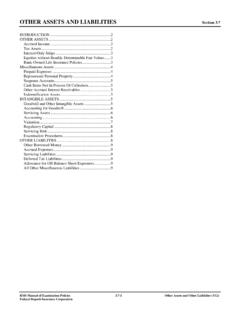
1 Prompt Corrective Action Chapter 5 Formal and Informal Enforcement Actions Manual Chapter 5 Prompt Corrective Action federal Deposit insurance corporation (11-2019) Chapter 5 Prompt Corrective Action Prompt Corrective Action 5-1 Purpose of PCA 5-1 Capital Categories 5-1 Community Bank Leverage Ratio 5-2 Mandatory and Other Discretionary Supervisory Actions 5-3 Provisions Applicable to all FDIC Supervised Institutions 5-3 Provisions Applicable to IDIs that are less than Adequately Capitalized 5-3 Provisions Applicable to IDIs that are Significantly Undercapitalized or Critically Undercapitalized.
2 Or are Undercapitalized and have Failed to Submit an Acceptable Capital Restoration Plan 5-3 Provisions Applicable to IDIs that are Critically Undercapitalized 5-4 Reclassifying (Downgrading) a Capital Category 5-5 Criteria 5-5 Simultaneous Actions 5-5 Capital Restoration Plans 5-5 Reclassification Procedures 5-6 Issuing a Notice of Intent to Reclassify 5-6 Requests for an Informal Hearing 5-7 Modifying or Terminating a Notice of Intent to Reclassify 5-7 Modifying or Terminating an Order to Reclassify 5-7 Reconsideration Requests 5-7 Supervisory Directives 5-8 Written Notice Generally Required 5-8 Exception to Notice Requirement 5-9 Modifying or Terminating NOIs and Supervisory Directives
3 5-9 Enforcement of Directives 5-9 Dismissing Directors or Senior Executive Officers 5-9 Definitions 5-9 Grounds for Dismissal 5-10 Dismissal Criteria 5-10 Comparison to Section 8(e) Removals 5-10 Issuing a Notice of Intent 5-10 Issuing an Order of Dismissal 5-11 Modifying or Terminating Notices, Immediate Suspensions, and Dismissal Orders 5-11 Reinstatement Requests 5-11 Prompt Corrective Action Chapter 5 Formal and Informal Enforcement Actions Manual Chapter 5 Prompt Corrective Action federal Deposit insurance corporation (11-2019)
4 Delaying Mandatory Resolution of a Critically Undercapitalized Institution 5-12 When a Mandatory Resolution Is Required 5-12 When Mandatory Resolution Can Be Extended 5-12 Final Resolution 5-12 Exception to Mandatory Resolution 5-12 Appointing the FDIC as Receiver or Conservator 5-13 Authority Retained by the FDIC Board 5-13 Grounds for Self-Appointment 5-13 Processing Self-Appointment Actions 5-14 Prompt Corrective Action Chapter 5 Formal and Informal Enforcement Actions Manual Chapter 5 Prompt Corrective Action federal Deposit insurance corporation 5-1 (11-2019) Prompt Corrective Action Section 38 of the FDI Act authorizes the FDIC to take PCA against IDIs based on their capital levels.
5 The actions may include the following: Reclassifying (downgrading) an IDI s capital category. Issuing supervisory directives to IDIs in certain capital categories. Dismissing directors or senior executive officers of IDIs. Under certain circumstances, the FDIC may delay resolution of a critically undercapitalized IDI if a determination is made that it is in the best interest of the DIF. Instructions for processing actions under PCA appear in the following pages. This Chapter also provides information regarding the FDIC s authority to appoint itself as conservator or receiver of an IDI under Section 11(c) of the FDI Act.
6 Purpose of PCA Based upon specific capital categories, PCA is intended to resolve various issues concerning problem IDIs in an expeditious manner through early intervention in such problem banks. Capital Categories Section 38 and Subpart H of 12 Part 324 provide five capital categories, as described below. PCA Category Description Well Capitalized Total risk-based capital ratio and tier 1 risk-based capital ratio and common equity tier 1 capital ratio and leverage ratio and not subject to any Action issued by the FDIC under Section 8 of the FDI Act, the International Lending Supervision Act of 1983 (ILSA), the Home Owners Loan Act (HOLA), or Section 38 of the FDI Act, or any regulations thereunder, to meet and maintain a specific capital level for any capital measure.
7 A bank subsidiary of a covered bank holding company will be deemed well capitalized if it meets the above criteria and has a supplementary leverage ratio Adequately Capitalized Total risk-based capital ratio and tier 1 risk-based capital ratio and common equity tier 1 capital ratio and leverage ratio and does not meet the definition of a well capitalized IDI. An IDI using advanced approaches will be deemed adequately capitalized if it meets the above criteria and has a supplementary capital ratio Undercapitalized Total risk-based capital ratio < or tier 1 risk-based capital ratio < or common equity tier 1 capital ratio < or leverage ratio < An IDI using advanced approaches will be deemed undercapitalized if it has a supplementary capital ratio < Significantly Undercapitalized Total risk-based capital ratio < or tier 1 risk-based capital
8 Ratio < or common equity tier 1 capital ratio < or leverage ratio < Prompt Corrective Action Chapter 5 Formal and Informal Enforcement Actions Manual Chapter 5 Prompt Corrective Action federal Deposit insurance corporation 5-2 (11-2019) PCA Category Description Critically Undercapitalized Ratio of tangible equity to total assets (Note: tangible equity is tier 1 capital plus the amount of outstanding perpetual preferred stock (including related surplus) not included in tier 1 capital. Community Bank Leverage Ratio Section 38 and Subpart H of 12 Part 324 also defines a qualifying community banking organization as having less than $10 billion in total consolidated assets, a leverage ratio greater than 9 percent, off-balance sheet exposures of 25 percent or less of total consolidated assets, and trading assets and liabilities of 5 percent or less of total consolidated assets (qualifying criteria).)
9 A qualifying community banking organization with a leverage ratio greater than 9 percent is considered to have met: the requirements of the generally applicable capital rule; the well capitalized capital ratio thresholds under the agencies PCA framework for IDIs or the well capitalized standards under the Board s regulations for holding companies, as applicable; and any other capital or leverage requirements to which the banking organization is subject. Such qualifying community banking organizations are not required to calculate capital ratios under the generally applicable rule.
10 Additionally, to be considered well capitalized under the community bank leverage ratio framework, and consistent with the agencies PCA framework, a qualifying community banking organization must not be subject to any written agreement, order, capital directive, or PCA directive to meet and maintain a specific capital level for certain PCA capital measures. Under the community bank leverage ratio framework, a qualifying community banking organization that has a leverage ratio that is greater than 8 percent and equal to or less than 9 percent is allowed a two-quarter grace period to maintain its well capitalized PCA status under the community bank leverage ratio framework after which it must either: again meet all qualifying criteria or apply and report the generally applicable risk-based capital rule.