Transcription of Chapter 7: Control of Microbial Growth
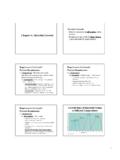
1 Control of Microbial Growth : Introduction 4 Early civilizations practiced salting, smoking, Chapter 7: Control of pickling, drying, and exposure of food and clothing to sunlight to Control Microbial Growth . Microbial Growth 4 Use of spices in cooking was to mask taste of spoiled food. Some spices prevented spoilage. 4 In mid 1800s Semmelweiss and Lister helped developed aseptic techniques to prevent contamination of surgical wounds. Before then: Nosocomial infections caused death in 10% of surgeries.
2 Up to 25% mothers delivering in hospitals died due to infection Control of Microbial Growth : Control of Microbial Growth : Definitions Definitions Sterilization: Killing or removing all forms of Disinfection: Reducing the number of pathogenic Microbial life (including endospores) in a material microorganismsto the point where they no longer or an object. cause diseases. Usually involves the removal of vegetative or non-endospore forming pathogens. Heating is the most commonly used method of sterilization.
3 May use physical or chemical methods. u Disinfectant: Applied to inanimate objects. Commercial Sterilization: Heat treatment that u Antiseptic: Applied to living tissue (antisepsis). kills endospores of Clostridium botulinum the u Degerming : Mechanical removal of most microbes in a causative agent of botulism, in canned food. limited area. Example: Alcohol swab on skin. Does not kill endospores of thermophiles, which u Sanitization: Use of chemical agent on food-handling are not pathogens and may grow at temperatures equipment to meet public health standards and minimize above 45o C.
4 Chances of disease transmission. : Hot soap & water. Control of Microbial Growth : Control of Microbial Growth : Definitions Definitions Sepsis: Comes from Greek for decay or putrid. Bacteriostatic Agent: An agent that inhibits the Indicates bacterial contamination. Growth of bacteria, but does not necessarily kill Asepsis: Absence of significant contamination. them. Suffix stasis: To stop or steady. Aseptic techniques are used to prevent Germicide : An agent that kills certain contamination of surgical instruments, medical micoorganisms.
5 Personnel, and the patient during surgery. u Bactericide: An agent that kills bacteria. Most do not kill endospores. Aseptic techniques are also used to prevent u Viricide: An agent that inactivates viruses. bacterial contamination in food industry. u Fungicide: An agent that kills fungi. u Sporocide: An agent that kills bacterial endospores of fungal spores. 1. Control of Microbial Growth : Control of Microbial Growth : Rate of Microbial Death Rate of Microbial Death When bacterial populations are heated or treated Several factors influence the effectiveness of antimicrobial chemicals, they usually die at a antimicrobial treatment.
6 Constant rate. 1. Number of Microbes: The more microbes present, the more time it takes to eliminate population. 2. Type of Microbes: Endospores are very difficult to destroy. Vegetative pathogens vary widely in susceptibility to different methods of Microbial Control . 3. Environmental influences: Presence of organic material (blood, feces, saliva) tends to inhibit antimicrobials, pH etc. 4. Time of Exposure: Chemical antimicrobials and radiation treatments are more effective at longer times. In heat treatments, longer exposure compensates for lower temperatures.
7 Phsysical Methods of Microbial Phsysical Methods of Microbial Control : Control : Heat: Kills microorganisms by denaturing their Moist Heat: Kills microorganisms by coagulating enzymes and other proteins. Heat resistance their proteins. varies widely among microbes. In general, moist heat is much more effective than u Thermal Death Point (TDP) : Lowest temperature at dry heat. which all of the microbes in a liquid suspension will be u Boiling: Heat to 100 oC or more at sea level. Kills vegetative killed in ten minutes.
8 Forms of bacterial pathogens, almost all viruses, and fungi u Thermal Death Time (TDT): Minimal length of time in and their spores within 10 minutes or less. Endospores and which all bacteria will be killed at a given temperature. some viruses are not destroyed this quickly. However brief u Decimal Reduction Time (DRT): Time in minutes at boiling will kill most pathogens. which 90% of bacteria at a given temperature will be u Hepatitis virus: Can survive up to 30 minutes of boiling. killed. Used in canning industry.
9 U Endospores: Can survive up to 20 hours or more of boiling. Phsysical Methods of Microbial Autoclave: Closed Chamber with High Control : Temperature and Pressure Moist Heat (Continued): Reliable sterilization with moist heat requires temperatures above that of boiling water. u Autoclave: Chamber which is filled with hot steam under pressure. Preferred method of sterilization, unless material is damaged by heat, moisture, or high pressure. u Temperature of steam reaches 121o C at twice atmospheric pressure.
10 U Most effective when organisms contact steam directly or are contained in a small volume of liquid. u All organisms and endospores are killed within 15 minutes. u Require more time to reach center of solid or large volumes of liquid. 2. Phsysical Methods of Microbial Phsysical Methods of Microbial Control : Control : Moist Heat (Continued): Dry Heat: Kills by oxidation effects. u Pasteurization: Developed by Louis Pasteur to prevent the u Direct Flaming: Used to sterilize inoculating loops and spoilage of beverages.