Transcription of Chapter 9 Cellular Respiration, TE
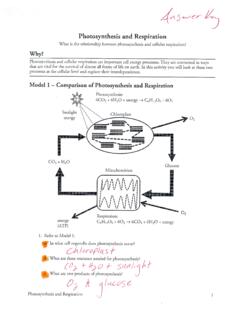
1 GlycolysisGlucoseCytoplasmATPE lectrons carried in NADHM itochondrionElectronscarried inNADH andFADH2 PyruvicacidKrebsCycleElectronTransportCh ainATPATPName_____Class _____Date _____Chapter 9 Cellular RespirationSection 9 1 Chemical Pathways(pages 221 225)This section explains what Cellular respiration is. It also describes whathappens during a process called glycolysis and describes two types of aprocess called Energy and Food(page 221) is a calorie?It is the amount of energy needed to raise the temperature of 1 gram of water 1 Celsius many calories make up 1 Calorie? respiration begins with a pathway called . the following sentence true or false? Glycolysis releases a great amount of energy. Overview of Cellular respiration (page 222) is Cellular respiration ?It is the process that releases energy by breaking down food molecules in the presence of is the equation for Cellular respiration , using chemical formulas?
2 6O2+ C6H12O6 6CO2+ 6H2O + would be the problem if Cellular respiration took place in just one step?All the energy from glucose would be released at once, and most of it would be lost in the form of light and the three main stages of Cellular respiration on theillustration of the complete Reading and Study Workbook/ Chapter 9 Pearson Education, Inc. All rights Reading and Study Workbook/ Chapter 971 Pearson Education, Inc. All rights _____Date does glycolysis take place?It takes place in the do the Krebs cycle and electron transport take place?They take place inside the (page 223) is glycolysis?It is the process in which one molecule of glucose is broken in half, producing two molecules of pyruvic acid, a 3-carbon does the cell get glycolysis going?It uses the energy of 2 molecules of the cell uses 2 ATP molecules at the beginning of glycolysis, how does it end up with a net gain of 2 ATP molecules?
3 When glycolysis is complete, 4 ATP molecules have been is NAD+?It is the electron carrier nicotinamide adenine is the function of NAD+in glycolysis?One of the reactions of glycolysis removes 4 high-energy electrons and passes them to NAD+, which becomes NADH and holds the electrons until they can be transferred to other can glycolysis supply energy to cells when oxygen is not available?It does not require problem does a cell have when it generates large amounts of ATP from glycolysis?In just a few seconds, all of the cell s available NAD+ are filled with (pages 224 225) is fermentation?It is a process in which cells convert NADH to NAD+by passing high-energy electrons back to pyruvic does fermentation allow glycolysis to continue?Fermentation produces a steady supply of fermentation does not require oxygen, it is said to be.
4 Are the two main types of fermentation? acid fermentationAlcoholic fermentationanaerobic72 Guided Reading and Study Workbook/ Chapter 9 Pearson Education, Inc. All rights _____Date organisms use alcoholic fermentation?Yeasts and a few other microorganisms use is the equation for alcoholic fermentation after glycolysis?Pyruvic acid + NADH alcohol + CO2+ NAD+ happens to the small amount of alcohol produced in alcoholic fermentation during the baking of bread?It does lactic acid fermentation convert into lactic acid? is the equation for lactic acid fermentation after glycolysis?Pyruvic acid + NADH lactic acid + NAD+ rapid exercise, how do your muscle cells produce ATP?After they use up the ATP produced from Cellular respiration , they produce it by lactic acid 9, Cellular respiration (continued)Reading Skill PracticeWhen your read about complex topics, writing an outline can help you organizeand understand the material.
5 Outline Section 9 1 by using the headings andsubheadings as topics and subtopics and then writing the most important detailsunder each topic. Do your work on a separate sheet of outlines should have four major topics, matching the four blue headings of the section. Detailsinclude highlighted vocabulary terms as well as the important concepts discussed under each 9 2 The Krebs Cycle and Electron Transport(pages 226 232)This section describes what happens during the second stage of cellularrespiration, called the Krebs cycle. It also explains how high-energy electronsare used during the third stage, called electron (page 226) the end of glycolysis, how much of the chemical energy in glucose is still unused?About 90 the final stages of Cellular respiration require oxygen, they are said to be .The Krebs Cycle(pages 226 227) the presence of oxygen, how is the pyruvic acid produced in glycolysis used?
6 It passes to the second stage of Cellular respiration , the Krebs happens to pyruvic acid during the Krebs cycle?It is broken down into carbon dioxide in a series of energy-extracting Reading and Study Workbook/ Chapter 973 Pearson Education, Inc. All rights _____Date is the Krebs cycle also known as the citric acid cycle?Citric acid is the first compound formed in this series of does the Krebs cycle begin?It begins when pyruvic acid produced by glycolysis enters the happens to each of the 3 carbon atoms in pyruvic acid when it is broken down?One carbon atom becomes part of a molecule of carbon dioxide. Two of the carbon atoms are joined to a compound called coenzyme A to form happens to the carbon dioxide produced in breaking down pyruvic acid?It is released into the is citric acid produced?Acetyl-CoA adds the 2-carbon acetyl group to a 4-carbon molecule, producing a 6-carbon molecule called acetic the energy extraction part of the Krebs cycle, how many molecules of CO2are released?
7 Is the energy tally from 1 molecule of pyruvic acid during the Krebs cycle?It is 4 NADH molecules, 1 FADH2molecule, and 1 molecule of electrons join NAD+and FAD during the Krebs cycle, what do they form?They form NADH and is the 4-carbon compound generated in the breakdown of citric acid the only permanent compound in the Krebs cycle?It is regenerated at the end of each complete turn of the Transport(pages 228 229) is the electron transport chain?It is a series of proteins in the inner membrane of does the electron transport chain use the high-energy electrons from the Krebs cycle for?The chain uses the electrons to convert ADP into does the location of the electron transport chain differ in eukaryotes and prokaryotes?In eukaryotes, the chain is composed of a series of proteins that is located in the inner membrane of the mitochondrion.
8 In prokaryotes, the chain is in the cell Reading and Study Workbook/ Chapter 9 Pearson Education, Inc. All rights _____Date does the electron transport chain get the high-energy electrons that are passed down the chain?It gets the electrons from NADH and FADH2, which are produced in the Krebs the following sentence true or false? Hydrogen serves as thefinal electron acceptor of the electron transport chain. is the energy of the high-energy electrons used for every time 2 high-energy electrons move down the electron transport chain?Their energy is used to transport hydrogen ions across the causes the H+ions in the intermembrane space to move through the channels in the membrane and out into the matrix?During electron transport, H+ions build up in the intermembrane space, making it positively charged. The other side of the membrane, from which those H+ions have been taken, is now negatively charged.
9 The charge differences that build up cause the ions to average, how many ATP molecules are produced as each pairof high-energy electrons moves down the electron transport chain? the flowchart about electron ATP moleculesfalseChapter 9, Cellular respiration (continued)High-energy electrons from NADH and FADH2are passed into and along the .electron transport chainThe energy from the electrons moving down the chain is used to move H+ions across the .inner membraneH+ions build up in the space, making it charged and making the matrix negatively +ions move through channels of in the inner synthaseThe ATP synthase uses the energy from the moving ions to combine ADP and phosphate, forming high-energy .AT PGuided Reading and Study Workbook/ Chapter 975 Pearson Education, Inc. All rights _____Date _____The Totals(page 229) is the total number of ATP molecules formed during Cellular respiration ?
10 Can 18 times as much ATP be generated from glucose in the presence of oxygen than when oxygen is not available?When oxygen is not available, the Krebs cycle and electron transport cannot proceed, and glycolysis produces just 2 ATP molecules per glucose molecule. Under aerobic conditions, the Krebs cycle and electron transport enable the cell to produce 34 more ATP molecules per glucose happens to the 62 percent of the total energy of glucose that is not used to make ATP molecules?It is released as are the final waste products of Cellular respiration ?Water and carbon dioxideEnergy and Exercise(pages 230 231) are the three sources of ATP a human body uses at the beginning of a race?The three sources are ATP already in the muscles and new ATP made by lactic acid fermentation and Cellular a runner needs quick energy for a short race, what source can supply enough ATP for about 90 seconds?