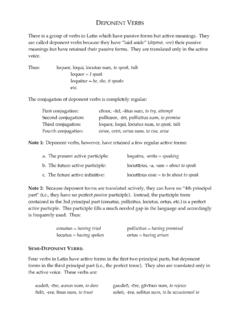
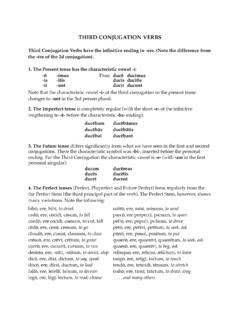
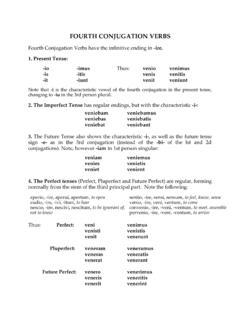
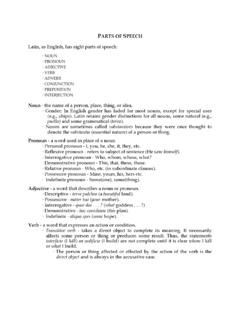
Transcription of Chapter One
1 Chapter One:Word order: Adjectives usually follow noun. Subject is usually first, verblast. But est and sunt go where emphasis : Adjective modifying a plural noun must also be plural, even ifadjective is in : Subject words - words - of prepositions - words after linking verb - declension : "There" always omitted when it merely indicates existence andnot a : -ne attached to first word in sentence. Affirmationstressed by ita. If negative, non placed before : Appositive noun is in same case as the noun it explains. Anapposition is always in the same cae as the substantive it refers :Nom. sing. - short aAbl. sing. - long ay = Frency u (Cyprum = Cooprum)Omission of et: With a series of words et is either used for all of them ornot at TwoWord Order: Order of transitive sentences: subject - direct object - Europam amat. But emphasis may change: Europam deus god love Europa (not someone else).
2 Amat deus Europam. The godloves Genetive: The genitive may function as adjective: Est deasapientiae. Nymphae silvae sunt :in + abl. - in, onin + acc. - intoad + acc. - to, toward, nearcum + abl. - (together) withde + abl. - about, concerning; down fromNouns in -us: Change to -um in the accusative and -o in the agrees with noun it Three:Nouns: Almost all nouns ending in -a are feminine. Some masculine nouns ofnatural gender ending in -a: agricola, poeta, of Nouns: Five declension patterns, each with characteristicvowel:FirstSecondThirdFour thFifth -a -o -i -u -eAgreement: Adjective always agrees with noun in case, number : -te used when addressing more than one person. Drop -tewhen addressing only one. Used in all FourInfinitives:First conjugation: conjugation: conjugation: conjugation: commonly used to complete meaning of a verb of desire orobligation: Ambulare desidero.
3 Deam vocare of verb is found by dropping the -re of infinitive. Conjugations arecharacterized by -a, -e (long), -e, endings:-o-mus-s-tis-t-ntVowel is short before final -t and :sumsumusesestisestsuntAblative: Object of certain prepositions:in Lydiade vitacum cum with pronoun is reversed: -que: Attached to end of second of two correlative words (nouns,verbs or adjectives).Principal Part of Verb: Four principal parts:1st per. 1st per Passive Partportoportareportaviportatumhabeohabe rehabuihabitumChapter FiveImperfect Tense: Insert -ba between stem and endings. Only exception is1st per. sing. -m instead of Conj.:vocabamvocabamusvocabasvocabatisvo cabatvocabant2nd. Conj.:docebamdocebamusdocebasdocebatisdo cebatdocebantThe long vowel is shortened before final -m, -t, and & minime:very much so - not in the least. Can stand alone orwith a verb to make an affirmative or negative of Sum:erameramuseraseratiseraterantDative of possession: Dative may conote ownership, but only insentences with sum as linking verb.
4 Sapientia est tibi. (You are wise). Mihisunt plus quam tibi. (I have more than you).Dative of interest (reference): Dative is used to denote personinterested in or affected by action described by sentence:Mihi filius est est nomen tibi?Nemo mihi magistra nomen est SixSecond Declension Nouns: Masculine nouns in -us and -er. Neuter nounsin of Adjectives: Regular second declension adjective endingsare identical to second declension noun endings of -us and bonusamici boniSecond Decl. bonumamicos bonaamicae bonaeFirst Decl. bonamamicas bonum dona bonaSecond Decl. bonumdona bonaBut note:puer bonuspueri bonipuerum bonumpueros bonosA few nouns of the first declension are masculine by natural gender:agricola, nauta, pirata, poeta. Advena (stranger) and incola arecommon in gender. All others are modifying a masculine -a noun must have masculine -us endings:poeta claruspirata malusagricolae multiCardinal Numbers: Always precede the words they modify.
5 Indeclinableexcept for unus, duo, and tres: unam filiamseptem - 1C - 100V - 5D - 500X - 10M - 1,000L - 50 Chapter SevenFirst and Second Declension Adjectives:SingluarPlural M. F. N. M. F. of Means: Ablative is used not only as object of certainprepositions (in via, de puella) but also without a preposition to indicate themeans of instrument by which something is filios sagittis necat. Niobe lacrimis vitam filae : Vocative is formed same as nominative, except masculinesingulare of second declension nouns ending in -us. Here form ends in -einstead of governing Accusative Case:ad regiam - to the palaceper a ria - through the airproper moenia - near the wallsin silvam - into the forestin + acc. = intoin + abl. = in, onChapter EightFuture Tense (Indicative): Formed by adding -bi between stem andendings. Note that characteristic -a retained for first conjugation, -e forsecond ConjugationSecond Conjugationvocabodocebovocabisdocebisvoc abitdocebitvocabimusdocebimusvocabitisdo cebitisvocabuntdocebuntNote that -bi becomes -bo in the lst person sing.
6 And -bu in the third : Two adjectives modifying a noun are usually connected with et:in silva densa et umbroso - in a dense, shady , mecum: Preposition cum is attached to end of pronouns te younobiscumwith usmecumwith mevobiscumwith you (pl.)Note: Dominus vobiscum - the Lord be with Declensin Nouns in -er and -ir:puerpueripueropuerumpueropueripueror umpuerispuerospuerisageragriagroagrumagr oagriagrorumagrisagrosagrisvirvirivirovi rumvirovirivirorumvirisvirosvirisVir is the only -ir noun in the in -er: miser and pulcher: Miser keeps the -e in the drops the -e after the nominative singular. Both declensions areregular is declined like noun puer, retaining the -e. Pulcher is declined likethe noun ager, dropping the of Sum: The stem is eri-eroerimuseriseritiseriteruntWord Order of Adjectives: Adjectives of size, quanity, and numberusually precede the noun they modify:Regina in magna regia equos in camp - always takes accusativePostpostives: quoque & : Syringa auxilium nymphas sic accusatives: what she asks and who she NinePerfect Tense: Take the third principal part of verb (lst per.)
7 Sing. perfecttense), drop it -i and added the endings:-i-imus-isti-istis-it-eruntPatte rn for first conjugation verbs:laudo, laudare, laudavinarro, narrare, narraviamo, amare, amaviAlmost all lst conj. verbs follows this pattern. Note exceptions:do, dare, dedi, datum - givesto, stare, steti - standiuvo, iuvare, iuvi, iutum - help, aidPerfect tense refers to time already past (not continuing), a single,completed action - brief, done at once, not continuous or habitual. In anarrative, past actions are normally in the perfect tense (unless theyexpress a repeated action).monebam - I used to warn, I was warningmonui - I warned, I have warnederrabat - he was wandering or used to - he wandered or has perfect tense is used for the present perfect in English: I have warned,he has wandered, is used for the English past perfect (he had done, had wandered).Patterns for 2d conj. verbs:debeo, debere, debuidoceo, docere, docuihabeo, habere, habuiprohibeo, prohibere, prohibuiteneo, tenere, tenuimoneo, monere, monuiException: deleo, delere, deleviThen add the endings:docuidocuimusdocuistidocuistisdo cuitdocueruntThe present stem (active and passive) is used to arrive at the Present,Imperfect and Future tenses.
8 The perfect stem (active) is used to arrive atthe Perfect, Pluperfect and Future with Certain Adjectives:A few adjectives take the dative, with the "to" implied:carusdear (to)gratuspleasing (to)Arcadia est deo is dear to the est deo is pleasing to the Clauses: Conditions: A subordinate clause introduced by si(if) expresses the condition under which the main clause is enacted. These"real" conditions may occur in all Iuno videt, delectamenta sunt pretiosa et digna Iuno me videbit, delectamenta erunt pretiosa et digna poeta Musam invocabat, fabula erat populo and eius: Suus (his, her its) is a reflexive adjective, declined likebonus, -a, -um and agreeing with its noun. Eius is a pronoun (gentive demonstrative pronoun is, ea, id (he, she, it). The possessive adjectiveis usually not expressed in Latin if the context is the possessor needs to be shown (for clarity or emphasis), suus is used(and agrees with noun) if the subject of the clause is the possessor:Minerva picturas suas monstravit, et Arachne picturas suas showed her pictures, and Arachne showed her the subject is not the possessor, eius is used.)
9 Eius does not change toagree with its noun, since it is itself a pronoun in the genetive case (meaningof him, of her, of it).Iuppiter nympham et filium eius in stellas in caelo transformed the nymph and her son into stars in the nympham et filium suum in stellas in caelo transformed the nymph and his (own) son into stars in the own can be added after the possesive, suus must be TenCardinal Numbers 13-19:tredecim (13)septendecim (17)quattuordecim (14)duodeviginti (18)quindecim (15)undeviginti (19)sedecim (16)All are undeclined. Post-classical Latin also has octodecim (18).Irregular Verbs - lst Conjugation:do, dare, dedi, datumsto, stare, stetiiuvo, iuvare, iuvi, iutumIrregular Verbs - 2nd Conjugation:Most 2d conjugation verbs follows pattern of doceo, docere, exceptions:video, videre, vidimaneo, manere, mansirespondeo, respondere, respondiPerfect Tense of esse:fuifuimusfuistifuistisfuitfueruntAd sum and absum: Both conjugated like sum, but -b- is dropped inperfect stem of absum:adsum, ades, adest, , aderas, aderat, , aderis, aderit, , adfuisti, adfuit, , abes, abest, , aberas, aberat, , aberis, aberit, , afuisti, afuit, ElevenDuo, duae, duo - duo is an irregular adjective, existing only in - undeclined, except for milia (thousands) which is pueros vidi - I saw a thousand puellas vidi - I saw a thousand oppida vidi - I saw a thousand Declension Nouns: Endings are added to stem (formed fromgentive singular by dropping -is ending).
10 SingularPluralMasc. & -isDat. -iAcc. -emAbl. -e-en, -us-is-i-en, -us-e-es-um (-ium)-ibus-es-ibus-a (-ia)-um (-ium)-ibus-a (-ia)-ibuspatre, patris (m.)arbor, arboris (f.)rex, regis (m.)IuppiterIovisIoviIovemIoveThird declension endings are added to stem formed from the genitivesingular, which often adds a syllable or changes the stem vowel orconsonant, or Nouns:finis, finis (m.)pars, partis (f.)finisfinesparspartesfinisfiniumparti spartiumfinifinibuspartipartibusfinemfin espartempartesfinefinibuspartepartibusNo uns in this group add an -i in the genitive plural. They are eitherparisyllabic in the nominative and genitive singular or they have one syllable inthe nominative singular and two consonants before the -is of the with Third Declension nouns:Masculines:rex bonusregis boniregi bonoregem bonumrege bonoreges boniregum bonorumregibus bonisreges bonosregibus bonispater piuspatris piipatri piopatrem piumpatre piopatres piipatrum piorumpatribus piispatres piospatribus piismagnus Iuppitermagni Iovismagno Iovimagnum Iovemmagno IoveFeminines: Neuters.