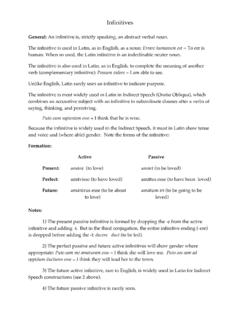
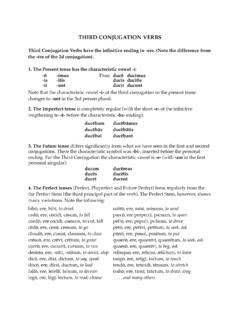
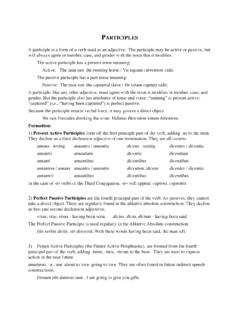
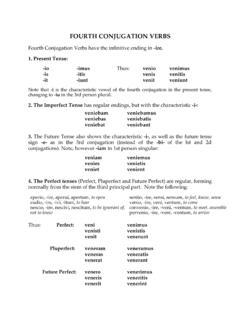
Transcription of Chapter One - The Latin Library
1 Chapter One:Word order: Adjectives usually follow noun . Subject is usually first, verblast. But est and sunt go where emphasis : Adjective modifying a plural noun must also be plural, even ifadjective is in : Subject words - words - of prepositions - words after linking verb - declension : "There" always omitted when it merely indicates existence andnot a : -ne attached to first word in sentence. Affirmationstressed by ita. If negative, non placed before : Appositive noun is in same case as the noun it explains. Anapposition is always in the same cae as the substantive it refers :Nom.
2 Sing. - short aAbl. sing. - long ay = Frency u (Cyprum = Cooprum)Omission of et: With a series of words et is either used for all of them ornot at TwoWord Order: Order of transitive sentences: subject - direct object - Europam amat. But emphasis may change: Europam deus god love Europa (not someone else). Amat deus Europam. The godloves Genetive: The genitive may function as adjective: Est deasapientiae. Nymphae silvae sunt :in + abl. - in, onin + acc. - intoad + acc. - to, toward, nearcum + abl. - (together) withde + abl. - about, concerning; down fromNouns in -us: Change to -um in the accusative and -o in the agrees with noun it Three:Nouns: Almost all nouns ending in -a are feminine.
3 Some masculine nouns ofnatural gender ending in -a: agricola, poeta, of Nouns: Five declension patterns, each with characteristicvowel:FirstSecondThirdFour thFifth -a -o -i -u -eAgreement: Adjective always agrees with noun in case, number : -te used when addressing more than one person. Drop -tewhen addressing only one. Used in all FourInfinitives:First conjugation: conjugation: conjugation: conjugation: commonly used to complete meaning of a verb of desire orobligation: Ambulare desidero. Deam vocare of verb is found by dropping the -re of infinitive. Conjugations arecharacterized by -a, -e (long), -e, endings:-o-mus-s-tis-t-ntVowel is short before final -t and :sumsumusesestisestsuntAblative: Object of certain prepositions:in Lydiade vitacum cum with pronoun is reversed: -que: Attached to end of second of two correlative words (nouns,verbs or adjectives).
4 Principal Part of Verb: Four principal parts:1st per. 1st per Passive Partportoportareportaviportatumhabeohabe rehabuihabitumChapter FiveImperfect Tense: Insert -ba between stem and endings. Only exception is1st per. sing. -m instead of Conj.:vocabamvocabamusvocabasvocabatisvo cabatvocabant2nd. Conj.:docebamdocebamusdocebasdocebatisdo cebatdocebantThe long vowel is shortened before final -m, -t, and & minime:very much so - not in the least. Can stand alone orwith a verb to make an affirmative or negative of Sum:erameramuseraseratiseraterantDative of possession: Dative may conote ownership, but only insentences with sum as linking verb.
5 Sapientia est tibi. (You are wise). Mihisunt plus quam tibi. (I have more than you).Dative of interest (reference): Dative is used to denote personinterested in or affected by action described by sentence:Mihi filius est est nomen tibi?Nemo mihi magistra nomen est SixSecond declension Nouns: Masculine nouns in -us and -er. Neuter nounsin of Adjectives: Regular second declension adjective endingsare identical to second declension noun endings of -us and bonusamici boniSecond Decl. bonumamicos bonaamicae bonaeFirst Decl. bonamamicas bonum dona bonaSecond Decl. bonumdona bonaBut note:puer bonuspueri bonipuerum bonumpueros bonosA few nouns of the first declension are masculine by natural gender:agricola, nauta, pirata, poeta.
6 Advena (stranger) and incola arecommon in gender. All others are modifying a masculine -a noun must have masculine -us endings:poeta claruspirata malusagricolae multiCardinal Numbers: Always precede the words they modify. Indeclinableexcept for unus, duo, and tres: unam filiamseptem - 1C - 100V - 5D - 500X - 10M - 1,000L - 50 Chapter SevenFirst and Second declension Adjectives:SingluarPlural M. F. N. M. F. of Means: Ablative is used not only as object of certainprepositions (in via, de puella) but also without a preposition to indicate themeans of instrument by which something is filios sagittis necat.
7 Niobe lacrimis vitam filae : Vocative is formed same as nominative, except masculinesingulare of second declension nouns ending in -us. Here form ends in -einstead of governing Accusative Case:ad regiam - to the palaceper a ria - through the airproper moenia - near the wallsin silvam - into the forestin + acc. = intoin + abl. = in, onChapter EightFuture Tense (Indicative): Formed by adding -bi between stem andendings. Note that characteristic -a retained for first conjugation, -e forsecond ConjugationSecond Conjugationvocabodocebovocabisdocebisvoc abitdocebitvocabimusdocebimusvocabitisdo cebitisvocabuntdocebuntNote that -bi becomes -bo in the lst person sing.
8 And -bu in the third : Two adjectives modifying a noun are usually connected with et:in silva densa et umbroso - in a dense, shady , mecum: Preposition cum is attached to end of pronouns te younobiscumwith usmecumwith mevobiscumwith you (pl.)Note: Dominus vobiscum - the Lord be with Declensin Nouns in -er and -ir:puerpueripueropuerumpueropueripueror umpuerispuerospuerisageragriagroagrumagr oagriagrorumagrisagrosagrisvirvirivirovi rumvirovirivirorumvirisvirosvirisVir is the only -ir noun in the in -er: miser and pulcher: Miser keeps the -e in the drops the -e after the nominative singular.
9 Both declensions areregular is declined like noun puer, retaining the -e. Pulcher is declined likethe noun ager, dropping the of Sum: The stem is eri-eroerimuseriseritiseriteruntWord Order of Adjectives: Adjectives of size, quanity, and numberusually precede the noun they modify:Regina in magna regia equos in camp - always takes accusativePostpostives: quoque & : Syringa auxilium nymphas sic accusatives: what she asks and who she NinePerfect Tense: Take the third principal part of verb (lst per. sing. perfecttense), drop it -i and added the endings:-i-imus-isti-istis-it-eruntPatte rn for first conjugation verbs:laudo, laudare, laudavinarro, narrare, narraviamo, amare, amaviAlmost all lst conj.
10 Verbs follows this pattern. Note exceptions:do, dare, dedi, datum - givesto, stare, steti - standiuvo, iuvare, iuvi, iutum - help, aidPerfect tense refers to time already past (not continuing), a single,completed action - brief, done at once, not continuous or habitual. In anarrative, past actions are normally in the perfect tense (unless theyexpress a repeated action).monebam - I used to warn, I was warningmonui - I warned, I have warnederrabat - he was wandering or used to - he wandered or has perfect tense is used for the present perfect in English: I have warned,he has wandered, is used for the English past perfect (he had done, had wandered).