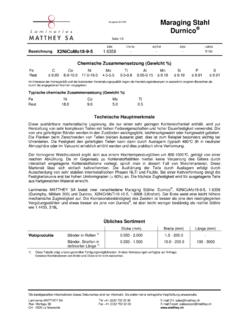
Transcription of Chemical composition (Weight %) Main technical properties ...
1 Edition 2013/01 Page 1/3 Steel EN UNS AISI LMSA Designation X10 CrNi18-8 S30100 301 D100 The information in this document is informative only. Information provided does not constitute any contractual commitment or warranty of any kind. Lamineries MATTHEY SA T l +41 (0)32 752 32 32 E-mail CH: Rue Montagu 38 Fax +41 (0)32 752 32 00 E-mail Export: CH - 2520 La Neuveville Chemical composition (Weight %) Fe C Cr Ni Si Mn P S Mo N Balance In order to achieve maximum homogeneity and consistent quality, the actual tolerances on both alloy components and impurities are significantly tighter and more precisely defined than the standard composition indicated.
2 Main technical properties and features The tensile strengths of austenitic stainless steels are average but can be increased considerably, for certain types, by cold rolling. The , X10 CrNi18-8, is the most widely used stainless steel for the production of springs. It reaches very high mechanical strength through cold working. Its austenitic structure is rather unstable and its corrosion resistance is lower than, for example, that of the , 316L, or of the , X5 CrNiMo 18-10. An increase of the mechanical strength of the , X10 CrNi18-8, by more than 250 N/mm2 can be achieved by tempering at 280 to 420 C after having been highly cold worked.
3 This tempering is interesting in that it also increases the fatigue strength limit. Lamineries MATTHEY SA proposes a special version of the : the Its Chemical composition has been adapted in order to increase the reaction to work hardening (Ni content between and ). is also specially cast in order to avoid unwanted inclusions: The is especially suitable for demanding spring applications such as the manufacturing of snap domes. Typical manufacturing range Thickness (mm) Width (mm) Length (mm) Rolled products Strip in coils 1) - - Strip as sheets in 1) - 100 - 3000 1) Not all our production possibilities are presented here.
4 Other dimensions or other product forms available upon request. Certain combinations of thicknesses and widths are not possible. Mechanical properties of strips Temper Rm (N/mm2) HV C700 1) soft 690 - 900 170 - 250 C13001) hard 1300 - 1550 390 - 480 C1500 1) hard 1500 - 1800 410 - 520 C1700 1) extra hard 1700 450 1) These tempers do not correspond exactly to the EN 10151 standard and are only indicative. Edition 2013/01 Page 2/3 Steel EN UNS AISI LMSA Designation X10 CrNi18-8 S30100 301 D100 The information in this document is informative only. Information provided does not constitute any contractual commitment or warranty of any kind.
5 Lamineries MATTHEY SA T l +41 (0)32 752 32 32 E-mail CH: Rue Montagu 38 Fax +41 (0)32 752 32 00 E-mail Export: CH - 2520 La Neuveville Physical properties Modulus of elasticity kN/mm2 1951 Poisson ratio Density kg/dm3 Melting point / Melting range C 1400-1450 Linear dilatation coefficient (20-300 C) 10-6/ C Thermal conductivity at 20 C W/m K Electrical resistivity cm 70 Electrical conductivity MS/m Specific heat at 20 C J/(kg K) 460 Magnetic properties Amagnetic in soft temper2 Permeability = - 1 The Modulus of elasticity of varies slightly with the amount of cold working and depends, therefore, on the temper as well as the direction of measurement, longitudinal or transverse to the rolling direction.
6 In the longitudinal direction, the Young s Modulus decreases from approx. 205 kN/mm2 in the annealed temper to 185 kN/mm2 for a cold working of about 40% (Rm approx. 1400-1600N/mm2) and then increases gradually with further cold working. In all cases, the tempering process will increase the Young s Modulus and decrease its tendency to change as a function of cold working. 2 The magnetic permeability increases very quickly with the cold working and the mechanical resistance. Typical uses Stainless steel is often used for the manufacturing of springs and other products requiring a good fatigue resistance such as connector components, electric switch blades, watch components, certain types of knives etc.
7 Edition 2013/01 Page 3/3 Steel EN UNS AISI LMSA Designation X10 CrNi18-8 S30100 301 D100 The information in this document is informative only. Information provided does not constitute any contractual commitment or warranty of any kind. Lamineries MATTHEY SA T l +41 (0)32 752 32 32 E-mail CH: Rue Montagu 38 Fax +41 (0)32 752 32 00 E-mail Export: CH - 2520 La Neuveville Tolerances Thickness Thickness (mm) Lamineries MATTHEY SA < LMSA Standard LMSA Precision LMSA Extreme The table shown is an outline of our typical thickness tolerances available, which are tighter than industry standards. Our "Precision" and "Extreme" tolerances are available upon request.
8 - - Width Our width tolerance is + mm (or mm upon request). They are available for slit widths < 125 mm and thicknesses < mm. Special tolerances upon request. Camber Width (mm) Camber max. (mm/m) LMSA standard LMSA extreme > mm > mm mm > mm Our tolerance "standard" respects the EN Standard 1654 (Length of measurement 1000 mm). Other tolerances upon request.
9 3 6 12 - 6 - 6 10 8 10 4 5 10 20 4 6 2 3 20 250 2 3 1 Surface Special surface qualities upon request Flatness Special requirement on the longitudinal or transversal flatness upon request