Transcription of CHESS
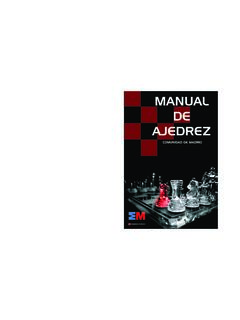
1 STEM-BasedCHESSCHESSBOY SCOUTS OF AMERICAMERIT BADGE SERIES Enhancing our youths competitive edge through merit badges 35973 ISBN 978-0-8395-0000-1 2016 Boy Scouts of America2016 PrintingRequirements 1. Discuss with your merit badge counselor the history of the game of CHESS . Explain why it is considered a game of planning and strategy. 2. Discuss with your merit badge counselor the following: a. The benefits of playing CHESS , including developing critical thinking skills, concentration skills, and decision-making skills, and how these skills can help you in other areas of your life b. Sportsmanship and CHESS etiquette 3. Demonstrate to your counselor that you know each of the following.
2 Then, using Scouting s Teaching EDGE*, teach someone (preferably another Scout) who does not know how to play CHESS : a. The name of each CHESS piece b. How to set up a chessboard c. How each CHESS piece moves, including castling and en passant captures 4. Do the following: a. Demonstrate scorekeeping using the algebraic system of CHESS notation. b. Discuss the differences between the opening, the middle game, and the endgame. c. Explain four opening principles. d. Explain the four rules for castling. e. On a chessboard, demonstrate a scholar s mate and a fool s mate. f. Demonstrate on a chessboard four ways a CHESS game can end in a draw.
3 * You may learn about Scouting s Teaching EDGE from your unit leader, another Scout, or by attending 3 5. Do the following: a. Explain four of the following elements of CHESS strategy: exploiting weaknesses, force, king safety, pawn structure, space, tempo, time. b. Explain any five of these CHESS tactics: clearance sacrifice, decoy, discovered attack, double attack, fork, interposing, overloading, overprotecting, pin, remove the defender, skewer, zwischenzug. c. Set up a chessboard with the white king on e1, the white rooks on a1 and h1, and the black king on e5. With White to move first, demonstrate how to force checkmate on the black king.
4 D. Set up and solve five direct-mate problems provided by your merit badge counselor. 6. Do ONE of the following: a. Play at least three games of CHESS with other Scouts and/or your merit badge counselor. Replay the games from your score sheets and discuss with your counselor how you might have played each game differently. b. Play in a scholastic (youth) CHESS tournament and use your score sheets from that tournament to replay your games with your merit badge counselor. Discuss with your counselor how you might have played each game differently. c. Organize and run a CHESS tournament with at least four players, plus you. Have each competitor play at least two ResourcesChess ResourcesBooksBasman, Michael.
5 CHESS for Kids. DK Children, , Murray. CHESS Tactics for Kids. Gambit Publications, , Jeff. Winning CHESS Exercises for Kids. CHESS n Math Association, 2004.. Winning CHESS Puzzles for Kids. CHESS n Math Association, 2006.. Winning CHESS Strategy for Kids. CHESS n Math Association, , John. Concise CHESS : The Compact Guide for Beginners. Everyman CHESS , , Al. CHESS for Beginners: A Picture Guide. Harper Perennial, , Edmar. Practical Middlegame Tips. Everyman CHESS , , John. Understanding CHESS Endgames. Gambit Publications, , Bruce. CHESS Openings: Traps and Zaps. Fireside, 1989.. CHESS Thinking: The Visual Dictionary of CHESS Moves, Rules, Strategies and Concepts.
6 Fireside, 1995.. Pandolfini s Ultimate Guide to CHESS . Fireside, , Dave. CHESS 101: Everything a New CHESS Player Needs to Know! Questions Inc., , John, and Graham Burgess. CHESS Openings for Kids. Gambit Publications, , Fred, and Bruce Alberston. 202 Checkmates for Children. Cardoza, and WebsitesWhile you can type CHESS into your search engine and find many good CHESS sites and resources, here are a few sites you might States CHESS Federation (USCF) Telephone: 931-787-1234 Website: Visit the Boy Scouts of America s official retail website (with your parent s permission) at for a complete listing of all merit badge pamphlets and other helpful Scouting materials and CHESSC hess State Scholastic CHESS Coordinators Website: content/view/172/131 World CHESS Federation (FIDE) Website.
7 Boy Scouts of America is grateful to Ralph Bowman, CHESS enthusiast, author, and coach, for leading the effort to create the CHESS merit badge. Mr. Bowman played a significant role in the develop-ment of the merit badge requirements and pamphlet. We thank Jerry Nash, national education consultant for the CHESS Federation, for his assistance, as well. Many of Mr. Nash s photographs appear on these pages. We appreciate Joseph Lewis Bell, Robert Boland, Stan Kern, Dr. Chris Kim, and Dr. John McCrary for their involvement and contributions. Thanks also to Betsy Dynako for her assistance with photography and Illustration CreditsFrank A. Camaratta Jr., photo used by permission; The House of Staunton Inc.
8 ; page 19 Betsy Dynako Photographer, courtesy pages 11, 60, and 86 Federation Internationale des Echecs, courtesy page 17 (FIDE logo)Steve Hassenplug, courtesy page 95 ( CHESS board)NASA, courtesy page 48 (astronaut)Jerry Nash, courtesy pages 10, 12, 13 (tournament), 20, 28, 32, 36, 39, 58, 65, 70, 72, 74, 76 79 (all), 83, 84 (digi-tal clock), and , courtesy cover (wooden CHESS set, Hung Chung Chih); pages 3 and 22 ( CHESS pieces, Seregam), 4 ( korea), 6 ( Air Images), 8 ( Tinydevil), 22 (players, Air Images), 45 ( Vlad ozerov), 46 ( Ossile), 47 ( Blend Images), 48 (clouds, BestPhotoPlus), 50 ( CHESS pieces, cunaplus), 51 ( CHESS board, thodonal88), 69 ( Vera Volkova), 82 ( Bachkova Natalia), 84 ( Africa Studio), 88 ( Hannah Gleghorn), 92 ( Foodstocker), and 96 ( valbar) CHESS Federation, courtesy page 17 (USCF logo) pages 15 17 (all) cover (clock) L.
9 Kaufman page Yorck Project page 14 World CHESS Hall of Fame, courtesy page 95 (logo)All other photos and illustrations not mentioned above are the property of or are protected by the Boy Scouts of McDearmon cover (illustrated board); all illustrations on pages 7, 21, 23 27, 30, 31, 33 35, 38, 40 44, 49 56, 59, 62 64, 67, 68, 81 ( CHESS board), and 89 Shane Noem page 29