Example: dental hygienist
Children’s Global Assessment Scale
ruminations, school refusal and other forms of anxiety, obsessive rituals major conversion symptoms, frequent anxiety attacks, frequent episodes of aggressive or other antisocial ... Needs constant supervision (24-hour care) due to severely aggressive or self-destructive behaviour or gross impairment in reality testing, communication, cognition ...
Tags:
Information
Domain:
Source:
Link to this page:
Documents from same domain
Wellbeing Measurement Framework for Primary Schools
www.corc.uk.netAbout the wellbeing measurement framework for primary schools 3 Me and my feelings (M&MF) 4 Students’ Life Satisfaction Scale (SLSS) 5 Student Resilience Survey (SRS) 6 Useful reading 9 The measures included in this booklet are suggestions for age-appropriate measures to use with primary school children.

The Short Warwick–Edinburgh Mental Well-being Scale …
www.corc.uk.netSTATEMENTS None of the time Rarely Some of the time Often All of the time I’ve been feeling optimistic about the future 1 2 3 4 5 I’ve been feeling useful 1 2 3 4 5
Dr Duncan Law and Jenna Jacob GOALS AND GOAL BASED ...
www.corc.uk.netChoosing your Goals in therapy or counselling 28 A guide for young people Using goals in clinical practice 36 Clinical supervision 36 Lack of progress towards goals 36 ... some therapeutic modalities have goals and the monitoring of goals is already built into the intervention themselves: e.g., Cognitive

Outcome Rating Scale (ORS)
www.corc.uk.netsession measures is not there with the Outcome and Session Ratings Scales as they usually take on average a minute for administration and scoring. Over 3000 young people participated in the four year validation study of the ORS with adolescents aged 13 -17, and the Child Outcome Rating Scale (CORS) for children aged 6-12 (Duncan, et al., 2006).

Recommendations for using outcome measures
www.corc.uk.netright support. Outcome measures may answer questions like ‘what’s the problem?’, ‘how are things going?’, or ‘have we done as much as we need to?’ • Understand effectiveness: This involves evaluating support and interventions to understand the impact they are having – and to help improve support in a responsive way.

Eating Disorder examination questionnaire (EDE-Q 6.0)
www.corc.uk.netEating Disorder examination questionnaire (EDE-Q 6.0) Questions 13-18: Please fill in the appropriate number in the boxes on the right. Remember that the questions only refer to th …

Guide to Using Outcomes and Feedback Tools with Children ...
www.corc.uk.netThis guide presents wisdom and learning from frontline practitioners, managers, researchers and young people . with experience of service use as to how to use the outcome and feedback measures in the Children and Young

Using WEMWBS to measure the impact of your work on …
www.corc.uk.netMeasuring the impact of your work on mental wellbeing 6 September 2012 Things to bear in mind when asking people to take part WEMWBS is validated for use in individuals aged 13 and older. The participant will be involved in the project for at least 2 weeks. The participant is willing to take part in the project evaluation. Introducing WEMWBS & consent to participate

EATING DISORDER EXAMINATION QUESTIONNAIRE
www.corc.uk.net3. Has thinking about food, eating or calories. 1 2 3 are interested in. su. h as working, following a conversation or reading)?4. Has thinking about your weight or shape made it very difficult to concentrate on things you are interested i. (.
Related documents
Students with Anxiety in the Schools - ed
files.eric.ed.govwhich can mask untreated anxiety. Anxiety-based school refusal is common during times of transition, for example, moving from elementary to middle and middle to high school, and it aff ects 2% to 5% of school-age children (Anxiety Disorders Associa-tion of America, n.d.). Th e onset of social anxiety disor-
Promoting Emotional Resilience - Support & Advice
hbtg.org.ukgrow out of their anxiety. There is however a strong probability of success through recognising and dealing with the problem appropriately. Adapted from: ‘Overcoming your Child’s Fears and Worries. A self-help guide using Cognitive Behavioural Techniques’ 2007 Cresswell, C & Willetts L. Emotionally Based School Refusal (EBSR)
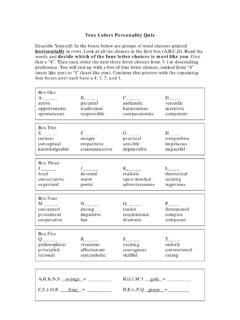
True Colors Personality Quiz - Wedgworth Leadership Institute
wedgworthleadership.comschool life. 9 I reacted with great sensitivity to discordance or rejection and sought ... 9 Refusal to comply or cooperate; the silent treatment 9 Extreme aloofness and withdrawal 9 Snobbish, put-down remarks, and sarcasm 9 Perfectionism due to severe performance anxiety 9 Highly critical attitudes toward yourself or others. Title: BLUES Author:
Anxiety Disorders in Children and Adolescents
www.ihs.govAnxiety Disorders in Children and Adolescents •Anxiety disorders are the most frequent mental health problems seen ... •Persistent reluctance or refusal to go to school due to fear of separation. • Duration 4wks> • Must have onset before age 18. Specified early onset if …

Exploring Leadership Styles - True Colors
www.lonestar.eduRefusal to comply or cooperate Extreme aloofness and withdrawal Snobbish, put-down remarks, and sarcasm Refusal to communicate; the silent treatment Perfectionism due to severe performance anxiety Highly critical attitudes toward yourself or others
Text-Dependent Analysis Sampler
dpi.wi.gov• Incoherent (e.g., best day school teacher inspired so I car) • Insufficient length • Responses that address some part of the question, but does not refer to the passage as evidence • Responses that consist solely, or almost solely, of text copied directly from the passage(s) • Refusal • Off topic . Purpose and Uses
Assessment and treatment of children and ... - Queensland …
www.health.qld.gov.au• Symptoms of depression, anxiety and obsessive-compulsive disorder or other co-morbid conditions Other features of severe malnutrition • Lanugo hair • Dull thinning scalp hair • Dry skin • Skin breakdown and/or pressure sore • Bruising/abrasions over the spine related to excessive exercises • Muscle wasting (can be proximal and ...