Transcription of CLASSIFICATION OF ELEMENTS AND PERIODICITY IN …
1 74 CHEMISTRYThe periodic table is arguably the most important concept inchemistry, both in principle and in practice. It is the everydaysupport for students, it suggests new avenues of research toprofessionals, and it provides a succinct organization of thewhole of chemistry . It is a remarkable demonstration of thefact that the chemical ELEMENTS are not a random cluster ofentities but instead display trends and lie together in awareness of the periodic table is essential to anyone whowishes to disentangle the world and see how it is built upfrom the fundamental building blocks of the chemistry , thechemical T. SeaborgIn this Unit, we will study the historical development of thePeriodic table as it stands today and the Modern PeriodicLaw. We will also learn how the periodic classificationfollows as a logical consequence of the electronicconfiguration of atoms. Finally, we shall examine some ofthe periodic trends in the physical and chemical propertiesof the DO WE NEED TO CLASSIFY ELEMENTS ?
2 We know by now that the ELEMENTS are the basic units of alltypes of matter. In 1800, only 31 ELEMENTS were known. By1865, the number of identified ELEMENTS had more thandoubled to 63. At present 114 ELEMENTS are known. Ofthem, the recently discovered ELEMENTS are to synthesise new ELEMENTS are continuing. Withsuch a large number of ELEMENTS it is very difficult to studyindividually the chemistry of all these ELEMENTS and theirinnumerable compounds individually. To ease out thisproblem, scientists searched for a systematic way toorganise their knowledge by classifying the ELEMENTS . Notonly that it would rationalize known chemical facts aboutelements, but even predict new ones for undertaking 3 After studying this Unit, you will beable to appreciate how the concept ofgrouping ELEMENTS in accordance totheir properties led to thedevelopment of periodic table . understand the periodic Law; understand the significance ofatomic number and electronicconfiguration as the basis forperiodic CLASSIFICATION ; name the ELEMENTS withZ >100 according to IUPAC nomenclature; classify ELEMENTS into s, p, d, fblocks and learn their maincharacteristics; recognise the periodic trends inphysical and chemical properties ofelements; compare the reactivity of elementsand correlate it with theiroccurrence in nature; explain the relationship betweenionization enthalpy and metalliccharacter.
3 Use scientific vocabularyappropriately to communicate ideasrelated to certain importantproperties of atoms , atomic/ionic radii, ionization enthalpy,electron gain enthalpy,electronegativity, valence OF ELEMENTS ANDPERIODICITY IN PROPERTIES2022-2375 CLASSIFICATION OF ELEMENTS AND PERIODICITY IN OF PERIODICCLASSIFICATIONC lassification of ELEMENTS into groups anddevelopment of periodic Law and PeriodicTable are the consequences of systematisingthe knowledge gained by a number of scientiststhrough their observations and German chemist, Johann Dobereiner inearly 1800 s was the first to consider the ideaof trends among properties of ELEMENTS . By1829 he noted a similarity among the physicaland chemical properties of several groups ofthree ELEMENTS (Triads). In each case, henoticed that the middle element of each of theTriads had an atomic weight about half waybetween the atomic weights of the other two( table ). Also the properties of the middleelement were in between those of the othertwo members.
4 Since Dobereiner s relationship,referred to as the Law of Triads, seemed towork only for a few ELEMENTS , it was dismissedas coincidence. The next reported attempt toclassify ELEMENTS was made by a Frenchgeologist, de Chancourtois in 1862. Hearranged the then known ELEMENTS in order ofincreasing atomic weights and made acylindrical table of ELEMENTS to display theperiodic recurrence of properties. This also didnot attract much attention. The Englishchemist, John Alexander Newlands in 1865profounded the Law of Octaves. He arrangedthe ELEMENTS in increasing order of their atomicweights and noted that every eighth elementhad properties similar to the first element( table ). The relationship was just like everyeighth note that resembles the first in octavesof music. Newlands s Law of Octaves seemedto be true only for ELEMENTS up to his idea was not widely accepted atthat time, he, for his work, was later awardedDavy Medal in 1887 by the Royal Society, periodic Law, as we know it today owesits development to the Russian chemist, DmitriMendeleev (1834-1907) and the Germanchemist, Lothar Meyer (1830-1895).
5 Workingindependently, both the chemists in 1869proposed that on arranging ELEMENTS in theincreasing order of their atomic weights,similarities appear in physical and chemicalproperties at regular intervals. Lothar Meyerplotted the physical properties such as atomicvolume, melting point and boiling pointagainst atomic weight and obtained aperiodically repeated pattern. UnlikeNewlands, Lothar Meyer observed a change inlength of that repeating pattern. By 1868,Lothar Meyer had developed a table of the Dobereiner s Triads table Newlands OctavesElementLiBeBCNOFAt. that closely resembles the ModernPeriodic table . However, his work was notpublished until after the work of DmitriMendeleev, the scientist who is generallycredited with the development of the ModernPeriodic Dobereiner initiated the study ofperiodic relationship, it was Mendeleev whowas responsible for publishing the PeriodicLaw for the first time. It states as follows :The properties of the ELEMENTS are aperiodic function of their arranged ELEMENTS in horizontalrows and vertical columns of a table in orderof their increasing atomic weights in such away that the ELEMENTS with similar propertiesoccupied the same vertical column or s system of classifying ELEMENTS wasmore elaborate than that of Lothar Meyer fully recognized the significance ofperiodicity and used broader range of physicaland chemical properties to classify theelements.
6 In particular, Mendeleev relied onthe similarities in the empirical formulas andproperties of the compounds formed by theelements. He realized that some of the elementsdid not fit in with his scheme of classificationif the order of atomic weight was strictlyfollowed. He ignored the order of atomicweights, thinking that the atomicmeasurements might be incorrect, and placedthe ELEMENTS with similar properties example, iodine with lower atomic weightthan that of tellurium (Group VI) was placedin Group VII along with fluorine, chlorine,bromine because of similarities in properties(Fig. ). At the same time, keeping hisprimary aim of arranging the ELEMENTS ofsimilar properties in the same group, heproposed that some of the ELEMENTS were stillundiscovered and, therefore, left several gapsin the table . For example, both gallium andgermanium were unknown at the timeMendeleev published his periodic table . He leftthe gap under aluminium and a gap undersilicon, and called these ELEMENTS Eka-Aluminium and Eka-Silicon.
7 Mendeleevpredicted not only the existence of gallium andgermanium, but also described some of theirgeneral physical properties. These elementswere discovered later. Some of the propertiespredicted by Mendeleev for these ELEMENTS andthose found experimentally are listed inTable boldness of Mendeleev s quantitativepredictions and their eventual success madehim and his periodic table s periodic table published in 1905is shown in Fig. (predicted)(found)(predicted)(found)Atom ic / (g/cm3) point of oxideE2O3Ga2O3EO2 GeO2 Formula of chlorideECl3 GaCl3 ECl4 GeCl4 table s Predictions for the ELEMENTS Eka-aluminium (Gallium) andEka-silicon (Germanium)2022-2377 CLASSIFICATION OF ELEMENTS AND PERIODICITY IN PROPERTIESPERIODIC SYSTEM OF THE ELEMENTS IN GROUPS AND SERIESFig. Mendeleev s periodic table published periodic LAW AND THEPRESENT FORM OF THE PERIODICTABLEWe must bear in mind that when Mendeleevdeveloped his periodic table , chemists knewnothing about the internal structure of , the beginning of the 20th centurywitnessed profound developments in theoriesabout sub-atomic particles.
8 In 1913, theEnglish physicist, Henry Moseley observedregularities in the characteristic X-ray spectraof the ELEMENTS . A plot of (where isfrequency of X-rays emitted) against atomicnumber (Z ) gave a straight line and not theplot of vs atomic mass. He thereby showedthat the atomic number is a more fundamentalproperty of an element than its atomic s periodic Law was, therefore,accordingly modified. This is known as theModern periodic Law and can be stated as :The physical and chemical propertiesof the ELEMENTS are periodic functionsof their atomic periodic Law revealed importantanalogies among the 94 naturally occurringelements (neptunium and plutonium likeactinium and protoactinium are also found inpitch blende an ore of uranium). It stimulatedrenewed interest in Inorganic chemistry andhas carried into the present with the creationof artificially produced short-lived may recall that the atomic number isequal to the nuclear charge ( , number ofprotons) or the number of electrons in a neutralatom.
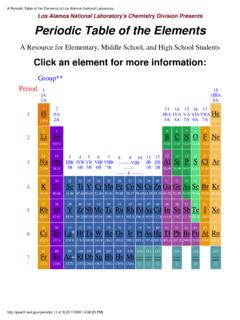
9 It is then easy to visualize the significanceof quantum numbers and electronicconfigurations in PERIODICITY of ELEMENTS . Infact, it is now recognized that the periodic Lawis essentially the consequence of the periodicvariation in electronic configurations, whichindeed determine the physical and chemicalproperties of ELEMENTS and their forms of periodic table havebeen devised from time to time. Some formsemphasise chemical reactions and valence,whereas others stress the electronicconfiguration of ELEMENTS . A modern version,the so-called long form of the periodic Tableof the ELEMENTS (Fig. ), is the most convenientand widely used. The horizontal rows (whichMendeleev called series) are called periods andthe vertical columns, groups. ELEMENTS havingsimilar outer electronic configurations in theiratoms are arranged in vertical columns,referred to as groups or families. Accordingto the recommendation of International Unionof Pure and Applied chemistry (IUPAC), thegroups are numbered from 1 to 18 replacingthe older notation of groups IA.
10 VIIA, VIII, VIIB and are altogether seven periods. Theperiod number corresponds to the highestprincipal quantum number (n) of the elementsin the period. The first period contains 2elements. The subsequent periods consists of8, 8, 18, 18 and 32 ELEMENTS , respectively. Theseventh period is incomplete and like the sixthperiod would have a theoretical maximum (onthe basis of quantum numbers) of 32 this form of the periodic table , 14 elementsof both sixth and seventh periods (lanthanoidsand actinoids, respectively) are placed inseparate panels at the bottom*. OF ELEMENTS WITHATOMIC NUMBERS > 100 The naming of the new ELEMENTS had beentraditionally the privilege of the discoverer (ordiscoverers) and the suggested name wasratified by the IUPAC. In recent years this hasled to some controversy. The new ELEMENTS withvery high atomic numbers are so unstable thatonly minute quantities, sometimes only a fewatoms of them are obtained. Their synthesisand characterisation, therefore, require highly*Glenn T.