Example: quiz answers
Classroom Observations Feedback Protocol: Give it with ...
3. Feedback is most effective when the receiver invites the comments. Therefore, the observer asks explicitly for permission to give cool feedback. It is important that the teacher be prepared for the feedback so that she or he can listen openly and without defense, and that the observergive the feedback with care. Consider the following: a.
Tags:
Information
Domain:
Source:
Link to this page:
Documents from same domain

Social Emotional Learning in High School: How …
edpolicy.stanford.eduthe classroom.4 Social emotional learning is commonly defined as the processes through which students “acquire and effectively apply the knowledge, attitudes, and skills necessary to understand and manage emotions, set and achieve posi-

Austin Independent School District and the School …
edpolicy.stanford.eduThe Austin Independent School District (AISD) is an urban school district of 80,000 students. The district is redesigning its 11 high schools to better prepare

Student Engagement in Assessments: What Students and ...
edpolicy.stanford.edu4 Stanford Center for Opportunity Policy in Education Authenticity The concept of authenticity refers to the extent to which a task requires students to solve real-world problems and has value beyond school (Lombardi, 2007). Real-world problems reflect tasks that are encountered in …

Using Technology to Support At-Risk Students’ Learning
edpolicy.stanford.educommunity (that is, who the student learns with, online and in person), the goals of the community, and the nature of the learning activities. Figure 4 shows the aspects of the learning context at each of these levels as they commonly appear in the research literature. The technology and learning contexts interact

Linked Learning Performance Based Assessment
edpolicy.stanford.eduPerformance-based assessment is consistent with modern learning theories and also helps teachers employ what the profession considers to be best practices. the msPaP report (Koretz et al., 1996) found that in implementing performance-based assessment, teachers changed their instructional practice to

Developing and Assessing Teacher Effectiveness.SCOPE
edpolicy.stanford.eduEvidence of practices that support student learning both in and outside of the classroom (including work with parents & colleagues) Evidence of student learning measured in a variety of ways (e.g. work samples, learning progressions, pre- and post-measures tied to curriculum, exhibitions of mastery, as well as tests)
Related documents
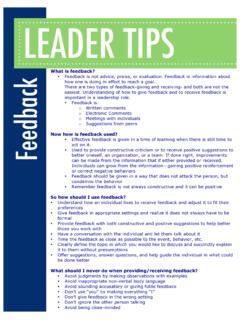
What is feedback?
www.creighton.eduWhat is feedback? • Feedback is not advice, praise, or evaluation. Feedback is information about how one is doing in effort to reach a goal. There are two types of feedback-giving and receiving- and both are not the easiest. Understanding of how to give feedback and to receive feedback is important in a leadership role. • Feedback is:
Effects of Positive and Negative Feedback on Student’s ...
elpaso.ttuhsc.eduJan 20, 2017 · How to give Feedback to Increase Motivation • Show that you are interested in their success • Competence - frame the feedback as common mistakes made my most medical students; stick to the facts and behaviors - Not ‘you were unprofessional’ but ‘when you were late, it slowed us all down, which made you seem unprofessional’

How to Give (And Receive) Constructive Feedback
managers.usc.edu“I didn’t ask for your feedback.” Step 2: Request. For example: “I ask that you keep your opinions to yourself.” “I only want constructive feedback.” Step 3: Insist. For example: “I insist that you only give constructive feedback.” “I insist that you keep your judgments to yourself.” Step 4: Leave.

Behavior Specific Praise - Positive Descriptive Feedback
sde.ok.govAug 18, 2020 · X Learn a phrase you can use as part of your feedback in the home language of the child who is a dual language learner. Be consistent and be equitable X Make sure all of the adults in the classroom know how and when to give positive descriptive feedback. X Pay attention to how and how often you and others give positive descriptive feedback.
How to Give Effective Feedback to Your Couples
relationshipinstitute.com.aunaires. Give the couple a copy of the Sound Relationship House (available in the Resources tab). Tell them you’re going to provide feedback about their relationship strengths and areas needing improvement. We recommend following each of these steps for an effective Feedback Session: 1. Establish a trusting alliance with each person. 2.
Instructional Strategies: Teacher and Peer Feedback
www.intel.comPeer feedback can be done at any time during the course of a project. It can be used as a starting point to get ideas, or can be structured to give students feedback in the middle of the project so they can revise their work based on their peers’ input. It can also be helpful to get peer feedback before a

A Guide to Giving & Receiving Performance Feedback
ocpe.nt.gov.aufeedback on your managerial skills it would be a good idea to get feedback from someone you manage. • Give the other person time to prepare for their discussion with you. Don’t expect an immediate answer. • Be open to the feedback, ask for specific examples and respond after you

Giving Constructive Feedback on Presentations
learninginnovation.duke.eduGiving Constructive Feedback on Presentations 1. Positive phrasing – provide a positive framework for the message Explicitly identify and positively reinforce what was done well Constructive feedback is based on a foundation of trust between sender and receiver.

Giving Useful Feedback to Your Professors mark 2
facultyinnovate.utexas.eduGiving&Useful&Feedback&to&YourProfessors&& “Another)end)of)semester)form)to)fill)out)about)my)professor)(sigh))–)why)do)I)have)to)do)these?”)