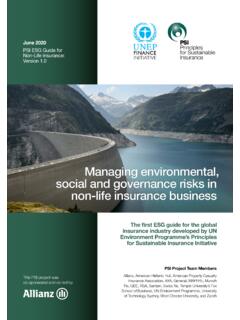
Transcription of Climate Risk & Commercial Property Values
1 A review and analysis of the literatureClimate Risk & Commercial Property Values : Climate Risk & Commercial Property Values 2 AcknowledgementsAcknowledgementsAuthorsJ im Clayton is professor, the Timothy R. Price Chair and the director of the Brookfield Centre of Real Estate and Infrastructure at the Schulich School of Business, York Univer-sity, Toronto, ON CanadaSteven Devaney is associate professor and research division lead in real estate and plan-ning at the Henley Business School at the University of Reading, UKSarah Sayce is professor of sustainable real estate at the Henley Business School, University of Reading, UK and Emeritus Professor, Kingston University, UKJorn Van de Wetering is associate professor in sustainable real estate and director of studies for real estate & planning at the Henley Business School, University of Reading, UKThe authors acknowledge support, project management and help provided by Matthew Ulterino, Property Investment Project Coordinator, UNEP Finance Initiative.
2 Oliver Chatwin, postgraduate student of the University of Reading for assistance in identifying literature sources; and all those individuals with whom informal contact have helped the research team reflect on the literature Clayton, J.; Devaney, S.; Sayce, S. and van de Wetering, J. (2021) Climate Risk and Commercial Property Values : a review and analysis of the literature. UNEP FI available at Climate Risk & Commercial Property Values 3 ContentsContentsAcknowledgements ..2 Executive summary ..41. Introduction, aims and objectives ..102. Method ..133. Key findings from the literature ..174. Hazard exposure and evidence on asset Values .. Flood .. Hurricane/Cyclone .. Sea Level Rise .. Wildfire ..275. Market factors and evidence on asset Values .. Perceptions and beliefs .. Adjacency and amenity .. Governance .. Valuation practices.
3 Short-term and bounce-back, or sustained value erosion .. Liquidity .. Lending behaviour and securitisation .. Insurability .. Asset level investment in resilience ..426. Conclusions for Commercial real estate investors ..447. Recommendations for next steps ..50 Appendix: key paper summaries ..54 Hurricane/Cyclone ..56 Sea level rise (SLR) ..58 Wildfire ..63 References ..65 Climate Risk & Commercial Property Values 4 Executive summaryExecutive summary This paper was commissioned to help support real estate practitioners and investors in understanding and managing the physical risks from Climate change with a specific focus on how these risks affect Commercial real estate asset Values and prices. Regula-tors and market actors are signalling the need for forward-looking Climate risk analysis and assessment of asset value impact, and the authors sought to assess the evidence that Property markets are, or are not, responding to Climate risk through pricing, capex or opex decisions.
4 If Climate change risks are being recognised by real estate partici-pants, then this should be observable through the literature that examines purchase/sale or opex/capex decisions. If such market evidence is lacking, on what basis are forward-looking projections of value at risk being made? Climate events are not new assets have always been exposed to extreme events some-times. But an increase in extreme weather events is having greater financial conse-quences that are being borne by insurers, owners and occupiers, as well as governments. The research thus focused on academic literature from the last decade to address the link between Climate hazard and financial materiality through the variables and param-eters that go into financial modelling of Climate impacts on value. With an emphasis on Commercial Property investment, the study sought to understand: the extent to which the evidence demonstrates that real estate markets have priced in the risks from extreme weather and Climate change; and the channels through which the impacts of these risks on value have systematic, thematic review of English language academic literature on Climate risk and real estate pricing and Values was undertaken, focusing on developed real estate markets in North America, Australasia and Europe.
5 The review found that evidence to date is more plentiful for residential rather than Commercial real estate markets, although some recent research has begun to examine the Commercial real estate sector in a more rigorous way. From the evidence on residential real estate, inferences were made for how these findings might apply to Commercial real estate, noting that deci-sions by homeowners tend to be more subjective and less informed by professional advice than decisions taken by the real estate investment community who often adopt formal, rules-driven processes. Little literature was found on the response by commer-cial real estate Risk & Commercial Property Values 5 Executive summaryThe findings from the literature are presented in the report so that evidence of financial impact can be considered both by hazard and thematically by market factors, structured as follows: Climate hazard (peril) exposureThematic findings (how and why Climate risk affects markets) Flood Hurricane / Cyclone Sea Level Rise Wildfire Perceptions and beliefs Adjacency and amenity Governance Valuation practices Short-term and bounce-back, or sustained value erosion Liquidity Lending behaviour and securitisation Insurability Asset level investment in resilienceMany studies come with caveats to their analysis and the results are sometimes in conflict with similar research.
6 For these reasons, the transmission channels through which pricing and value are influenced by Climate risks are cloudy. Nonetheless, key headlines that emerged from the literature review were as follows: Property prices decline after Climate events, but historically the drop has been modest and short-lived in locations where there is strong awareness of, and experience with, extreme weather-related events (particularly flooding and exposure to hurricanes/cyclones). Potential explanations include that Climate risk was already capitalised into Property Values or that pricing was myopic in nature. There is a small body of recent evidence that certain events can lead to a long-last-ing decline in prices or liquidity in geographies that have heretofore been relatively unexposed to extreme weather or Climate events, or where intensity and frequency have appreciably increased.
7 This may be a correction to previous under-acceptance or awareness of risk. Trading volumes or time on market may provide early signals of how markets are reacting to Climate events and risks through lower liquidity that could ultimately feed into prices. Evidence is starting to emerge that buyer demand has shifted in response to Climate risk exposure, rather than changes in lender or insurer behaviour, although these might follow. Proactive public investment and strong governance as risk mitigating factors may contribute to the modest and short-term nature of pricing reductions. There is some countervailing evidence that a lack of governance capacity or proactive investment may be harming prices, for example in sea level rise studies. Commercial owners/investors in some geographies are placing a higher risk premium on all properties in metro areas affected by Climate events, regardless of whether their individual properties have been directly affected.
8 There is some evidence that this may extend to areas with similar Climate risk profiles, even where events have not occurred. Climate Risk & Commercial Property Values 6 Executive summary There is some evidence from residential markets that levels of belief in Climate change and its impacts may result in differing levels of price impacts of Climate risk. In areas with high levels of Climate change deniers the price impacts may be muted. For areas affected by wildfires, floods and storms, significant short-term value drops may, in part at least, be offset by amenity value. Further, the very limited number of Commercial studies points to greater persistence of urban agglomeration benefits offsetting perceived climatic risks. Access to information on risks and on mitigation measures is a contributing factor in value assessment and pricing. The evidence suggests that better information leads to greater awareness, belief acceptance and integration of Climate impacts on prices achieved.
9 Valuation practices, which are largely driven by lagging indicators, suffer from a paucity of specific Climate risk evidence and available data. Some papers also claim that valuers may lack the necessary specific interdisciplinary skills and professional standards to enable or require them to fully integrate Climate effects. There is evidence in the context of lender concerns about Climate risk being mani-fested through a shift in mortgage originations to loans that are able to be securitised. In this way, lenders can sell the loans and transfer risk to government sponsored enterprises (GSEs) through the MBS (mortgage-backed securities) market. There is little evidence in recent literature that quantifies the financial performance benefits from asset-level risk mitigation expenditure. There is also a lack of evidence that insurance pricing reflects owner investment in help apply the research practically, the diagram below was developed to conceptu-alise the potential financial materiality of Climate risk on Commercial real estate assets.
10 It demonstrates how, in theory, Climate change physical risks could, or have in some cases been found to, feed through to income- Property pricing in a discounted cash flow (DCF) appraisal framework. At a general level, it is expected that Climate risk could be incorporated in Property valuations through an impact on three primary valuation components: 1) cash flow leasing fundamentals (rent, rental growth and vacancy) net of operating expenses and capital expenditures; 2) capitalisation rate capital market conditions including the overall required return that embeds the required risk premium, which captures expectations of cash flow prospects (including exit price) and liquidity within a conventional multi-year pro forma; and 3) financing the cost and availability of funds from both equity partners and mortgage debt finance are directly related to return requirements and indirectly to Property liquidity.