Transcription of Closed and Open Loop Gain lecture - ITTC
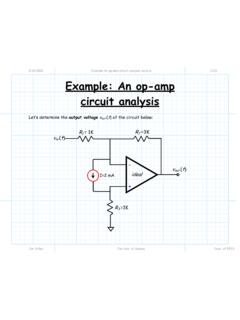
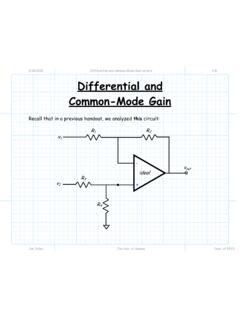
1 2/13/2011 Closed and Open Loop Gain lecture 1/5 Jim Stiles The Univ. of Kansas Dept. of EECS Closed -Loop and Open-Loop Gain Consider the inverting amplifier a feedback amplifier constructed with an op-amp: The open-circuit voltage gain of this amplifier: 21voRAR = is also referred to by engineers the Closed loop gain of the feedback amplifier. + - vin ocoutv ideal R2 R1 v- v+ 2/13/2011 Closed and Open Loop Gain lecture 2/5 Jim Stiles The Univ. of Kansas Dept. of EECS A Closed loop Q: Closed loop? What does that mean? A: The term Closed loop refers to loop formed by the feed-forward path and the feed-back ( , feedback) path of the amplifier. In this case, the feed-forward path is formed by the op-amp, while the feed-back path is formed by the feedback resistor R2. + - vin ocoutv ideal R2 R1 v- v+ Feed-back Path Feed-forward Path Closed -Loop 2/13/2011 Closed and Open Loop Gain lecture 3/5 Jim Stiles The Univ.
2 Of Kansas Dept. of EECS An open loop If the loop is broken, then we say the loop is open . The gain (oivv) for the open loop case is referred to as the open-loop gain. i1 i2 + - vin ocoutv ideal R2 R1 v- v+ Open-Loop 2/13/2011 Closed and Open Loop Gain lecture 4/5 Jim Stiles The Univ. of Kansas Dept. of EECS Open and Closed loop gains For example, in the circuit we know that: ()1211000ocoutopinvvAv viivviR++ == === = Combining, we find the open-loop gain of this amplifier to be: ocoutopenopinvAAv== Once we close the loop, we have an amplifier with a Closed -loop gain: 21ocoutclosedinvRAvR== which of course is the open-circuit voltage gain of this inverting amplifier. i1 i2 + - vin ocoutv ideal R2 R1 v- v+ 2/13/2011 Closed and Open Loop Gain lecture 5/5 Jim Stiles The Univ. of Kansas Dept. of EECS Feedback is a wonderful thing Note that the Closed -loop gain (21RR ) does not explicitly involve the op-amp gain Aop.
3 * The Closed -loop gain is determined by two resistor values, which typically are selected to provide significant gain (1voA>), albeit not so large that the amplifier is easily saturated. * Conversely, the open-loop gain (-Aop) obviously does involve the op-amp gain. Moreover, as in this case, the open-loop gain of a feedback amplifier often only involves the op-amp gain! * As a result, the op-amp gain is often alternatively referred to as the open-loop gain. Note that closing the feedback loop turns a generally useless amplifier (the gain is too high!) into a very useful one (the gain is just right)!