Transcription of Example An op amp circuit analysis lecture - ITTC
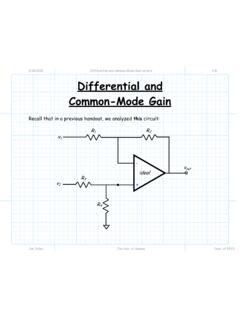
1 2/21/2011 Example An op amp circuit analysis lecture 1/23 Jim Stiles The Univ. of Kansas Dept. of EECS Example : An op-amp circuit analysis Let s determine the output voltage vout (t) of the circuit below: R2 =3K R1 = 1K + - ideal R3 =1K vout (t) vin (t) I=2 mA 2/21/2011 Example An op amp circuit analysis lecture 2/23 Jim Stiles The Univ. of Kansas Dept. of EECS Without this step, your answer (and thus your grade) mean nothing The first step in EVERY circuit analysis problem is to label all currents and voltages: 1i3i2ii i+1v+ 2v+ 3v+ R2 =3K R1 = 1K + - ideal R3 =1K vout vin I=2 mA v+v 2/21/2011 Example An op amp circuit analysis lecture 3/23 Jim Stiles The Univ.
2 Of Kansas Dept. of EECS The search for a Q: I looked and looked at the notes, and I even looked at the book, but I can t seem to find the right equation for this configuration! A: That s because the right equation for this circuit does not exist at least yet. It s up to you to use your knowledge and your skills to determine the right equation for the output voltage outv! 2/21/2011 Example An op amp circuit analysis lecture 4/23 Jim Stiles The Univ. of Kansas Dept. of EECS You have the tools to determine this yourself no need to find a template! Q: OK, let s see; the output voltage is: outv= ???? I m stuck. Just how do I determine the output voltage?
3 A: Open up your circuit analysis tool box. Note it consists of three tools and three tools only: Tool 1: KCL Tool 2: KVL Tool 3: Device equations ( , Ohm s Law and the virtual short). Let s use these tools to determine the right equation! First, let s apply KCL (I m quite partial to KCL). 2/21/2011 Example An op amp circuit analysis lecture 5/23 Jim Stiles The Univ. of Kansas Dept. of EECS The first KCL Note there are two nodes in this circuit . The KCL for the first node is: 12iiiI =++ Note the potential of this node (with respect to ground) is that of the inverting op-amp terminal ( , v ). v v+1i3i2ii i+1v+ 2v+ 3v+ R2 =3K R1 = 1K + - ideal R3 =1K vout vin I=2 mA 2/21/2011 Example An op amp circuit analysis lecture 6/23 Jim Stiles The Univ.
4 Of Kansas Dept. of EECS The second KCL The KCL of the second node is: 3Ii i+=+ Note the potential of this node (with respect to ground) is that of the non-inverting op-amp terminal ( , v+). v v+1i3i2ii i+1v+ 2v+ 3v+ R2 =3K R1 = 1K + - ideal R3 =1K vout vin I=2 mA 2/21/2011 Example An op amp circuit analysis lecture 7/23 Jim Stiles The Univ. of Kansas Dept. of EECS The first KVL Now for our second tool KVL. We can conclude: 11ininvvvvv v = = 1i3i2ii i+1v+ 2v+ 3v+ R2 =3K R1 = 1K + - ideal R3 =1K vout vin I=2 mA v+v 2/21/2011 Example An op amp circuit analysis lecture 8/23 Jim Stiles The Univ. of Kansas Dept.
5 Of EECS The second KVL And also: 22outoutvvvvvv = = 1i3i2ii i+1v+ 2v+ 3v+ R2 =3K R1 = 1K + - ideal R3 =1K vout vin I=2 mA v+v 2/21/2011 Example An op amp circuit analysis lecture 9/23 Jim Stiles The Univ. of Kansas Dept. of EECS The third KVL And likewise: 330vvvv++ = = 1i3i2ii i+1v+ 2v+ 3v+ R2 =3K R1 = 1K + - ideal R3 =1K vout vin I=2 mA v+v 2/21/2011 Example An op amp circuit analysis lecture 10/23 Jim Stiles The Univ. of Kansas Dept. of EECS There are seven device equations Finally, we add in the device equations. Note in this circuit there are three resistors, a current source, and an op-amp From Ohm s Law we know: 111viR= 222viR= 333viR= And from the current source: 2I= And from the op-amp, three equations!
6 0i = 0i+= vv += 2/21/2011 Example An op amp circuit analysis lecture 11/23 Jim Stiles The Univ. of Kansas Dept. of EECS 12 equations and 12 unknowns! Q: Yikes! Two KCL equations, three KVL equations, and seven device equations together we have twelve equations. Do we really need all these? A: Absolutely! These 12 equations completely describe the circuit . There are each independent; without any one of them, we could not determine outv! To prove this, just count up the number of variables in these equations: We have six currents: 123,,,,,ii i i i I+ And six voltages: 123,,,,,outvvvvvv+ Together we have 12 unknowns which works out well, since we have 12 equations!
7 Thus, the only task remaining is to solve this algebra problem! 2/21/2011 Example An op amp circuit analysis lecture 12/23 Jim Stiles The Univ. of Kansas Dept. of EECS Don t ask the calculator to figure this out! Q: OK, here s where I take out my trusty programmable calculator, type in the equations, and let it tell me the answer! A: Nope. I will not be at all impressed with such results (and your grade will reflect this!). Instead, put together the equations in a way that makes complete physical sense just one step at a time. 2/21/2011 Example An op amp circuit analysis lecture 13/23 Jim Stiles The Univ. of Kansas Dept. of EECS i3 = 2 mA First, we take the two device equations: 0i+= and 2I= And from the second KCL equation: 333202Ii iii+=+ =+ = 1i22ii 01v+ 2v+ 3v+ R2 =3K R1 = 1K + - ideal R3 =1K vout vin I=2 mA v+v 2/21/2011 Example An op amp circuit analysis lecture 14/23 Jim Stiles The Univ.
8 Of Kansas Dept. of EECS So v3 = V Now that we know the current through 3R, we can determine the voltage across it (um, using Ohm s ). ()33321 2viR=== 1i22ii 01v+ 2v+ 2+ v+v R2 =3K R1 = 1K + - ideal R3 =1K vout vin I=2 mA 2/21/2011 Example An op amp circuit analysis lecture 15/23 Jim Stiles The Univ. of Kansas Dept. of EECS Thus v- = V Thus, we can now determine both v+ (from a KVL equation) and v (from a device equation): 32vv+== and 2vv +== 1i22ii 01v+ 2v+ 2+ 2v+=2v =R2 =3K R1 = 1K + - ideal R3 =1K vout vin I=2 mA 2/21/2011 Example An op amp circuit analysis lecture 16/23 Jim Stiles The Univ.
9 Of Kansas Dept. of EECS And now i1 =i2 +2 Now, inserting another device equation: 0i = into the first KCL equation: 121212022iiiIiiii =++ =++ =+ 22i+22i001v+ 2v+ 2+ 2v+=2v =R2 =3K R1 = 1K + - ideal R3 =1K vout vin I=2 mA 2/21/2011 Example An op amp circuit analysis lecture 17/23 Jim Stiles The Univ. of Kansas Dept. of EECS So that v2 = 2- vout From KVL we find: 1110inininvv vvvvv = = = and: 222outoutvvvvv = = 22i+22i00()2inv+ ()2outv+ 2+ 2v+=2v =R2 =3K R1 = 1K + - ideal R3 =1K vout vin I=2 mA 2/21/2011 Example An op amp circuit analysis lecture 18/23 Jim Stiles The Univ. of Kansas Dept.
10 Of EECS Now we can find vout So, from Ohm s law (one of those device equations!), we find: 112212241ininvviiivR = += = and: 222223outvviiR = = Equating these last two results: 241433outinoutinvvvv = = 2/21/2011 Example An op amp circuit analysis lecture 19/23 Jim Stiles The Univ. of Kansas Dept. of EECS The right equation ! Thus, we have at last arrived at the result: 14 3outinvv= 2inv 24inv 00()2inv+ ()312inv+ 2+ 2v+=2v =R2 =3K R1 = 1K + - ideal R3 =1K 14 3outinvv= vin I=2 mA 2/21/2011 Example An op amp circuit analysis lecture 20/23 Jim Stiles The Univ. of Kansas Dept. of EECS An alternative: superposition Note an alternative method for determining this result is the application of superposition.