Example: confidence
CODE OF PRACTICE - Labour
Health hazards of gas welding and flame cutting are mainly due to the radiation and toxic fumes or gases emitted during the process. The resultant health problems include: (a) eye injuries, such as (i) eye discomfort and burns from the intense light and heat emitted from the operation, (ii) heat cataract caused by radiation from molten metal,
Tags:
Information
Domain:
Source:
Link to this page:
Documents from same domain
Code of Practice for Safety at Work (Lift and Escalator)
www.labour.gov.hkCode of Practice for Safety at Work (Lift and Escalator) Occupational Safety and Health Branch Labour Department October 1997
Chapter 4: Rest Days, Holidays and Leaves - …
www.labour.gov.hkChapter 4: Rest Days, Holidays and Leave. An employee shall enjoy rest days, statutory holidays and paid annual leave during employment. REST DAY

Practical Guide for Employment of FDHs Eng - …
www.labour.gov.hkPractical Guide For Employment Of Foreign Domestic Helpers – What foreign domestic helpers and their employers should know . Table of Contents

A Concise Guide to the Employees ... - labour.gov.hk
www.labour.gov.hkA Concise Guide to the Employees’ Compensation Ordinance (with Frequently Asked Questions on Common Employees’ Compensation Issues) Labour Department
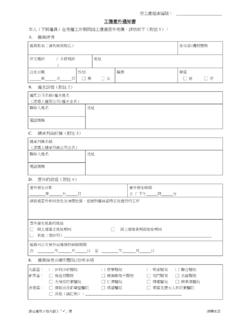
工傷意外通知書 - labour.gov.hk
www.labour.gov.hk請在適用方格內劃上「 」號 請轉後頁 勞工處檔案編號: 工傷意外通知書 . 本人(下稱僱員)在受僱工作期間因工遭遇意外受傷,詳情如下(附註1):
Printed by the Government Logistics Department
www.labour.gov.hkReport of the Policy Study on Standard Working Hours Table of Content Table of Content Page Executive Summary 1 Part I – Background Chapter 1 Introduction 15

to the Employment (Amendment) Ordinance
www.labour.gov.hkSummary of Amendments made under the Amendment Ordinance II • The Revised Mode of Calculation Calculating relevant statutory entitlements on the basis

Lighting Assessment in the Workplace - labour.gov.hk
www.labour.gov.hk3. Approaches to Lighting Assessment There are basically two approaches to conducting a lighting assessment in the workplace: by means of a checklist and by
Chapter 1: Application of the Employment Ordinance
www.labour.gov.hkChapter 1: Application of the Employment Ordinance. The Employment Ordinance applies to all employees with the following exceptions: 1. a family member who lives in the same dwelling as the employer;

A Concise Guide to the Employment Ordinance
www.labour.gov.hk2 Foreword This guide sets out in simple terms the main provisions of the Employment Ordinance (Cap. 57). It should be noted that the Ordinance itself remains the
Related documents
OWNER’S MANUAL - Welding Equipment
www.millerwelds.comWelding produces fumes and gases. Breathing these fumes and gases can be hazardous to your health. 1. Keep your head out of the fumes. Do not breathe the fumes. 2. If inside, ventilate the area and/or use exhaust at the arc to remove welding fumes and gases. 3. If ventilation is poor, use an approved air-supplied respirator.

Guidelines For Gas Tungsten Arc Welding (GTAW)
www.millerwelds.comperson nearby. Welding fumes and gases can displace air and lower the oxygen level causing injury or death. Be sure the breath-ing air is safe. Do not weld in locations near degreasing, cleaning, or spraying op-erations. The heat and rays of the arc can react with vapors to form highly toxic and irritating gases.
IM510-E RANGER 8 - Lincoln Electric
www.lincolnelectric.comFUMES AND GASES can be dangerous. 5.a.Welding may produce fumes and gases hazardous to health. Avoid breathing these fumes and gases.When welding, keep your head out of the fume. Use enough ventilation and/or exhaust at the arc to keep fumes and gases away from the breathing zone. When welding with electrodes which require special
INTRODUCTION TO WELDING - GlobalSecurity.org
www.globalsecurity.orgwelding and gas shielded arc welding is the type of ... mary gases used for this process are helium, argon, or ... Nearly all fluxes give off fumes that may be toxic. Use ONLY in …
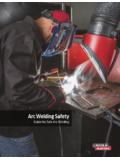
Arc Welding Safety Guide - Lincoln Electric
www.lincolnelectric.comoverexposure to fumes and gases, arc radiation, and fire and explosion; which may result in serious, or even fatal injuries. This bulletin is written with the arc welding operator in mind, containing both mandatory safety practices and those based on shop experience. Be sure to read ANSI Z49.1, and
Personal Protective Equipment (PPE) for Welding and Cutting
app.aws.orgWelding and cutting can produce hazards such as sparks, spatter, radiation (infrared, ultraviolet, and blue light), slag, heat, hot metal, fumes and gases, and even electric shock. Since these hazards may cause burns, injury, or death, it is important to wear proper PPE at all times. EYE AND FACE PROTECTION

12.19 Electric Arc Welding - United States Environmental ...
www3.epa.govwelding processes. Only electric arc welding generates these pollutants in substantial quantities. The lower operating temperatures of the other welding processes cause fewer fumes to be released. Most of the particulate matter produced by welding is submicron in size and, as such, is considered to be all PM-

Controlling Hazardous Fume and - Occupational Safety and ...
www.osha.govGases during Welding Welding joins materials together by melting a metal work piece along with a filler metal to form a strong joint. The welding process produces visible smoke that contains harmful metal fume and gas by-products. This fact sheet discusses welding operations, applicable OSHA standards, and suggestions for protecting welders and
Welding Handbook - American Welding Society
pubs.aws.orgii Welding Handbook, Ninth Edition Volume 1 Welding Science and Technology Volume 2 Welding Processes—Part 1 Volume 3 Welding Processes—Part 2 Volume 4