Transcription of COMMERCIAL INSULATING GLASS SELECTION & …
1 COMMERCIAL INSULATING GLASS SELECTION & make -UP GENERAL RULES - INSULATING GLASS has an outboard (outside) and inboard (inside) lite. - The base GLASS used in a coated product is called a substrate . - GLASS surfaces are numbered sequentially starting with the exterior GLASS surface to select surfaces for coatings: #1 Outside Surface / #2 -Airspace Side of Outboard Lite / #3 - Airspace Side of Inboard Lite / #4 - Inside Surface - Visible light transmittance is the percent of visible light that passes through GLASS . - Reflectivity (in or out) is the percent of visible light that is reflected away from the GLASS . - The u-factor describes the INSULATING value of GLASS . It is improved by using a Low E coating, argon gas, or a warm edge spacer. The u-factor is not changed if the Low E coating is on the #2 or #3 surface.
2 - The SHGC Solar Heat Gain Coefficient describes the ability to reduce solar heat gain. It can be improved by adding a tinted GLASS or a Solar Control coating. - Coatings are either: 1/ Solar Control Low E ( improves u-factor AND SHCG) , or 2/ Passive Solar Low E (improves u-factor ONLY), or 3/ Solar Reflective (improves SHGC ONLY) - Tinted GLASS is generally the Outboard lite. SHCG is improved by the darker (high performance, lower light transmission) tinted products. - Solar Control Low E Coated GLASS Like Guardian SN-68 (clear, ultra-clear, green, crystal gray substrate) or Pilkington Eclipse Advantage (bronze, gray, blue-green, evergreen, arctic blue substrate) are generally the outboard lites, with coatings on the #2 Surface. - Guardian SN-68 (clear substrate) or Pilkington Energy Advantage Passive Solar Low E (clear substrate) can be used as the inboard lite, with coatings oriented to the #3 surface to incorporate an uncoated tinted GLASS as an outboard lite.
3 This design may be selected for aesthetic or energy performance reasons if the desired coatings aren t offered on the desired substrates. - Pilkington Energy Advantage is a Passive Solar Low E coating only available on a clear GLASS substrate, designed for heating dominated climates, to allow for maximum visible light transmission and the capture of solar heat. Energy Advantage coating on the #3 surface maximizes harvesting of solar heat, a #2 surface orientation provides an improved Solar Heat Gain Coefficient (SHGC). - Solar Reflective coated GLASS (no Low E properties) like PPG Solarcool is intended to be the outboard lite. The coating can be oriented to the #2 surface for a deep tinted appearance, or to the #1 surface for a highly reflective appearance. A Low E coated clear lite can be included as the inboard lite to improve u-factor. - Generally, obscure GLASS components are the inboard lite.
4 Acid etched GLASS , with the etched surface oriented to the #3 surface (easier maintenance), or a relatively flat rolled pattern GLASS like Pattern 62 with the pattern oriented to the #4 surfaces (flat side toward spacer makes a better seal). Highly textured rolled patterns, like Rain, are intended for monolithic applications, but can be used with the pattern oriented to the #4 side with a glazing system that is designed to accommodate the textured surface. - Generally, retailers and schools want high light transmission, and low reflectivity, to convey a welcoming appearance, and enhance security. Clear (or even ultra- clear) substrates are a good start. Low E coatings or Solar Control Low E coatings to improve energy performance or impart a desired color can be added. Energy advantage or SN-68 are good choices. Shading the GLASS , by setting the GLASS into the building, or incorporating sunshades in the glazing system helps accommodate a higher light transmitting GLASS .
5 - Generally, office building owners want GLASS to reduce air conditioning load and provide for better occupant comfort (less heat and glare) so a lower light transmission and better SHGC are called for. With a clear substrate, an SN- 54 or a Sunguard High Performance Series coating are good choices, as well as tinted substrates with Solar Control Coatings, depending on color, reflectivity, and performance requirements. Another good design practice in office buildings using a GLASS with higher light transmission/ lower reflectivity in doors and entrance areas. Tinted GLASS absorbs solar energy. If heated unevenly, annealed tinted GLASS can crack. Any INSULATING GLASS containing tinted GLASS (especially important if the unit also contains a Low E coating) should be evaluated for thermal stress before being ordered annealed. Newer high performance tinted GLASS products (ie. Evergreen, Arctic Blue, etc.)
6 Are very heat absorbing, and are more subject to thermal stress than the traditional tinted substrates. In addition to product factors, job factors, like shading (especially at the top), interior blinds or drapes close to the GLASS surface, glazing in cold temperatures before the building is heated, and other factors should be evaluated to determine if the outboard lite or both lites of the unit should be tempered or heat strengthened. We can assist in the thermal stress analysis with customer supplied information on job factors. (framing type, color, overhangs, mullion depth, etc.) using GLASS manufacturer web-based software. If the heat stress analysis is too much trouble, the general rule is to heat treat the outboard tinted lite if the INSULATING unit contains both tinted GLASS and a low e coating. But even in units without a low e coating, severe job conditions can break tinted GLASS .
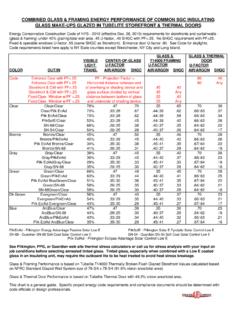
7 STOCK STANDARD GLASS SUBSTRATES- Clear, Ultra-clear, Bronze, Gray, Green, Evergreen (dark green), Arctic Blue, Graylite (dark gray). STOCK STANDARD SOLAR CONTROL LOW E Guardian SN-68 on Clear, Pilkington Eclipse Advantage on Bronze, Gray, Blue-green, Evergreen, Arctic Blue STOCK STANDARD PASSIVE SOLAR LOW E Pilkington Energy Advantage STOCK STANDARD REFLECTIVE PPG Solarcool on Bronze and Gray STOCK STANDARD OBSCURE GLASS - Acid Etched, Pattern 62, White Laminated, Glue Chip