Transcription of COMMONLY USED RESIDENTIAL BUILDING CODES
1 COMMONLY used RESIDENTIAL BUILDING CODES INTERNATIONAL RESIDENTIAL code (2009) form revised 5/10 WALL FRAMING 23. DESIGN AND CONSTRUCTION. Section IRC 2009 Exterior walls of wood-frame construction shall be designed and constructed in accordance with the provisions of this chapter and Figures (1) and (2) or in accordance with AF&PA s NDS. Components of exterior walls shall be fastened in accordance with Tables (1) through (4). Structural wall sheathing shall be fastened directly to structural framing members.
2 Exterior wall coverings shall be capable of resisting the wind pressures listed in Table (2) adjusted for height and exposure using Table (3). Wood structural panel sheathing used for exterior walls shall conform to the requirements of Table (3). Studs shall be continuous from support at the sole plate to a support at the top plate to resist loads perpendicular to the wall. The support shall be a foundation or floor, ceiling or roof diaphragm or shall be designed in accordance with accepted engineering practice.
3 Exception: Jack studs, trimmer studs and cripple studs at openings in walls that comply with Tables (1) and (2). 24. FASTENER SCHEDULE. Tables (1) - (4) IRC 2009 Components of exterior walls shall be fastened in accordance with Tables (1) through (4). 25. WALL SHEATHING. Section , Tables (2), (3), (3) IRC 2009 Structural wall sheathing shall be fastened directly to structural framing members. Exterior wall coverings shall be capable of resisting the wind pressures listed in Table (2) adjusted for height and exposure using Table (3).
4 Wood structural panel sheathing used for exterior walls shall conform to the requirements of Table (3). 26. BRACED WALL LINES. Section IRC 2009 Braced wall lines. Braced wall lines shall be provided in accordance with this section. The length of a braced wall line shall be measured as the distance between the ends of the wall line. The end of a braced wall line shall be considered to be either: 1. The intersection with perpendicular exterior walls or projection thereof, 2. The intersection with perpendicular braced wall lines.
5 The end of the braced wall line shall be chosen such that the maximum length results. Braced wall panels. Braced wall panels shall be constructed in accordance with the intermittent bracing methods specified in Section , or the continuous sheathing methods specified in Sections and Mixing of bracing method shall be permitted as follows: 1. Mixing bracing methods from story to story is permitted. 2. Mixing bracing methods from braced wall line to braced wall line within a story is permitted, except that continuous sheathing methods shall conform to the additional requirements of Sections and 3.
6 Mixing bracing methods within a braced wall line is permitted only in Seismic Design Categories A and B, and detached dwellings in Seismic Design Category C. The length of required bracing for the braced wall line with mixed sheathing types shall have the higher bracing length requirement, in accordance with Tables (1) and (2), of all types of bracing used . Length of bracing. The length of bracing along each braced wall line shall be the greater of that required by the design wind speed and braced wall line spacing in accordance with Table (1) as adjusted by the factors in the footnotes or the Seismic Design Category and braced wall line length in accordance with Table (2) as adjusted by the factors in Table (3).
7 Braced wall panel location requirements shall comply with the requirements of Section Only walls that are parallel to the braced wall line shall be counted toward the bracing requirement of that line, except angled walls shall be counted in accordance with Section In no case shall the minimum total length of bracing in a braced 2 wall line, after all adjustments have been taken, be less than 48 inches (1219 mm) total. 27. HEADERS AND LINTELS.
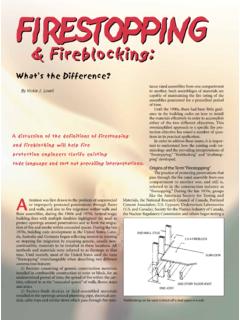
8 Section IRC 2009. For header spans see Tables (1) and (2). 28. FIRE BLOCKING. Section IRC 2009 Fireblocking shall be provided in accordance with Section Fireblocking. In combustible construction, fireblocking shall be provided to cut off all concealed draft openings (both vertical and horizontal) and to form an effective fire barrier between stories, and between a top story and the roof space. Fireblocking shall be provided in wood-frame construction in the following locations: 1. In concealed spaces of stud walls and partitions, including furred spaces and parallel rows of studs or staggered studs, as follows: Vertically at the ceiling and floor levels.
9 Horizontally at intervals not exceeding 10 feet (3048 mm). 2. At all interconnections between concealed vertical and horizontal spaces such as occur at soffits, drop ceilings and cove ceilings. 3. In concealed spaces between stair stringers at the top and bottom of the run. Enclosed spaces under stairs shall comply with Section 4. At openings around vents, pipes, ducts, cables and wires at ceiling and floor level, with an approved material to resist the free passage of flame and products of combustion.
10 The material filling this annular space shall not be required to meet the ASTM E 136 requirements. 5. For the fireblocking of chimneys and fireplaces, see Section 6. Fireblocking of cornices of a two-family dwelling is required at the line of dwelling unit separation. Fireblocking materials. Except as provided in Section , Item 4, fireblocking shall consist of the following materials. 1. Two-inch (51 mm) nominal lumber. 2. Two thicknesses of 1-inch ( mm) nominal lumber with broken lap joints.