Transcription of CommunityPracticein OccupationalTherapy: WhatIsIt?
1 OverviewThis chapter provides a basic introduction to community practice as a foun-dation for program development and grant writing for occupational therapypractitioners. The premise of this book is that successful grant proposals arebased on sound program development. Throughout this book, many of theconcepts introduced in this chapter are discussed in greater detail includingapplication and examples. In this chapter, models of community occupa-tional therapy practice are defined and described along with skills and chal-lenges related to community practice. Important concepts of community1c h a p t e rCommunity Practice inOccupational Therapy:What Is It?1By the end of this chapter, the reader will be able to complete thefollowing:1. Describe the role of the occupational therapy practitioner incommunity Compare and contrast theoretical approaches to community practicein occupational Reflect on the skills required to engage in community practice as anoccupational therapy Terms Community Community-basedparticipatoryresearch (CBPR) Community-basedpractice Community-builtpractice Community capacitybuilding Community-centered Communitypartnership Community practice Health Primary healthpromotion Secondary healthpromotion Tertiary healthpromotionLEARNING :J&B_60656_Doll 7/26/09 11:29 AM Page 1 Jones and Bartlett Publishers, LLC.
2 NOT FOR SALE OR DISTRIBUTION. 2 CHAPTER 1:Community Practice in Occupational Therapy: What Is It?practice are described as are methods and strategies for building evidence in com-munity do not occur in a vacuum and, as outlined in the Occupational Ther-apy Practice Framework (OTPF), occupations are affected by the context in whichpeople live (American Occupational Therapy Association [AOTA], 2008).Com-munityis an important context that influences peoples ability to engage in occu-pations. Communities can facilitate or inhibit occupational engagement of thosewith and without disabilities. In this book, the skills of grant writing are thoroughlydiscussed as applied to community occupational therapy practice. Occupationaltherapycommunitypracticecan be initiated and supported by external funding,including grants (Brownson, 1998).
3 Prior to delving into the topic of grant writing,the question must be asked: What is community practice for occupational therapypractitioners?What Is Community?Communities provide a unique setting for occupational therapy practice. Every-day life of a community, its mix of people, their needs, concerns, joys and strug-gles, offers an unparalleled opportunity to define [the occupational therapy]discipline, research its potential (Fidler, 2001, p. 8). Communities are individu-als tied together by occupational engagement and a collectivesense of meaning. Communities are not simply defined bygeographic location but refer to a person s natural environ-ment, that is, where the person works, plays, and performsother daily activities (Brownson, 1998). Communities arethe settings where people reside, build relationships, andengage in health practices (Brownson, 1998; Scaffa, 2001;Grady, 1995).
4 Communities exist as a context in which peo-ple define their lives. For some people, identifying member-ship in a community may be challenging, yet everyonebelongs to multiple importance and relevance of community practice in occupational therapyhave been discussed throughout the profession s history (McColl, 1998). In occu-pational therapy, an essential conception of community is one that considersgroups of people engaged in a collective occupation. In other words, just as indi-viduals have unique occupations, so do communities. The basis of a community isrelationships, and communities of people come together to do something thatcannot be easily done in isolation (Scaffa, 2001, p. 8). Based on this premise, com-munities have unique cultures, relationships, views of health, and do you define community?
5 What communities do you belongto? Take some time to write downanswers to these questions andreflect on your definition and thecommunities of importance to S STOP AND :J&B_60656_Doll 7/26/09 11:29 AM Page 2 Jones and Bartlett Publishers, LLC. NOT FOR SALE OR DISTRIBUTION. Health in the Context of Community3 Health in the Context of CommunityThe World Health Organization defineshealthas a state of complete physical,mental and social well-being and not merely the absence of disease or infirmity (World Health Organization [WHO], 1998). Health has been comprehensivelydefined in the profession of occupational therapy asthe absence of illness, but not necessarily disability; a balance of physical,mental, and social well-being attained through socially valued and individu-ally meaningful occupation; enhancement of capacity and opportunity tostrive for individual potential; community cohesion and opportunity; socialintegration, support, and justice, all within and as part of a sustainable ecol-ogy.
6 (Wilcock, 2006, p. 110)Both definitions acknowledge that health is not only about disease state. Thesedefinitions incorporate a holistic view of well-being and the importance of qualityof life as a significant component of health. In community practice, occupationaltherapy practitioners must retain a broad view of health in order to implement suc-cessful health-related programs because the extrinsic factors of health cannot bedenied. For example, when conducting an occupational therapy evaluation in thehome, the practitioner can explore the impact that the environment has on theclient s occupational engagement and easily visualize the barriers to transfers ormobility that the client may face in the the community context of occupational therapy practice, the definition ofhealth moves away from the medical definition.
7 Health is viewed as the ability toengage in occupation (Baum & Law, 1998; Wilcock, 2006). Occupations demon-strate a community s and an individual s culturally sanctioned intellectual, moral,social and physical attributes. It is only by what they do that people can demon-strate what they are or what they hope to be (Wilcock, 2006, p. 9). The inability toengage in occupation, whether caused by physical, mental, social, or environmen-tal challenges, leads to many problems with maintenance of health and (2006) says it best: Health is remarkably simple and remarkably com-plex (p. 3). Perhaps this perception of health can act as an appropriate mantra foroccupational therapy practitioners working in the community. Health can beaffected by simple factors, such as risk factors, in which people make consciouschoices to engage in healthy and unhealthy behaviors that prevent or lead to dis-ease.
8 On the other hand, the health status of an individual and a community maybe affected by forces beyond individual or group behaviors. External forces, suchas transportation, socioeconomic status, and health disparities, greatly affect thehealth of a Paul Farmer (2003), physician and medical anthropologist, discusses theimpacts of social and political decisions on public health, acknowledging that :J&B_60656_Doll 7/26/09 11:29 AM Page 3 Jones and Bartlett Publishers, LLC. NOT FOR SALE OR DISTRIBUTION. larger systems affect the health of communities and entire countries. Many of thefactors that affect the health of groups and communities are out of the autonomouscontrol of the people affected. For example, many underserved communities findtheir health status affected by oppressive forces outside of their control (Farmer,2003).
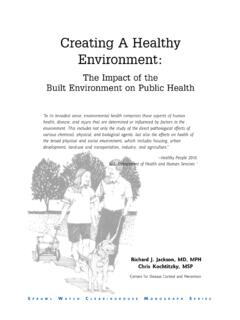
9 Health disparities, unequal treatment of patients, and access to health insur-ance (including both the uninsured and underinsured) are sociopolitical factorsthat affect peoples ability to access and respond to healthcare regimens and howcommunity members define and engage in healthy example, community members may not walk in the community for exer-cise because there are no sidewalks and residents fear for their safety when they haveto walk in the streets. Although this may sound like an oversimplified problem,many times infrastructure and city planning issues, such as a lack of sidewalks,make community members feel like they are unable to practice healthy behaviors,like walking. In this example, the health determinant actually has nothing to dowith the community members physical ability to engage in health maintenanceactivities but demonstrates a simple barrier to health and well-being in a commu-nity setting.
10 By considering factors such as these, occupational therapy practition-ers can explore alternative methods for engaging community members in healthmaintenance because they understand the complexity of the human experts in occupation, occupational therapy practitioners easily identify fac-tors that prevent a person from healing. Skills in activity analysis provide occupa-tional therapy practitioners with a basis for understanding engagement and howactivities and occupations are impeded by physical factors. In a community prac-tice setting, occupational therapy practitioners use these same clinical skills toexplore the determinants of health beyond the physical by taking a systemsapproach to understanding health and disease (Wilcock, 2006; McColl, 1998;Scriven & Atwal, 2004). The role of the occupational therapy practitioner in com-munity practice is to explore occupational engagement in a broad sense.