Transcription of Conducting a Job Hazard Assessment
1 Conducting a Job Hazard AssessmentEnvironmental, Health and Safety275-3241 EH&S Programs: Fire Safety Blood Borne Pathogens Hazard Communication Personal Protective Equipment Emergency Preparedness General Safety Radiation Safety Laser Safety OR Safety Dental Safety Disinfectant Safety Power Industrial Trucks Respiratory Safety Hearing Conservation Lock Out/Tag Out Confined SpaceOverview What is a Hazard Assessment ? When is one required? How do I conduct one?DefinitionA Hazard Assessment is an evaluation of a work place, or work situation, as to the potential for hazards that an employee may encounter while performing the are required (by OSHA) to certify in writing that they have assessed the work place to determine if hazards are present or likely that would require personal protective equipment (PPE)and/or medical monitoring, or other requirements such as fit testing for respirator use, and vaccines.
2 You may use this presentation as a tool for completing the Job Hazard Assessment form located on the EH&S website department Supervisor is required to perform a job Hazard Assessment and oversee that personal protective equipment is appropriate for the Hazard and is being used do you begin?It may be difficult to begin assessing every location, job title, or job task. The most logical place to begin is to review your accident and illness reports. Is there a work area that seems to have more accidents and injuries than others? Is there a type of injury that seems to occur more frequently than others?Where do you begin?If injury and illness reports do not point you towards a place to begin, consider beginning with: Close calls or near misses New tasks or positions Tasks that have changed Non-routine jobs Routine jobsWork Area AssessmentAfter you have chosen a place to start, perform a walk-through of the work area, looking for hazards as indicated in this : Involve employees in this process to gain valuable input!
3 Identify the HazardsAs you walk through the area and discuss work tasks with employees, look for the following hazards . If you are unsure whether something should be included in your Hazard Assessment , contact EHS for assistance or try using the reference material suggested on some of the ObjectsAre there objects which may fall from above onto employees? Employees working overhead? Tools or materials handled above your head?Chemical HazardsChemical use requires safe procedures as well as protective equipment. If your employees use chemicals (examples include cleaners, drugs, paint, gasoline, etc) as part of their job duties, they need to know the hazards associated with those chemicals. Harmful Dusts/Mists/Fumes/ParticulatesAre employees exposed to chemicals or harmful dusts/mists/fumes? Examples: Any chemical, particulate, oraerosolizationof microorganisms which poses a health Hazard Asbestos Welding fumes Solder fumes TBReference for chemicals: Obtain a Material Safety Data Sheet on the product in question from the supplier and review the information provided for health hazards and suggested Exposure to Blood or Body Fluids Medical procedures Accidents Research samples Medical wasteAre there sources of blood and/or other potentially infectious materials?
4 All employees with reasonably anticipated exposure to blood are covered by OSHA s Bloodborne Pathogens StandardBiohazardsIn addition to human blood/ body fluids/ tissues, other biohazards may be worked with in your location. These agents include research microbes, recombinant DNA, and select agents. The possession, use, and transfer of these materials may be subject to additional University and federal requirements. Emergency Preparedness & Fire SafetyKnowing what to do in an emergency, whether it be a fire, flood, power outage, or other situations, is necessary in every work setting at the University. A plan is needed so that if an emergency situation occurs, you will know what to do before it 911 Energy SourcesAre there energy sources which could be harmful if accidental release or startup occurs? Electrical Pneumatic Hydraulic Thermal Mechanical GravitySharp ObjectsAre there sharp objects which could cut or pierce the body?
5 Glass Knife blades Sheet metal Nail guns Needles Splinters (wood) Burrs (metal)Temperature ExtremesAre there hot or cold surfaces which could burn or freeze employees? Welded parts Cryogenic materials Autoclaves Ovens/stoves Molten metalsLight RadiationIs there light radiation which could be harmful to the skin or eyes? Welding and cutting LasersFlying DebrisWill employee be operating, or be exposed to, tools/equipment which may generate flying debris? Hammering Sawing Chipping Grinding Drilling BuffingExcessive NoiseWill employee be operating, or be exposed to, tools/equipment which may generate excessive noise? Jack-hammering Woodworking machinery Metalworking machinery Operating heavy equipmentWorkplace LayoutDoes the layout of the workplace create a potential Hazard ? Fall hazards exceeding 4 feet. Low clearances Confined spacesConfined SpaceAreas classified as a permit required confined space ; has inadequate size and configuration for employee entry, has limited means of access and/or egress, is not designated for continuous employee occupancy, contains or has the potential to contain a hazardous Industrial Trucks (PIT)PITsare material moving machines such as fork lifts and motorized pallet jacks.
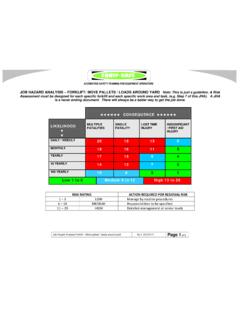
6 If your employees use these machines, additional training may be is the study of fitting the job task to the human body. Areas of interest are computer workstation design, back and lifting safety, and repetitive impact tasks. Injuries and illnesses from poor work designs include pain, carpal tunnel, strained muscles, back injuries, 2 Once the Hazard has been identified, you must implement an effective control to eliminate the Hazard , reduce the Hazard to an acceptable manner, or protect the 3 Evaluate the level of risk for each Hazard to help determine what type of control should be implemented to reduce exposure. Step 4 Select an appropriate solution to each Hazard . Always consider eliminating the Hazard (if possible) first. If elimination is not possible, consider reducing the Hazard to an acceptable level. If an acceptable level cannot be reached, select and provide appropriate personal protective equipment for the ControlsEngineering controls eliminate exposure to the Hazard .
7 They are: relatively permanent, can be costly, and can be controls are things that you do to fix the Isolate the employee from the Hazard . Control rooms Machine guarding Protective barriers and shields Guardrails Clearance distancesDesignIs there new (or existing) technology on the market for the product which, by it s design, protects the person using it?Process Change Can a non-hazardous process be substituted for a hazardous process?Dipping or BrushingSpray PaintingWork Area LayoutCan a hazardous work area layout be improved?Hot WorkChemicalStorageElectricalPipe StorageStackedBoxesTool RoomMainWorkAreaWork Area LayoutChemical storage area was moved away from hot work and electrical WorkChemicalStorageElectricalPipeStorage StackedBoxesTool RoomMainWorkAreaSubstitution Can a non-hazardous product be substituted for a hazardous product? Pesticides Solder Cleaning agents SolventsVentilationWill ventilation improve the air quality to an acceptable ( safe) level?
8 Administrative ControlsAdministrative controls reduce employee exposure to a Hazard . They do not eliminate the Hazard , but they provide an acceptable way to work around the you reduce the frequency of performing the hazardous task?RotationCan employees be rotated to reduce exposure time?Training Can employees be trained to recognize hazards and employ safe work practices?Protect the EmployeeIf the Hazard cannot be eliminated or reduced to an acceptable level, the employee must be protected from exposure. This protection requires that the employee wear and/or use appropriate personal protective the Employee Body wear Sleeves Gloves Protective footwear Hard hats Eye protection Face protection Respiratory protection Hearing protectionSummary Identify hazards in the workplace that could result in injury or illness. Evaluate the level of risk to help determine what controls to implement. Select an appropriate solution to control the Hazard and/or protect the employee.
9 Complete the Job Hazard Assessment form located at more information regarding hazards in the workplace, contact EHS at 275-3241, or visit our website at