Transcription of Electronic Cigarette Fires and Explosions
1 Fire AdministrationElectronic Cigarette Fires and ExplosionsOctober Fire AdministrationMission StatementWe provide national leadership to foster a solid foundation for our fi re and emergency services stakeholders in prevention, preparedness, and Cigarette Fires and Explosions 1 Electronic Cigarette Fires and Explosions Key Points More than million Americans are using Electronic cigarettes (e-cigs or e- cigarettes ), and this number is growing rapidly. Fires or Explosions caused by e- cigarettes are rare. Twenty-five separate incidents of explosion and fire involving an e- Cigarette were reported in the United States media be-tween 2009 and August 2014. Nine injuries and no deaths were associated with these 25 incidents. Two of the injuries were serious burns. Most of the incidents occurred while the battery was charging. The shape and construction of e- cigarettes can make them more likely than other products with lithium-ion batteries to be-have like flaming rockets when a battery fails.
2 Lithium-ion batteries must be charged in accordance with the manufacturer s instructions. Using power sources not approved by the manufacturer to recharge a lithium-ion battery can result in an explosion and is an E- Cigarette ?The e- Cigarette , also called a personal vaporizer (PV) or Electronic nicotine delivery system, is a battery-powered device that simulates tobacco smoking by producing a heated vapor, which resembles smoke. These devices have become very popular as an alternative to smoking, including among a growing number of individuals who have never been smokers but who enjoy the many fla-vors and/or the experience of using were first patented in 2003 and have been available for sale in the since 2007. E-cigs have been rapidly growing in popularity as the number and selec-tion of products expand at an extremely rapid rate. Zhu, et al.
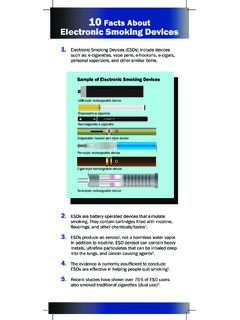
3 (2014) report that by January 2014, there were 466 brands of e- cigarettes and 7,764 unique flavors available for sale. They also state that the number of products has been increasing at a rate of brands and 242 new flavors per month. Richtel (2014) reported that annual e- Cigarette sales have reached billion dollars in the StatisticBrain1 reports that as of July 13, 2014, there were million e- Cigarette smokers in America. Indica-tors point to continued dynamic growth in the do they look like? How much do they cost?E- Cigarette designs vary greatly. Some resemble a tradi-tional Cigarette , cigar or pipe, while others resemble a flashlight or a small pack of cigarettes with a protrud-ing tube. Cellphone cases with built-in e- cigarettes are also available. Figure 1 shows three common commer-cially available for the devices range from $30 to over $300, with a corresponding range in battery size, liquid capacity and vapor output.
4 The most basic device is an e-ciga-rette, which looks like a traditional Cigarette . Moving up the line, devices designed to make larger quantities of vapor are called PVs or Mods. Users can purchase a wide variety of commercially available products or make their own. Homemade vaporizers and e-liquids are 1. Three of the many e-cig styles Cigarette Fires and Explosions 2 How do they work?The devices have a heating element (an atomizer or car-tomizer) to vaporize a liquid solution. Solutions (also called juice) usually contain a mixture of propylene glycol (PG), which increases flavor; vegetable glycerin (VG), which increases vapor; nicotine; and flavorings. Some juices provide flavored vapor without nicotine. Figure 2 shows the principal parts that are found in ev-ery e- Cigarette or devices have a light-emitting diode on the end to simulate the glow of a burning element/Atomizer heats the juice to make (tank) holds the liquid juice.
5 Many devices have a switch to activate the heating of an Electronic CigaretteFigure 2. Parts of an Electronic Cigarette . Automatic e- cigarettes activate the heating coil when a user takes a drag from the device. Manual e- cigarettes have a switch that the user depresses to energize the heating element to make the heated vapor. Most manufactured de-vices have built-in timeout features that prevent overheat-ing, and many have locking features to prevent the switch from being activated in a pocket or purse. A light-emitting diode to simulate a Cigarette s glow on the end is common among e- cigarettes , but not common in PVs or UsesE- cigarettes are sometimes used to smoke hash oil or honey oil, a cannabis product derived by separating the resins from marijuana. Separating hash oil from marijuana is a hazardous process that is often done il-legally in hotels and homes.
6 First responders should be aware of this practice and the hazards that it 2 For more information, see MenuItemID/691/ and SafetyThe health effects of the vapor and the danger of nico-tine overdose by ingestion or dermal contact with the juice are the subject of ongoing review by various agen-cies (Cressey, 2014; World Health Organization (WHO), 2014). The regulatory situation related to e- cigarettes varies by jurisdiction. At the time of publication of this report, the following facts were known: The Food and Drug Administration (FDA) re-cently proposed regulations for e- cigarettes . These proposed FDA regulations do not include consid-eration of the battery or electronics used in/with the devices the FDA is proposing to address only the health effects of inhaling the vapors (FDA, 2014; Ledford, 2014). WHO has recently proposed that member states adopt stringent controls on e- cigarettes (WHO, 2014).
7 The proposal is limited to the potential health effects of e- cigarettes and does not include language addressing the electronics. The Consumer Product Safety Commission has advised that e- cigarettes do not fall under its juris-diction. Gourdet, et al. (2014) report that 34 states laws address e- cigarettes either explicitly or as part of language applying to tobacco-derived or nico-tine-containing products. Laws explicitly address-ing e- cigarettes primarily focus on youth access (22 states) or smoke-free air (12 states). Underwriters Laboratories (UL) has developed stan-dards that relate to lithium-ion battery safety. These standards are applied to products containing batter-ies that undergo UL safety testing. No regulation, code or law applies to the safety of the electronics or batteries in e- cigarettes . While many consumer products are required to be tested by a nationally recognized test laboratory, such as UL, there are no requirements that e- cigarettes be subjected to product safety Cigarette Fires and Explosions 3Do You Mind If I Vape?
8 The world of Cigarette alternatives has a vocabulary of its term vape is a contracted form of the word vapor, which has its origins in the Latin vaporem meaning steam or exhala -tion. The word vape mirrors the path of word formation that the term smoking followed; for instance, there are nonvapers as well as vapers, and those who oppose the habit talk about antivaping is what the e- Cigarette does. Vapor is what the e- Cigarette produces. Vaping is what users do. No-nic vapers are vapers who vape using juice that does not contain common terms used within the vaping community include analog (slang for a traditional Cigarette ), juice, e-juice, e-liquid, tanks, atomizers, cartomizers, clearomizers, drippers, vape pens, twists, Mods, subohm coils, mechanical Mod, PG, VG, and did we look at e- cigarettes ?A number of recent Fires have been attributed to e-cig-arettes, causing some concern within the fire service community.
9 In response, a review of incidents involv-ing e- cigarettes was National Fire Incident Reporting System (NFIRS) does not collect information that is specific enough to provide accurate analysis of the frequency or impact of e- Cigarette Fires . Lacking NFIRS data to use, media re-ports were selected as an available, albeit less reliable, information source. The results cited herein should be viewed in this light as qualitative information rather than as a quantitative we foundMedia reports of 25 separate incidents in the dating from 2009 to the present were found during an Internet search. This list is not thought to be all-inclusive since it is likely that there were incidents that were not report-ed to the fire department and/or reported in the media. The media reports were reviewed, and key information was extracted and summarized.
10 The information con-tained in many reports was brief and often inconsis-tent with other media reports covering the same inci-dent. The photographs or video segments included in some of the reports provided more useful information for this study than the body of the article. A summary spreadsheet of the reports was prepared and is included in Appendix 1 for reference. Twenty incidents occurred while the battery in the device was being charged. Two incidents occurred during use. In two incidents, it is not clear whether the e-ciga-rette was in use, idle or being charged. One incident occurred during transportation on a cargo aircraft. Ten injuries and zero deaths were reported by the Several burn injuries were reported. Two serious injuries occurred when devices exploded in us-ers BeingCharged!8%E-cig BeingUsed8%Not Reported4%Storage orTransport20122 Status of E- Cigarette at Time of Fire3 Press in the United Kingdom has reported one death in an August 2014 incident where an e- Cigarette that was being charged in a nonmanufac-turer-approved device exploded and ignited nearby oxygen Cigarette Fires and Explosions 4 Media reports generally characterize these incidents as Explosions .