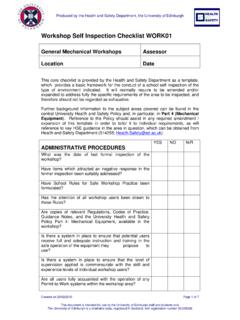
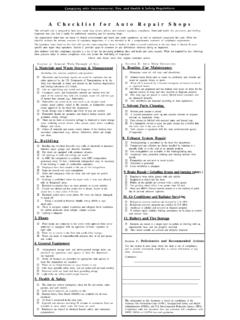
Transcription of CONDUCTING FARM SAFETY INSPECTIONS
1 CONDUCTING farm SAFETY INSPECTIONS David W. Smith, Extension SAFETY Program Why conduct a SAFETY inspection ? The most important responsibility of any farm owner or manager is to ensure the SAFETY and health of his or her employees and family members. Not only is it the right thing to do, but a safe farm protects the farm owner or manager by limiting the likelihood of costly accidents. Safe farms protect co-workers, children, other family members, and animals from accidental injuries that can destroy a livelihood and devastate a family. Most farm accidents are completely preventable. The smart farm owner or manager takes a proactive approach to farm SAFETY by CONDUCTING regularly scheduled and thorough INSPECTIONS of the entire farmstead.
2 What should be inspected? Farming is an inherently dangerous occupation primarily because of the number and variety of hazards that exist. Tractor-related accidents account for over half of farm fatalities. Other dangers include farm machinery, equipment, grain handling facilities, animals, chemicals, and environmental factors. Young children, family members, and farm visitors are injured and killed each year from poisoning, drowning, electrocution, and falling from farm structures and equipment. Consequently, it is essential that farm owners and managers assess the entire farm for hazards. At a minimum, the following facilities should be inspected: Barns and buildings Animal facilities Grain storage and handling facilities Workshops Chemical storage and handling facilities farm machinery Fuel storage and handling facilities General farmstead Who should do the inspection ?
3 The most obvious choice to conduct the inspection is the farm owner or manager, because they are most familiar with the operation. However, one disadvantage is the tendency to overlook or ignore problems that have become an acceptable risk over the years. A farm worker or family member may offer a more unbiased assessment. SAFETY professionals or inspectors with experience in detecting visible and invisible hazards may provide the most comprehensive assessment. How long will an inspection take? The length of time required to conduct an inspection will vary with the size and variation of farming facilities.
4 A small farm SAFETY inspection may only require 30 minutes to an hour. Large farms with several operations may require several days. When should the inspection take place? General farmstead INSPECTIONS , as well as INSPECTIONS of barns, buildings, and animal facilities, may be conducted at any time. inspection of farm machinery, grain handling, chemical, and fuel facilities should be conducted before the planting and harvesting seasons. It s important to establish a regular SAFETY inspection schedule. farm workers and family members will likely come to respect your commitment to maintaining a safe workplace and buy in to SAFETY -first attitude.
5 What should I do with inspection results? The reason for CONDUCTING a farm SAFETY inspection is to identify and remove hazards. Failure to remediate obvious problems can cost lives and property, and result in low-employee moral. The following checklist provides guidance on CONDUCTING farm INSPECTIONS but does not necessarily cover all potential hazards encountered on a farm . PART A: BARNS AND BUILDINGS Yes No Is a first aid kit available and placed in a prominent location? Are emergency phone numbers (fire station, policy station, EMS) listed and posted in a prominent location?
6 Are smoke detectors installed in appropriate locations and operating properly? Is the building free of unnecessary accumulations of trash, litter, junk, and other things that could start or fuel a fire? Is the building free from any highly flammable liquid such as gasoline? Are stairs and permanent ladders in good condition? Do stairs have handrails? Are stairs clear of objects and slippery substances? Are passageways clear of tools, buckets, or slippery substances. that could cause falls? Are protrusions such as nails removed from walls or railings to prevent contact?
7 Is the building properly lighted, especially in common work areas? Does electrical wiring appear to be in good condition? Can the main electrical power source be locked out if necessary? Are portable equipment power cords in good condition? Are materials and supplies stored and secured so as to not present a falling object hazard? Is power equipment properly shielded? Are shields in place during equipment operation? Are head-bumpers such as low ceilings, beams, low doors, and hanging objects marked with warnings? Are doors and gates to hazardous areas (silos, manure storage, chemical storage, animal quarters, etc.)
8 Kept closed and secured to keep out children and visitors? Are the correct size and type of fire extinguishers mounted at building entrances and exits? Are No Smoking signs posted? Where smoking is permitted, are plenty of ashtrays or safe receptacles available? Are toxic products locked up out of reach of children? PART B: ANIMAL FACILITIES Yes No Are pens, gates, chutes, and lot fences in good condition? Are children forbidden to play in or around barns, pens, and feedlots? Are feeding, grinding, and materials handling equipment properly shielded and all shields in place when used?
9 Are loading chutes on augers, elevators, and conveyors covered with grating? Are animal medicines kept in a secure area stored in the original containers? Are electrical stock water heaters grounded? Are all heat lamps for farrowing and brooding well secured and placed at least two feet from combustible materials? Are animal working pens free from sharp projections such as nails and metal objects that might endanger animals or workers? Are head gates and animal confinement equipment in good working condition? Are walking surfaces in work areas and passageways kept clear of manure, mud, and spilled grain?
10 Are all electrical outlets in animal handling area properly covered, protected from moisture, and equipped with ground fault circuit interrupters (GFCIs)? Are there at least two exits from each area used for working livestock? Have milking parlor steps and walkways been roughened to prevent slips and falls? Are children kept away from stock watering tanks and manure pits? Are ventilation fans and vents in confinement housing in good working condition? Is newly stored hay monitored for the possibility of overheating? Are barn chemicals, fly sprays, disinfectants, or medications kept in their original containers and stored out of the reach of children?