Example: dental hygienist
Constellations - Science A-Z
summer, people on Earth face one direction in space. On a winter night, they face the other As Earth orbits the Sun, the dipper direction. So, they see different constellations. From Earth, all the stars seem to surround Earth like a big ball. But some of the stars are closer to Earth, while others are much farther away.
Tags:
Information
Domain:
Source:
Link to this page:
Documents from same domain
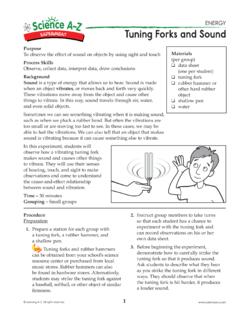
ENERGY Tuning Forks and Sound - Science A-Z
www.sciencea-z.comTuning Forks and Sound Purpose To observe the effect of sound on objects by using sight and touch Process Skills Observe, collect data, interpret data, draw conclusions Background Sound is a type of energy that allows us to hear. Sound is made when an object vibrates, or moves back and forth very quickly.
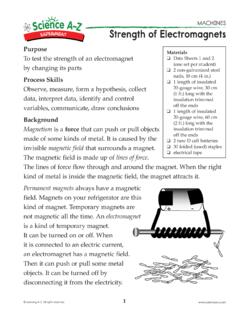
MACHINES Strength of Electromagnets
www.sciencea-z.comdifferent electromagnets can pick up. You will change two variables to make different electromagnets: the number of wire coils around the nail (10 or 20) and the number of D cell batteries (1 or 2). With your group, discuss what you think will happen. For each variable, predict which electromagnet will pick up more staples and why.
Related documents
Physical Setting/ Earth Science - NYSED
www.nysed.govthe discovery process. To that end, Standards 1, 2, 6, and 7 incorporate in the Physical Setting/Earth Science Core Curriculum a student-centered, problem-solving approach to Earth Science. The following is a sample of Earth Science process skills.

Middle School Science Study Companion
www.ets.orgScience and Engineering, (II) Physical Science, (III) Life Science, and (IV) Earth and Space Science. The assessment is designed and developed through work with practicing middle school science teachers, ... reflect the Disciplinary Core Ideas (DCIs) and Science and Engineering Practices (SEPs) established by the ...
Origin and Evolution of Earth - National Academies Press
www.nap.edutions between Earth’s core, magnetic field, mantle, and surface and to investigate why Earth differs from other planets, or how it may change in the future. 5. Why does Earth have plate tectonics and continents? A major focus of Earth science has been on deciphering the nature of the continents—the features
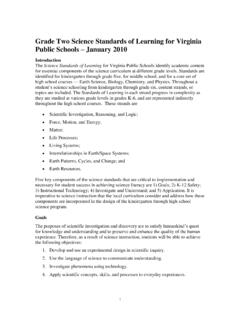
Grade Two Science Standards of Learning for Virginia ...
www.doe.virginia.govThe Science Standards of Learning for Virginia Public Schools identify academic content for essential components of the science curriculum at different grade levels. Standards are identified for kindergarten through grade five, for middle school, and for a core set of high school courses — Earth Science, Biology, Chemistry, and Physics.

Kindergarten through Grade 12 - Government of New Jersey
www.nj.govThe New Jersey Student Learning Standards for Science (NJSLS-S) describe the expectations for what students should know and be able to do as well as promote three-dimensional science instruction across the three science domains (i.e., physic al sciences, life science, Earth and space sciences). From the earliest grades, the expectation is
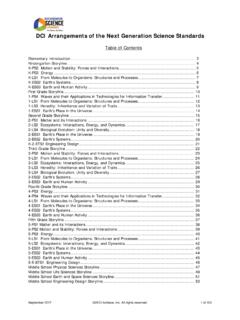
DCI Arrangements of the Next Generation Science Standards
www.nextgenscience.org*The performance expectations marked with an asterisk integrate traditional science content with engineering through a Practice or Disciplinary Core Idea. The section entitled “Disciplinary Core Ideas” is reproduced verbatim from A Framework for K-12 Science Education: Practices, Cross-Cutting Concepts, and Core Ideas.

GRADE 3 SCIENCE - Virginia Department of Education
www.doe.virginia.govScience Directions Read each question and choose the best answer. Then fill in the circle on your answer document for the answer you have chosen. SAMPLE When Earth is seen from outer space, it looks mainly blue. This is because most of Earth is covered with — A ice B mountains C oceans D deserts
english Language arts Literacy in History/social studies ...
www.corestandards.orgCommon Core State StandardS for engliSh language artS & literaCy in hiStory/SoCial StudieS, SCienCe, and teChniCal SubjeCtS appendix b | 3 How to Read This Document The materials that follow are divided into text complexity grade bands as defined by the Standards: K–1, 2–3, 4–5, 6–8, 9–10, and 11–CCR.