Transcription of Contents
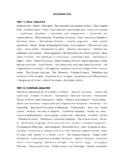
1 FUNCTIONAL ANALYSIS: NOTES AND are the notes prepared for the course MTH 405 tobe offered to graduate students at IIT Basic Inequalities12. Normed Linear Spaces: Examples33. Normed Linear Spaces: Elementary Properties54. Complete Normed Linear Spaces65. Various Notions of Basis96. Bounded Linear Transformations157. Three Basic Facts in Functional Analysis178. The Hahn-Banach Extension Theorem209. Dual Spaces2310. Weak Convergence and Eberlein s Theorem2511. Weak* Convergence and Banach s Theorem2812. Spectral Theorem for Compact InequalitiesExercise :(AM-GM Inequality) Consider the setAn={x= (x1, ,xn) Rn:x1+ +xn=n, xi 0 everyi},and the functiong:Rn R+given byg(x1, ,xn) =x1 :(1)Anis a compact subset ofRn,andgis a continuous function.(2) Letz= (z1, ,zn) Rnbe such that maxx Ang(x) =g(z).Thenzi= 1 for alli.(Hint. Letzp= minziandzq= maxzifor some 1 p,q (y1, ,yn) Anbyyp= (zp+zq)/2 =yqandyi=zifori6=p, < zqtheng(y)> g(z).)
2 (3) Letx :=1n ni=1xiandy:= (x1/ , ,xn/ ) (y) that ( ni=1xi)1/n 1n ni= :(Characterization of differentiable convex functions) Letf:[a,b] Rbe a differentiable function. Fora < x < y < b,verify:12 FUNCTIONAL ANALYSIS: NOTES AND PROBLEMS(1) Iffis convex thenf is monotonically >0 be such thatx+h < (x+h) f(x)h f(y) f(x)y x f(y) f(y h)h.(2) Iff is monotonically increasing thenfis (1 t)x+ty. Then there existsc1 (x,z) andc2 (z,y) such thatf(z) =f(x) +f (c1)(z x), f(y) =f(z) +f (c2)(y z).Exercise :(Characterization of twice differentiable convex functions)Letf: [a,b] Rbe a twice differentiable function. Show thatfis convex(resp. strictly convex) if and only iff 0 ( >0). part follows from the last exercise. For sufficiency part,use Taylor s mean value :The exponential is strictly :Leta1,a2be positive numbers and letp1,p2>0 be suchthatp1+p2= thatap11ap22 p1a1+ holds iffa1= logarithm log1xis strictly :(Young s Inequality) Letp,q >1 be conjugate exponents(that is, 1/p+ 1/q= 1).
3 For positive numbersa,bprove thatab app+ holds iffap= ,a2=bqandp1= 1/p,p2= 1/qin the preceding :(Geometric Proof of Young s Inequality) Letp,q >1 beconjugate exponents (that is, 1/p+ 1/q= 1). Given positive real numbersa b,considerD1:={(x,y) R2: 0 x a,0 y xp 1}D2:={(x,y) R2: 0 y b,0 x yq 1}.Verify the following:(1) The intersection ofD1andD2is{(x,y) R2: 0 x a ,y=xp 1}( (p 1)(q 1) = 1,y=xp 1iffx=yq 1).(2) The rectangle{(x,y) R: 0 x a,0 y b}is contained inthe unionD1 thatab ap/p+ holds iffap= :Assume the H older s (resp. Minkowski s) inequality for finitesequences, and derive it for ANALYSIS: NOTES AND PROBLEMS3 Exercise :(H older s Inequality for measurable functions) Letp,q >1be conjugate exponents. Letfandgbe lebesgue measurable complex-valued functions. Thenfgis measurable such that f(x)g(x)dx ( |f(x)|pdx)1/p( |g(x)|qdx)1 f p:=( |f(x)|pdx)1/p, f=f/ f Young s Inequality,| f(x)|| g(x)| | f(x)|p/p+| g(x)| integrate both :Prove Minkowski s Inequality for measurable Linear Spaces: ExamplesThroughout these notes, the fieldKwill stand either :For 1 p < ,forx= (x1, ,xn) Kn,consider x p:= n j=1|xj|p 1 that (Kn, p) is a normed linear s :What goes wrong in the last exercise if 0< p <1 ?
4 1/2 then calculate thep-norms of (1,1),(1,0) and (2,1).Exercise :How does a unit discDp:={(x,y) R2:|x|p+|y|p<1}in(R2, p) look like ? WhetherD makes sense ? invariant under reflections alongXandYaxes: (x,y) Dpiff ( x, y) Dpfor , { 1}.Now plotxp+yp= 1 forx,y :For 1 p < ,letlpstand forlp:={(an) : n=1|an|p< }.Show thatlpis a normed linear space with norm (an) p:= ( n=1|an|p)1 :For a non-empty subsetXofR(endowed with the subspacetopology), letb(X) denote the vector space of bounded functionsf:X K,andC(X) denote the vector space of continuous functionsf:X f := supx X|f(x)|forf C(X).Verify:(1) defines a norm onb(X).(2) defines a norm onCb(X) :=b(X) C(X).4 FUNCTIONAL ANALYSIS: NOTES AND PROBLEMSE xercise :Discuss the last exercise in caseXequals(1){1, ,n}.What isC({1, ,n}) ?(2) the setNof positive integers. In this case,b(N) =Cb(N).This iscommonly denoted asl .Exercise :LetC(n)(0,1) consist of functionsf(t) on (0,1) havingncontinuous and bounded derivatives.
5 Verify that f := sup{n k=0|f(k)(t)|: 0< t <1}defines a norm onC(n)(0,1).We say that ( lebesgue ) measurable functionsfis equivalent tog(forshort,f g) iffandgagree outside a set of ( lebesgue ) measure 0. Let [f]denote the equivalence class containingf,and let [f] p:=( |f(x)|pdx)1 :Verify the following:(1) is an equivalence relation.(2) If two measurable functionsf,gare equivalent then [f] p= [g] simplicity, we denote the equivalence class [f] :For a measurable setX, letLp(X) denote the set of all(equivalence classes of) measurable functionsffor which f p< .ShowthatLp(X) is a normed linear space with norm f complex-valued functionfis said to be -essentially boundedif m, is finite, where m, inf{M R+:| (z)| Moutside set of measure 0}.Exercise :Iff gthen f may be not be equal to g . Showthat f m, = g m, .Exercise :For a measurable setX, letL (X) denote the set of all(equivalence classes of) measurable functionsffor which f m, <.
6 Show thatL (X) is a normed linear space with norm f m, .Exercise :Lett,u,v,wbe generators R3,define x := inf{|a|+|b|+|c|+|d|:a,b,c,d Rsuch thatx=at+bu+bcv+dw}.Show that (R3, ) is a normed linear x = 0 then there exists a sequence|an|+|bn|+|cn|+|dn| 0such thatx=ant+bnu+cnv+ see x1+x2 x1 + x2 ,note{|a|+|b|+|c|+|d|:x1+x2=at+bu+cv+dw} {|a1+a2|+|b1+b2|+|c1+c2|+|d1+d2|:xi=ait+ biu+civ+diw}.FUNCTIONAL ANALYSIS: NOTES AND Linear Spaces: Elementary PropertiesExercise :(The norm determined by the unit ball)) Let (X, ) be anormed linear space. LetB(x0,R) :={x X: x x0 < R}be the ballcentered atx0and of that the norm is determined completelybyD(0,R): x = inf{R >0 :x D(0,R)}. D(0,R) then x < x is at most the entity onRHS. To see the reverse inequality, argue by say that two norms and on a normed linear spaceXareequivalentif the identity mappingIfrom (X, ) onto (X, ) is a ho-moemorphism (that is,Iis continuous with continuous inverse).
7 Remark :A subset ofXis open with respect to topology if andonly if it is open with respect to :Prove that two norms and on a normed linearspaceXare equivalent if and only if there exist positive scalarsC1andC2such thatC1 x x C2 x for allx :(Geometric interpretation of equivalence of norms) Showthat two norms and on a normed linear spaceX(with ballsB(x0,r) andB (x0,R)) are equivalent if and onlyB (0,1) B(0,r) andB(0,1) B (0,R) for some positive :Show that the equivalence of norms is an equivalence re-lation. Conclude that all norms ponKnare equivalent by verifying x x p np x ..Exercise :(All norms onKnare equivalent) Let be an arbitrarynorm :(1) Lete1, ,endenote the standard basis x (n i=1 ei ) x .(2) The functionf: (Kn, ) Rgiven byf(x) = x is continuous.(3) There existsa Knsuch that a = 1 such that x a >0for everyx Knwhenever x = 1.
8 (4) The norm is equivalent to .Exercise :(Inequivalent norms onK[x]) LetK[x] denote the vectorspace of polynomials (x) K[x] be given byp(x) = kn= :={cn} n=0,define p c:= kn=0|cn||an|.Verify:(1) cdefines a norm onK[x].(2) Letcn= 1/nanddn= cand dare not ANALYSIS: NOTES AND PROBLEMSE xercise :For 1 p < r ,verify the following:(1) x p x rfor every finite or infinite sequencex.(2) There does not existK >0 such that x p K x rfor everyinfinite thatlr( the first, lety=:x/ x pwhich has norm equal to that1 = y pp y rr,and hence y r the second part, find a sequencexsuch that x r< but x p= (Try:xk= 1/kq).Exercise :Let 1 p < r .For measurable functionfon [0,1],let f p:= [0,1]|f(x)|pdm,wheredmdenotes the normalized Lebesguemeasure. Verify:(1) f p f r.(2) There does not existK >0 such that f r K f pfor everymeasurable functionfon [0,1].Conclude thatLr[0,1](Lp[0,1].))
9 >1 such thatp/r+ 1/q= apply H older sinequality tof(x) =|x|pandg(x) = :Let 1 p .Show thatlpis separable iffp < . {an}denote a countable dense subset {an1e1+ +ankek:nk N, k 1}is dense inlpifp < .Ifp= then any two distinct points in theuncountable set{x:xn= 0 or 1}are at distance :Show that a proper subspace of a normed linear space hasempty a proper subspace has non-empty interior then it contains a Normed Linear SpacesA sequence{xn}in a normed linear spaceXisCauchyif xn xm 0asn,m .We say that{xn}is convergent inXif there existsx Xsuch that xn x 0 asn .Exercise :If{xn}in a normed linear spaceXthen show that thereexists a subsequence{xnk}of{xn}such that xnk xnl 2 kfor alll further that{xn}is convergent iff{xnk}is normed linear spaceXis said to becompleteif every Cauchy sequence isconvergent inX. Complete normed linear spaces are also known ANALYSIS: NOTES AND PROBLEMS7 Remark :LetXbe a normed linear spaceXwith norm.
10 ThenXis complete iff the metric spaceXwith metricd(x,y) := x y is :Verify the following:(1) A Banach space is closed.(2) A closed subspace of a Banach space is :IfEis a subset of a Banach spaceXthen the closure of thelinear span linspanEofEis also a Banach :LetXbe a normed linear space with two equivalent norms and .Show that (X, ) is complete iff (X, ) is :Let be an arbitrary norm that the normedlinear space (Kn, ) is view Exercise , we need to check that (Kn, ) is us see an example of incomplete normed linear :Consider the vector spaceK[x] of polynomialsp(x) inxwiththe norm p := supx [0,1]|p(x)|.Letfk(x) = kn=0(x/2)nbe a sequenceof polynomials inK[x].Verify:(1){fk}is Cauchy.(2) There is no polynomialg(x) such that fk g 0 ask . see (2): uniform convergence implies point-wise series nn=0xnin a normed linear spaceXis said to beconvergentifthere existsx Xsuch that kn=0xn x 0 ask.