Transcription of CONTRAINDICATIONS--------------------------
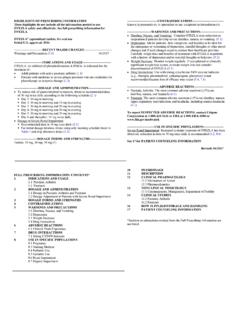
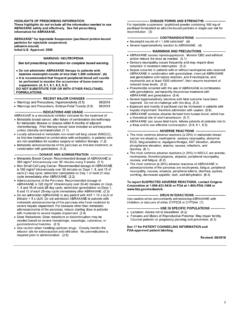
1 HIGHLIGHTS OF PRESCRIBING INFORMATIONT hese highlights do not include all the information needed to use vidaza safely and effectively. See full prescribing information for vidaza . vidaza (azacitidine for injection), for subcutaneous or intravenous useInitial Approval: 2004---------------------------RECENT MAJOR CHANGES---------------------------Dosage and Administration ( )7/2018----------------------------INDIC ATIONS AND USAGE--------------------------- vidaza is a nucleoside metabolic inhibitor indicated for the treatment of patients with the following FAB myelodysplastic syndrome (MDS) subtypes: Refractory anemia (RA) or refractory anemia with ringed sideroblasts (RARS) (if accompanied by neutropenia or thrombocytopenia or requiring transfusions), refractory anemia with excess blasts (RAEB), refractory anemia with excess blasts in transformation (RAEB-T), and chronic myelomonocytic leukemia (CMMoL).
2 (1)----------------------DOSAGE AND ADMINISTRATION----------------------- The recommended starting dose for the first treatment cycle, for all patients regardless of baseline hematology values, is vidaza 75 mg/m2daily for 7 days to be administered by subcutaneous injection or intravenous infusion. Premedicate for nausea and vomiting. ( ) Repeat cycles every 4weeks ( ). After 2 cycles, may increase dose to 100 mg/m2if no beneficial effect is seen and no toxicity other than nausea and vomiting has occurred ( ). Patients should be treated for a minimum of 4 to 6 cycles. Complete or partial response may require additionaltreatment cycles ( ). Continue treatment as long as the patient continues to benefit ( ). Monitor patients for hematologic response and for renal toxicity; delay or reduce dosage as appropriate ( , , ).
3 ---------------------DOSAGE FORMS AND STRENGTHS---------------------- Lyophilized powder in 100 mg single-dose vials (3). -------------------------------CONTRAIND ICATIONS------------------------------ Advanced Malignant Hepatic Tumors ( ). Hypersensitivity to Azacitidine or Mannitol ( ). -----------------------WARNINGS AND PRECAUTIONS------------------------ Anemia, Neutropenia and Thrombocytopenia: Monitor complete blood counts (CBC) frequently ( ). Hepatotoxicity: Patients with severe preexisting hepatic impairment are at higher risk for toxicity ( ). Renal Toxicity: Monitor patients with renal impairment for toxicity since azacitidine and its metabolites are primarily excreted by the kidneys ( ). Tumor Lysis Syndrome: VIDAZAmay cause fatal or serious tumor lysis syndrome, including in patients with MDS.
4 Assess baseline risk and monitor and treat as appropriate ( ). Embryo-Fetal Risk: vidaza can cause fetal harm. Advise females with reproductive potential of the potential risk to a fetus and to avoid pregnancy ( ). ------------------------------ADVERSE REACTIONS------------------------------- Most common adverse reactions (>30%) by subcutaneousroute are: nausea, anemia, thrombocytopenia, vomiting, pyrexia, leukopenia, diarrhea, injection site erythema, constipation, neutropenia and ecchymosis. Most common adverse reactions by intravenousroute also included petechiae, rigors, weakness and hypokalemia ( ). To report SUSPECTED ADVERSE REACTIONS, contact Celgene Corporation at 1-888-423-5436 or FDA at 1-800-FDA-1088 or IN SPECIFIC POPULATIONS------------------------ Lactation: Discontinue nursing taking into considerationthe importance of drug to mother ( ).
5 See 17 for PATIENT COUNSELING : 7/2018 FULL PRESCRIBING INFORMATION: CONTENTS*1 INDICATIONS AND Syndromes (MDS) 2 DOSAGE AND Treatment Cycle Treatment Cycles Adjustment Based on Hematology Laboratory Adjustment Based on Serum Electrolytes and Renal in Geriatric of vidaza for Subcutaneous Administration for Intravenous Administration 3 DOSAGE FORMS AND STRENGTHS4 Malignant Hepatic Tumors to Azacitidine or Mannitol5 WARNINGS AND , Neutropenia and Thrombocytopenia in Patients with Severe Pre-existing Hepatic Toxicity Lysis Risk6 ADVERSE Reactions in Clinical Trials Experience8 USE IN SPECIFIC and Males of Reproductive Use Use 10 OVERDOSAGE11 DESCRIPTION12 CLINICAL of Action 13 NONCLINICAL Carcinogenesis, Mutagenesis.
6 Impairment of Fertility 14 CLINICAL STUDIES15 REFERENCES16 HOW SUPPLIED/STORAGE AND HANDLING17 PATIENT COUNSELING INFORMATION*Sections or subsections omitted from the full prescribing information are not PRESCRIBING INFORMATION1 INDICATIONS AND Myelodysplastic Syndromes (MDS) vidaza is indicated for treatment of patients with the following French-American-British (FAB) myelodysplastic syndrome subtypes: refractory anemia (RA) or refractory anemia with ringed sideroblasts (if accompanied by neutropenia or thrombocytopenia or requiringtransfusions), refractory anemia with excess blasts (RAEB), refractory anemia with excess blastsin transformation (RAEB-T), and chronic myelomonocytic leukemia (CMMoL). 2 DOSAGE AND First Treatment CycleThe recommended startingdose for the first treatment cycle, for all patients regardless of baseline hematology laboratory values, is 75 mg/m2subcutaneously or intravenously, daily for 7 days.
7 Premedicate patients for nausea and complete blood counts, liver chemistries and serum creatinine prior to the first dose. Subsequent Treatment CyclesRepeat cycles every 4 weeks. The dose may be increased to 100 mg/m2if no beneficial effect is seen after 2 treatment cycles and if no toxicity other than nausea and vomiting has occurred. It is recommended that patients be treated for a minimum of 4 to 6 cycles. However, complete or partial response may require additional treatment cycles. Treatment may be continued as long as the patient continues to patients for hematologic response and renal toxicities [see Warnings and Precautions ( )], and delay or reduce dosage if necessary as described Dosage Adjustment Based on Hematology Laboratory Values For patients with baseline (start of treatment) WBC greater than or equal to x109/L, ANC greater than or equal to x109/L, and platelets greater than or equal to x109/L, adjust the dose as follows, based on nadir counts for any given cycle.
8 Nadir Counts% Dose in the Next CourseANC (x109/L)Less than than (x109/L)Less than 2525-50 Greater than 5050%67%100% For patients whose baseline counts are WBC less than x109/L, ANCless x109/L, orplatelets less x109/L, base dose adjustments on nadir counts and bone marrow biopsy cellularity at the time of the nadir as noted below, unless there is clear improvement in differentiation (percentage of mature granulocytes is higher and ANC is higher than at onset of that course) at the time of the next cycle, in which case continue the current or Platelet Nadir% decrease in countsfrom baselineBone MarrowBiopsy Cellularity at Time of Nadir(%)30-6015-30 Less than1550 - 75 Greater than 75% Dose in the Next Course1005033755033If a nadir as defined in the table above has occurred, give the next course 28 days after the start of the preceding course, provided that both the WBC and the platelet counts are greater than 25% above the nadirand rising.
9 If a greaterthan 25% increase above the nadir is not seen by day 28, reassess counts every 7 days. If a 25% increase is not seen by day 42, reduce the scheduled dose by 50%. Dosage Adjustment Based on Serum Electrolytes and Renal Toxicity If unexplained reductions in serum bicarbonate levels to less than 20 mEq/L occur, reduce the dosage by 50% for the next course. Similarly, if unexplained elevations of BUN or serum creatinine occur, delay the next cycle until values return to normal or baseline and reduce the dose by 50% for the next course [see Warnings and Precautions ( )]. Use in Geriatric PatientsAzacitidine and its metabolites are known to be substantially excreted by the kidney, and the risk of toxic reactions to this drug may be greater in patients with impaired renal function.
10 Because elderly patients are more likely to have decreased renal function, select the dose carefully and monitor renal function [see Warnings and Precautions ( )and Use in Specific Populations ( )]. Preparation of vidaza vidaza is a cytotoxic drug. Follow applicable special handling and disposal procedures. 1 The vidaza vial is single-doseand does not contain any preservatives. Discard unused portions of each vial properly[see How Supplied/Storage and Handling (16)]. Do not save any unused portions for later administration. Instructions for Subcutaneous Administration Reconstitute vidaza aseptically with 4 mL sterile water for injection. Inject the diluent slowly into the vial. Vigorously shake or roll the vial until a uniform suspension is achieved. The suspension will be cloudy.