Transcription of Convection, Conduction & Radiation
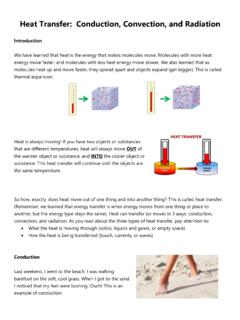
1 convection , Conduction & Radiation 1 convection , Conduction & Radiation There are three basic ways in which heat is transferred: convection , Conduction and Radiation . In gases and liquids, heat is usually transferred by convection , in which the motion of the gas or liquid itself carries heat from one place to another. Another way to transfer heat is by Conduction , which does not involve any motion of a substance, but rather is a transfer of energy within a substance (or between substances in contact). The third way to transfer energy is by Radiation , which involves absorbing or giving off electromagnetic waves. As long as there is a temperature difference in a system, heat will always move from higher to lower temperatures. A campfire is a perfect example of the different kinds of heat transfer . If you boil water in a kettle, the heat is transferred through convection from the fire to the pot.
2 heat is conducted along the handle of the pot, which is why you need to be careful picking the pot up, and why most pots don't have metal handles. In the water in the pot, convection currents are set up, helping to heat the water uniformly. While watching the campfire you feel the heat of the glowing fire via Radiation . convection heat transfer in fluids generally takes place via convection . convection currents are set up in the fluid because the hotter part of the fluid is not as dense as the cooler part, so there is an upward buoyant force on the hotter fluid, making it rise while the cooler, denser, fluid sinks. Birds and gliders make use of upward convection currents to rise, and we also rely on convection to remove ground-level pollution. Conduction If one end of a solid object, a piece of metal for example, is heated, the heat will pass through to the cooler end.
3 The faster molecules, which are hotter and have a greater kinetic energy collide with the slower moving cooler molecules that have a lower kinetic energy. The transfer of kinetic energy causes the cooler molecules to heat up (speed up), while in turn the faster molecules slow down and become cooler. Radiation Radiation , in this context means light (visible or not). heat is transferred, for example, from the sun to the earth through mostly empty space - such a transfer cannot occur via convection nor Conduction , which requires the movement of material from one place to another or the collisions of molecules within the material. Often the energy of heat can go into making light, such as that coming from a hot campfire. This light, being a wave, carries energy, so it can move from one place to another without requiring a medium.
4 When this light reaches you, part of the energy of the wave gets converted back into heat , which is why you feel warm sitting beside a campfire. Some of the light can be in the form of visible light that we can see, but a great deal of the light emitted is infrared light, whose longer wavelength is detectable only with special infrared detectors. The hotter the object is, the less infrared light is emitted, and the more visible light. For example, human beings, at a temperature of about 37 o Celsius, emit almost exclusively infrared light, which is why we don't see each other glowing in the dark. On other hand, the hot filament of a light bulb emits considerably more visible light. convection , Conduction , Radiation POTPOURRI Located around the room are various stations that demonstrate concepts related to thermal energy.
5 Conduct the investigation at each station and provide a description and explanation for your observations. Faster moving hot particles Slower moving cold particles Direction of heat flow convection , Conduction & Radiation 2 STATION #1: EVAPORATION Liquids undergo a phase change to a gas when sufficient heat energy is provided to help break intermolecular bonds between molecules. This allows them to free themselves from the attractions of other molecules to turn into a gas. Evaporation of a liquid is a similar process but occurs much slower and at lower temperatures than boiling. In each process the liquid absorbs heat . The stronger the intermolecular bonds the more heat energy is needed to break the bonds. Place a drop of water and a drop of alcohol on the back of your hand. Blow gently across the top of the liquids.
6 What differences do you feel when the two liquids evaporate? The two liquids are the same temperature. Why does your hand feel different for the two liquids? What supplied the energy to evaporate the liquids? Which liquid evaporated first? What are the differences in the attractive properties between molecules of the water and alcohol? Both the water and the alcohol are the same temperature (room temperature), however the intermolecular forces between alcohol molecules are not as strong as those for water molecules. This means that kinetic energy added to alcohol molecules will break with less heat than the intermolecular bonds in water. Your hot (high KE) skin molecules collide with and transfer KE to alcohol molecules, increasing their velocity breaking the bonds between molecules. Evaporation of the liquid alcohol to a gas carries KE away and your skin molecules ultimately lose KE, therefore your skin feels cool.
7 This is also true for when you sit in front of a fan on a hot summer day. The fan increases the rate of perspiration evaporating off your skin, carrying away KE leaving your skin with less KE. The fan does not produce cool air, it only feels like it. STATION #2: THE LOVE METER The pulse bulb (Love Meter) contains a colored alcohol similar to the alcohol you used in the previous station. Place one hand on one of the bulbs to move the liquid to the other side of the bulb. Rub your hands together to warm them up and try it again. Does the liquid flow from the warm end of the bulb or to the warm end of the bulb? Hold the pulse bulb in the center and place a couple of drops of alcohol on one end of the bulb. Blow across the top of the bulb which you placed the alcohol. Which way does the liquid flow this time?
8 Which end of the bulb is warmer? Explain how the heat of your hand can move the liquid to the other side of the bulb. (Hint: This is similar to what happened to the alcohol in the previous station.) Explain why the application of alcohol to one end of the pulse bulb can have the opposite effects of heat . Hot (high KE) skin molecules collide with and transfer KE to glass molecules; high KE glass molecules collide with and transfer KE to air molecules. High KE air molecules collide with the orange liquid molecules and the liquid evaporates. When a liquid evaporates there is a large increase in volume as it changes to a gas. As the volume increases the pressure inside the pulse bulb increases, forcing the orange liquid to the other side. Since evaporation is a cooling process, putting a drop of alcohol on the glass causes the glass molecules to lose KE which causes the air molecules to lose KE which causes the vapors of the orange liquid to condense.
9 As the gas condenses to a liquid on the cooler side, a decrease in pressure occurs. Since the opposite side of the pulse bulb in higher in temperature and higher in pressure, the orange liquid is pushed from the high pressure side to the cooler low pressure side of the pulse bulb. heat is not a substance, it is a property of a substance. When an object moves in response to a change in temperature, something must be pushing or pulling the object causing it to move. heat cannot move an object. convection , Conduction & Radiation 3 STATION #3: THERMAL CONDUCTIVITY Different substances are able to absorb heat at different rates and to different amounts. Materials that absorb heat rapidly are conductors. Materials which do not absorb heat energy are nonconductors, or insulators. The four pieces of material are all at room temperature.
10 Notice that they feel different when you place your hands on them. Place them in order in terms of their apparent temperature from "warmest" to "coldest". What direction is the heat flowing when you touch each material? Provide an explanation of why they feel different to the touch if they are the same temperature. All of the materials are at room temperature (about 20oC) while your skin is between about 35oC and 39oC. Each of the materials is absorbing your skin molecules KE through collisions. However, through collisions the materials transfer this extra KE away from your skin at different rates hence, the thermal conductivity of each tile is different. The aluminum feels the coolest to your brain because it is transferring the KE away most rapidly and has the highest thermal conductivity. The wood and the fur are poor thermal conductors, or better thermal insulators than the aluminum.