Transcription of How does basic refrigeration cycle work?
1 How does basic refrigeration cycle work? The basic refrigeration cycle for beginners If you are interested in learning how a refrigeration system works, it is helpful to understand from the Ph (Pressure Enthalpy) chart perspective. It makes our life much easier. This is how the refrigeration cycle diagram looks: Yeah, it seems complicated at first, but it will be easier to understand once I have explained the refrigeration cycle diagram section by section. It important to understand the basic refrigeration cycle , to comprehend what is going on within the air conditioner units, we cannot see it.
2 The refrigeration cycle tells us if there is air in the central air conditioner units, what to repair after troubleshooting the refrigeration system, if there is enough air conditioner freon, or if the ac filter is dirty. You could know the entire thing by knowing the pressure and temperature of the evaporator, condenser, and compressor. Once you have found the pressure and temperature, you plot in the Ph charts to determine what and where sub-cooled and superheat take place in the Ph charts. Here is how a Ph charts looks: The Ph chart graphically shows where the physical states of these five mechanical components is and what is happening to the refrigerant within these components.
3 However, first let s understand air conditioning theory, the basic principle, types of heat , how heat transfers and I will show you how the basic refrigeration cycle diagram works. Air conditioning theory There are two laws that are significant to understand the basic refrigeration cycle and air conditioning. Thermodynamics first law explains that energy cannot be neither created nor destroyed, but can be changed from one form to another. Thermodynamics second law can help us better understand how the basic refrigeration cycle works.
4 Once of these laws state that heat always flows from a material at a high temperature to a material at a low temperature. As I have mentioned in the residential air conditioners section, air conditioning (the refrigeration cycle ) is a process that simply removes heat from an area that is not wanted and transfers that heat to an area that makes no difference. The air conditioner itself does not create heat , it just transfers heat . For heat to transfer , there has to be a temperature and pressure difference. In the refrigeration process there are two sections which produce a pressure difference: a high-pressure, high temperature section (condenser) and a low-pressure, low temperature section (evaporator).
5 The refrigeration system removes heat from an area that is low-pressure, low temperature (evaporator) into an area of high-pressure, high temperature (condenser). For example, if cold refrigerant (40 F) flows through the evaporator and the air surrounding evaporator is 75 F, the cold 40 F will absorb the heat from the 75 F space. By absorbing the heat from the warm space, it also cools the space. It then transfers that heats to condenser (high side) through compressor. A hot refrigerant from the compressor flows to a cooler location the condenser medium (air surround condenser) for example, the refrigerant will give up the hot vapor heat it absorbs from the indoor evaporator and becomes cool again and turns back to liquid.
6 You will understand it better, once I have explained this from the ph diagram point of view. This is what the second thermodynamics law stated. It is more complicated, but I will describe it briefly. Air conditioning is a way to keep your home comfortable by controlling the temperature, air movement, cleanliness, humidity, or dehumidify for our comfort. To move heat from the evaporator to the condenser you need refrigerant, and other mechanical components, therefore we need to understand how heat transfers. So how does heat transfer occur in the basic refrigeration cycle ?
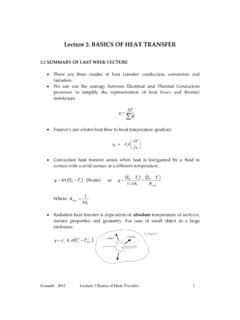
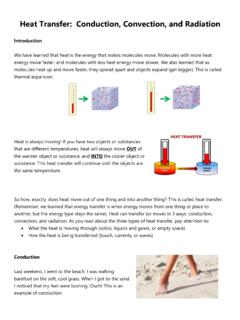
7 Maybe you are wondering how hot 75 F air transfers it heat to cool 40 F refrigerant. Well, there are three methods of heat transfer . They are conduction , convection , and radiation or any combination of the three methods. heat transfer is the movement of heat from solid, liquid or gas materials to other solid, liquid and gas materials. According to the second law of thermodynamics, heat always flows from a material at a high temperature to a material at a low temperature. For heat to transfer there has to be a temperature difference between the two materials.
8 heat transfer by conduction is when we heat a copper pipe to 100 F and grab that hot copper with our bare hand (I don t recommend that anyone do that, it s just for the example). That is molecule to molecule heat transfer . radiation is the transfer of heat in an invisible ray, for example, sun ray. We cannot see it, but we can feel the sun ray hits our skin. convection is the transfer of heat from one place to a different location by circulating it with a fan (force movement) or natural movement. Air conditioner refrigerant is a chemical substance that air conditioner units use; these refrigerants absorb heat from low-pressure, low temperature evaporator and condensing at a higher pressure, high temperature condenser.
9 These refrigerants could be R-22, R 410a, or R134a. It depends on what kind of refrigerant the air conditioner units are designed for. Refrigerant can change state from vapor (by absorbing heat ) to liquid (by condensing that heat ). basic refrigeration cycle principles: 1. As refrigerant in the latent state or as vapor refrigerant in the process of changed state to liquid, this is the phase where it absorbs or rejects large quantities of heat . The quantities of heat absorbed or rejected can be managed by controlling the pressure and temperature of the refrigerant.
10 2. The boiling point of closed-system liquid can be controlled by changing the vapor pressure above it. 3. Gauge pressure is used to determine the pressure inside the closed refrigeration cycle system. It s expressed in pounds per square inch gauge (psig). 4. heat flows from a material at a higher temperature to a material at low temperature. 5. heat energy is not created but converted and transferred. What are two forms of heat and where does it take place in basic refrigeration cycle ? Sensible heat when change in temperature can be measured by a thermometer or when you put your hand on an object you ll feel heat .