Transcription of Conversion Factors for Source Emission …
1 Conversion Factors FOR Source Emission MEASUREMENTS OF INCINERATOR FLUE GASES A. MARSHALLA G. CRAWFORD Joseph Coder Incinerators Elk Crove Village, Illinois ABSTRACT Since there are two basic units in which Source emis sion concentration of dustloading may be expressed, formulas are presented for their comparison. Furthermore, to standardize procedures and to elim inate some of the variables of dustloading tests, certain standards of correction have been agreed upon. Formulas are presented to facilitate these corrections. INTRODUCTION As more state and city agencies pass air pollution codes and as existing codes become more stringent, the need for incinerator dustloading values has become critical. Since there are two basic units of dustloading, the need for con version formulas is obvious. Furthermore, the initial results of dustloading test are meaningless without applying the appropriate correction; both a 50 percent excess air and a 12 percent CO2 cor rection standard are in widespread usage.
2 Formulas must be standardized for the application of these corrections. BASIC ASSUMPTIONS In any dustloading test some of the variables which must be taken into consideration are the type of refuse or fuel being consumed, atmospheric conditions, such as temperature and pressure, and the components of the flue gas. While the formulas presented in this paper take these 176 variables into account, certain assumptions and simplifi cations have been made to make their derivation possible. All formulas presented have been derived on the basis that the fuel or refuse being burned is of the general form: ex Hy Oz. However, the formulas are not dependent upon the specific values of the x, y, and z's. If the refuse being burned has a substantial quantity of elements other than carbon, hydrogen, and oxygen, as indicated above, it would be necessary to derive new formulas. Furthermore, all formulas have been derived on a dry basis; that is, all moisture content, whether resulting from oxidation of the refuse or ambient air of combustion has been neglected.
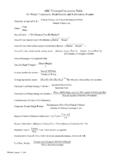
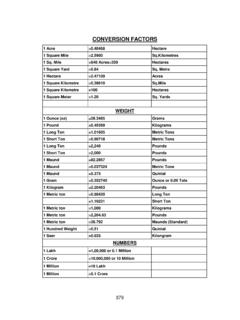
3 One further simplification has been made. Since the percentage of carbon monoxide (CO) is normally zero or very small in a proper incinerator operation, its effects on the Conversion and correction formulas have been neg lected. Conversion FORMULAS The dustloading is usually expressed in pounds of dust per 1,000 pounds of flue gas or grains of dust per standard cubic foot, where 7,000 grains is equal to one pound. Since the dustloading is first determined at sampling con ditions of temperature and pressure, the required correc tion to standard conditions of 68 F and inches Hg (ASME Standards) is t + 460 Dl = Do 68 + 460 P (1) where Dl = the dustloading in grains per standard cubic foot(gr/SCF), Do = the dustloading in grains per cubic foot (gr/CF), t = sampling temperature in degrees Fahren heit, P = atmospheric pressure in inches of Hg. To convert from gr/SCF to pounds of dust per thou sand pounds of flue gas (lbs dust/1,000 lbs flue gas) we have D _ (1544) z-D1 (2) where M = the molecular weight of the flue gas Dz = the dustloading in lbs dust/1,000 lbs flue gas.
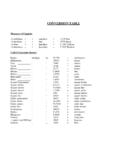
4 By combining formulas (1) and (2) we may proceed directly from gr/CF (Do) at sampling conditions to lbs dust/1,000 lbs flue gas (Dz). The required formula is _ [ (t + 460)J Dz -DO M xP (3) The inverse of the above formula required to convert from lbs dust/1,000 lbs flue gas (Dz) to gr/CF (Do) is [.320M xpJ DO = Dz (t + 460) (4) In many cases, including the T-6 Testing Method [1] the temperature of the flue gases, the molecular weight of the flue gases, and the barometric pressure are either not taken or are unknown to the person making the conver sions. In this case, formulas (3) and (4) are impossible to compute, so we offer the following alternate Conversion method which is reasonably accurate based on the assump tion of standard barometric pressure of in. Hg and an average molecular weight of at the listed tempera ture. For computing gr/CF at temperatures other than those listed below use formula (4), inserting the desired temperature along with the above values for molecular weight and pressure.]]
5 TABLE I Given Value In lbs dust/1 ,000 lbs flue gas lbs dust/1,000 lbs flue gas lbs dust/l,OOO lbs flue gas lbs dust/1,000 lbs flue gas Multiply By .574 .535 .533 .294 Resultant Value gr/ft3 @ 32 F gr/ft3 @ 68 F gr/ft3 @ 70 F gr/ft3 @ 500 F 177 A dustloading value presented in w/CF is meaningless if the temperature at which it was computed is not specified. Therefore, formula (3) cannot be used to convert gr/CF to lbs dust/1,000 lbs flue gas if the temperature is unknown. However, if the temperature is known and the molecular weight and barometric pressure are not, the formula may still be used with reasonable accuracy by substituting the assumed values above. All these Conversion formulas while presented without derivation merely represent a density Conversion based on the universal gas law with the appropriate numerical fac tors for the Conversion of units. CORRECTION FORMULAS Two standards of correction are now utilized by most air pollution agencies.
6 The first correction standard to be considered is the 50 percent excess air correction. The need for such a standard is obvious. When any fuel or refuse is oxidized, there is some minimum air require ment for combustion which may be determined stoichio metrically from the refuse composition. However, in most incinerator processes, far more air is supplied than is actually required. The percentage of excess air then is defined to be p = 100(lbs air supplied/lbs refuse _ 1) lbs air needed/lbs refuse where P = the percentage of excess air. (5 ) The greater the excess air, the more diluted the flue gases become, thus lowering the dustloading figure. Since the dustloading is a function of the excess air, a universal standard of procedure is to express the dustloading at 50 percent excess air. The accepted procedure for a 50 percent excess air cor rection is D = D [ lbs flue gas/lbs refuse (actual) J 6 c u lbs flue gas/lbs refuse (@ 50% excess air) () where Dc = the corrected dustloading, Du = the uncor rected dustloading.]
7 The units of the Dc and Du are arbitrary but must be the same for both. Th . lbs flue gas/lb refuse (actual) e ratIo "--,,----;;-f'- -__;:;'='= ;;__-!..-___;_,. lbs flue gas/lb refuse (@ 50% excess air) may be reduced to a function of the Orsat volume percen tages, giving a practical formula for the dustloading cor rection. (See [2] for derivation). - 02 - CO2 CO2 + 02 + (7) Care must be taken to use only decimal percentages of 02 and CO2 in formulas (7) and (8). Since the terms 02 and CO2 are usually very small, they may be neglected without introducing a per centage of error over percent. The resultant simplifica tion of (7) is C02 + 02 (8) A second standard of correction sometimes utilized is the 12 percent CO2 correction. Certain fuels, when burned at 50 percent excess air, give rise to a flue gas 12 percent by volume percentage. Most incinerator refuse, usually cellulose, does not approximate these fuels.
8 How ever, for historical reasons, the 12 percent CO2 correction has been retained. The correction of a dustloading figure on a 12 percent CO2 basis is very straightforward. D = D C u CO2 (9) Again, care should be taken to use a decimal percentage for CO2 T-6 TEST METHOD (see [1 J ) This test method is a measurement of the Source emis sion weight from a specified amount of refuse burned in the incinerator. The basic test procedure is the same as the ASME recommended method of testing (isokinetic sampling) except that it is not necessary to take an Orsat reading or measure the volume of gases sampled. Conver sion Factors are available to convert from lbs dust/100 lbs refuse to lbs dust/1,000 lbs flue gas corrected to 50 percent excess aIr. Fig. 1 shows the relation between the weight collected per 100 pounds of refuse burned, and the concentration of dust in the flue gas stream based on lbs of theore tical air per 10,000 Btu.]
9 The table below gives the ap propriate numerical factor for arriving at the dustloading. 178 a: -ct PERFORMANCE EVALUATION CURVE V! I. 2 ,.---, ,----c,--,----,.------, V! W U x w I. 0 t---t--------, :.e o o II') o t---t-- -+-, ---j-, t- a:: cr:: o u + --, '-' V! C) L>-V! m ..J o o o -"' V! t----c o m ..J LBS/IOO LBS REFUSE FIG. 1 RELA TlON BETWEEN DUST IN FLUE GAS PER 100 LB REFUSE (ABSCISSA) AND CORRECTED DUST LOADING OF FLUE GAS (ORDINATE) TOW = Type 0 Waste TtW = Type 1 waste T2W = Type 2 waste T3W = Type 3 waste TABLE II Test Result Pounds of dust per 100 pounds of refuse Multiply by .937 Resultant Dustloading Pounds of dust per 1000 pounds of flue gas corrected to 50% excess air Type Waste o 1 2 3 It should be realized that while the T-6 Test Method greatly simplifies the determination of a dustloading, the elimination of many variables may give rise to some errors. However, where extreme accuracy is not required, the T-6 Test Method is justified by its great simplicity.
10 SLIDE RULE A special slide rule has been developed by Joseph Goder Incinerators which greatly simplifies the use of the various formulas presented in this paper. The slide rule may be used to correct dustloading value to either a 50 percent excess air or 12 percent CO2 basis. For the purpose of correcting to 50 percent excess air, the slide rule utilizes the simplified correction formula (8). The slide rule may also be used for converting grains/ cubic foot to grains/standard cubic foot as well as for converting grains/cubic foot to Ibs dust/1,OOO lbs flue gas and vice-versa. In addition to these correction and Conversion ap plications the slide rule may be used for calculating the percentage of excess air in terms of the Orsat analysis of the flue gas. 179 ACKNOWLEDGMENT The authors wish to acknowledge the cooperation of the Incinerator Institute of America. Their help and advice has been invaluable in the development of the T-6 Testing Method and the final design of the gas formula slide REFERENCES (1] Incinerator Testing, Incinerator Institute of America, Bulletin T-6.)