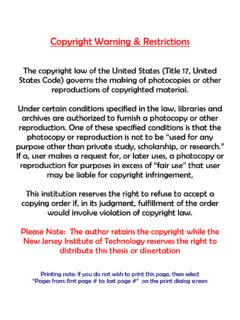
Transcription of Copyright Warning & Restrictions
1 Copyright Warning & Restrictions The Copyright law of the United States (Title 17, United States Code) governs the making of photocopies or other reproductions of copyrighted material. Under certain conditions specified in the law, libraries and archives are authorized to furnish a photocopy or other reproduction. One of these specified conditions is that the photocopy or reproduction is not to be used for any purpose other than private study, scholarship, or research.. If a, user makes a request for, or later uses, a photocopy or reproduction for purposes in excess of fair use that user may be liable for Copyright infringement, This institution reserves the right to refuse to accept a copying order if, in its judgment, fulfillment of the order would involve violation of Copyright law.
2 Please Note: The author retains the Copyright while the New Jersey Institute of Technology reserves the right to distribute this thesis or dissertation Printing note: If you do not wish to print this page, then select Pages from: first page # to: last page # on the print dialog screen The Van Houten library has removed some of the personal information and all signatures from the approval page and biographical sketches of theses and dissertations in order to protect the identity of NJIT graduates and faculty. ABSTRACT. Trouble Shooting in Plastic Injection Molding Machines by Zafar Kamal The purpose of this thesis is to find the solution of those problems which occur during plastic injection molding process.
3 Molding cycle problem analysis is an important field in plastic injection process. It is very necessary to catch the problems during operation. Therefore on the basis of research trouble shooting criteria is prepared. Good quality control is an essential feature for finding any sort of fault. Quality control is associated with each and every step of operation to maintain the required shape and surface finishing. Most of the molding problems are solved by varying the machine conditions and by changing the design of the mold. But some problems remain unchanged, therefore in such cases possible solution may be find out by means of examining the entire operation or by changing the variables.
4 Therefore on the basis of this research a trouble shooting program or a program solver is prepared, which helps to get the correct solution of the problems. TROUBLE SHOOTING IN PLASTIC INJECTION MOLDING. MACHINES. by Zafar Kamal A Thesis Submitted to the Faculty of New Jersey Institute of Technology in Partial Fulfillment of the Requirements for the Degree of Master of Science Department of Manufacturing Engineering January, 1993. APPROVAL PAGE. Trouble Shooting in Plastic injection Molding Machines Zafar Kamal cr:Sr,Sfeve Kotefski, Thesis Adviser Assistant Professor and Program Coordinator of Manufacturing Engineering Technology, NJIT.
5 Sodhi, Committee Member Associate Professor of Mechanical Engineering and Director of Manufacturing Engineering Programs, NJIT. E, Committee Member Associate Professor of Mechanical Engineering, NJIT. BIOGRAPHICAL SKETCH. Name: Zafar kamal Degree: Master of Science in Manufacturing Engineering Date: January, 1993. Undergraduate and Graduate Education: - Master of Science in Manufacturing Engineering New Jersey Institute of Technology, Newark, NJ, 1993. - Bachelor of Science in Mechanical Engineering University of Engineering and Technology, Karachi, 1986. Major: Manufacturing Engineering This thesis is dedicated to my parents v ACKNOWLEDGMENT.
6 I would like to thank my adviser Dr. Steve Kotefski for his guidance and advice in this research. I also thank Mr. Mohammed Nawaz without whose help completion of this work would have been difficult. I would like to thank my friend Asim Zubeiri for his kind help during this research. Specially, I am grateful to my cousin Aisha Nizam, who morally supported me to finish this degree. Finally, I would like to thank my family, for their help, understanding and patience during the years that I studied. vi TABLE OF CONTENTS. Chapter Page 1 PROCESSING OF PLASTIC 1. Introduction 1.
7 Extrusion 1. Injection Molding 2. Details of the Process 3. Clamping system 6. Molds 6. Different Features of Molds 7. Runners 8. Sprues 9. Venting 9. Mold Temperature Control 10. Heat Capacity of the Material 10. External Heating of Injection Cylinder 13. 2 MOLDING AND FINISHING 17. Molding Cycle 17. Mold Cooling 22. Part Ejection 24. Mold Release 25. Additives to the Plastics 26. Mold Shrinkage 27. Post Mold Shrinkage and Warping 29. Quality Control 30. vii 3 CLAMP SYSTEM 32. Introduction 32. Press Platen 32. Rating of the System 33. Efficiency of the Clamp 36.
8 Opening and Closing System for Mold 36. 4 SYSTEMS FOR INJECTION MOLDING MACHINE 38. Hydraulic System 38. Hydraulic Pumps 38. Operating Valves and Control 40. Hydraulic Motors and Cylinders 40. Hydraulic Fluids 41. Hydraulic Accessories 41. The Electrical System 41. Electrical Controls 42. Functional Controls 44. 5 INJECTION MOLDING TECHNIQUES 46. Blow Molding 46. Extrusion Blow Molding 47. Injection Blow Molding 49. Strech Blow Molding 52. Reaction Injection Molding 53. Liquid Injection Molding 57. Structural Foam Injection Molding 57. Sandwich Molding 60. Thermoforming 61.
9 Vacuum Forming 61. viii 6 FEED SYSTEM 65. Introduction 65. Runner 65. Runner Cross-Section Shape 66. Runner Size 70. Runner Layout 72. Single Impression Mold 72. Two Impressions Mold 74. Three Impressions Mold 74. Other Multi-lmpession Molds 77. 7 DESIGN OF THE GATES 78. Introduction 78. Location of the Gate 79. Balanced Gating 82. Types of Gates 83. Sprue Gate 83. Rectangular Edge Gate 84. Gate Size 87. Overlap Gate 88. Fan Gate 90. Tab Gate 91. Diaphram Gate 92. Ring Gate 94. Film Gate 95. Pin Gate 95. Subsurface Gate 98. ix 8 PLASTIC MOLDING MATERIALS 101. Introduction 101.
10 Types of Plastics 102. Definition for Plastics 105. Identification of Plastic Materials 106. 9 POLYETHYLENE AND POLYPROPYLENES 113. Low Density Polyethylenes 113. Injection Molding Polyethylene Lids 113. Molding Machines 114. Molding Conditions 116. Melt Temperature 116. Mold Temperature 116. Cycle Time 117. Injection Pressure and Injection Speed 117. Shot Size 117. Screw Speed 118. Materials 119. Polypropylenes 119. Physical Characteristics 123. Injection Molding Machines 123. Molding Thin Sections 126. Molding Thick Sections 126. Molding Techniques and Conditions Affecting Part 127.