Transcription of COSO Presentation - CAPLAW
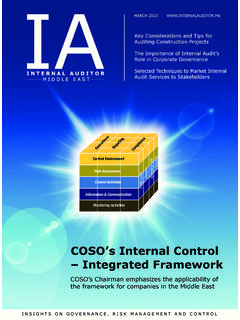
1 7/27/20111 Keys to Cost Effective Controls & Clean Audits: The COSO internal control integrated framework July 27, 2011 Presented by Kay SohlPart of the Beyond The Basics webinar series 2011 Community Action Program Legal Services, Use COSO frameworkto streamlineand improvecontrols and compliance Identify and address potential audit findings Reduceaudit time and costWebinar Goals:3 Topics: What is COSO Why does it matter to CAAs Documenting your system of controls Top control risks for CAAs Streamliningcontrols Next steps7/27/201124 COSO Basics: Committee of Sponsoring Organizations (COSO) Formed in 1985 to sponsor National Commission on Fraudulent Financial Reporting Sponsored jointly by: AAA, AICPA, FEI, IIA, and IMA5 COSO internal control Publications 1992 internal control integrated framework 2006 internal control for Financial Reporting 2009 Guidance for Monitoring internal control 2010 project to update 1992 framework 6 Auditors Use COSO framework to: Understand environment Identify and evaluate risks Understand controls& evaluate adequacy Design testsof controls Identify findings7/27/201137 CAAs Use COSO framework Develop cost effective approach to controls Identify & address risk Documentsystem of controls Reduceaudit cost Avoidaudit findings8 COSO internal control Framework9 framework : 5 Key Elements control Environment Risk Assessment control Activities Information & Communication Monitoring7/27/2011410 Apply COSO framework forInternal Controls to: Operations Financial Reporting Compliance11 Apply COSO framework to: Each program Management Fund raising All activities12 Bottom Line Reality.
2 CAA use of COSO framework can reduce audit costand risk of findings COSO framework can increase cost effectiveness of controls COSO framework can reduce risk of fraudand non-compliance7/27/2011513 COSO defines internal ControlA processeffected by an entity s board of directors, management & other personnel, designed to provide reasonable assurance regarding achievement of objectives Effectiveness & efficiency in operations Reliability of financial reporting Compliancewith applicable laws & regulations14 internal Controls designed to: Reduce the risk of improper actions Increase the likelihood that errorsor wrong acts will be detected Reduce the risk that error will go uncorrected15 Controls Designed to Prevent Misstatement: Financial statements do not fairly present financial condition Misappropriation: Theft or misuse of the organization s assets Non-Compliance:7/27/2011616 Reality No perfect controls Controls provide reasonable assurance, not absolute assurance Cost/benefit analysis essential in designing, implementing, & monitoring controls17 Core control Concepts internal control is not one event, but a series of actions and activitiesthat occur throughout an entity s operation an on an ongoing basis Integral part of each systemused to regulate & guide operations control environment is foundation for effective controls18 Comprehensive Controls Highest levels of management& governance Compliancewith law/regulation Programactivities Operational policies & procedures internal & external reporting7/27/2011719 COSO Framework1.
3 control environment2. Risk assessment3. control activities4. Information & effective communication5. Monitoring20 control Environment:Board oversight of controls Annual audit Audit committee /auditor communication CEO annual review Follow-up on audit/monitoring findings Review of monthly financial statements Awareness of most significant risks21 control Environment:CEO & Management CEO/Management awareness of high risk areas Adequacy of resources for fiscal and program management Monthly analysis of financial statements Authority/responsibility for compliance clearly assigned 7/27/2011822 Pre-Call SurveyWhen does your top management team discuss your control environment? Never 6% Monthly/ongoing 11% internal reports of problems 17% When auditors raise concerns 33% Part of annual goal setting 39%23 Risk Assessment:Risk Factors Materiality of exposure $$$ at risk Complexity of compliance requirements Experience/lack of experience with program Weak control environment/lack of management expertise24 Risk Assessment: More Risk Factors Financial pressure Failure to address previous findings Change in CFO7/27/2011925 control Activities:High Level Controls: Top level reviewof accomplishments Comparison of actual to planned, both $$$ & activities HR management to employ competent, high integrity staff Info processing controls26 control Activities: Operational Controls Physical control of assets Segregation of duties Proper execution of transactions Accurate/timely recording Access restrictions & accountability Documentation of transactions & controls27 control Activities.
4 Compliance Controls Identification of compliance requirements Personal activity reporting to substantiate personnel related charges Sub-recipient monitoring Procurement Cash Management7/27/20111028 control Activities: Key Compliance Controls (continued) Allowable costs including allocated costs Facilities & equipment controls29 COSO Framework1. control environment2. Risk assessment3. control activities4. Information & effective communication5. Monitoring30 Info & Communications:Key Elements Expectations, policies, procedures communicated clearly throughout organization Relevant, reliable, & timely access to programmatic & financial info for managers???7/27/20111131 Monitoring:Identifying control Breakdowns Is responsibilityfor periodic testing of compliance clearly assigned & adequate time available for timely testing? Responsibilityfor follow-upon prior findings clearly assigned with realistic timeline for resolution?32 Pre-Call SurveyStatus of your written Fiscal Policies andProcedures?
5 Complete, clear, updated 33% Reasonably complete 44% Mixed 22%33 Auditors & COSO Standards for independent audits requireevaluationof internal controls A-133requires additional consideration of controlsto ensure compliance Increasing emphasis on auditor understanding of risksspecific to each organization7/27/20111234 Auditing Standards Require Auditor to: Understand the nature of the business Assess risks of misstatement & noncompliance Understand controls to address risks Test controls Analyze results of test Determine significance of problems35 More Auditor Analysis Are controls working as designed? How likelyis it that the controls have failed To deter and or detect error or improper action To result in correction of error How significantwould be the consequences be if the controls failed?36 internal control Findings Material Weakness Significant Deficiency7/27/20111337A-133 Requires Auditor to: Determine whether organization is a high or low risk auditee Determine whether the organization has received awards through federal programsthat are deemed high risk Tailor audit procedures & tests to address the level of risk38 Auditor must plan A-133 audit to obtain low control risk Low control risk requires: Reliable controls Controls operate effectively Auditor gets to low control risk by: Documenting understanding of controls Testing control design and implementation Testing control effectiveness39 Compliance Testing If controls are found to be effective, auditor uses similar sized samples sizes to test compliance If controls are found to be not effective, samplesizes need to be significantly increased to determine compliance7/27/20111440 Audit Costs Time =$$$$ Reduce audit time by documenting.
6 control systems Risk assessment process & results Training & monitoring systems Compliance requirements System changes41 Pre-Call SurveyHas your auditor discussed the COSO framework with your CAA? Yes 6% No 61% Unsure 33%42 Steps to Reduce Likelihood of Findings Improve control environment Identifycompliance requirements Streamlinecontrols Improve internal communication internal testing of financial & program compliance 7/27/20111543 Top CAA control Risks Compliance breakdown Failure to identify & communicate compliance requirements Training & supervision glitches Lack of time for review & testing of financial & program data Cost allocation implementation problems44 More CAA control Risks: Inadequate or outdated documentation of control systems, policies, procedures control of assets purchased with federal $$$: Equipment Inventory45 Fraud Risks: Phantomemployee or vendor Payroll & benefits manipulation Expense reimbursement Misuse of CAA credit cards or accounts Misuseof equipment Corruption, exchange of favors7/27/20111646 Rethinking Controls DocumentMajor Processes Revenue & expense cycles Payroll cycle Contract management cycle GL closing & reporting cycle Budget cycle47 Tools for Documentation Flow charts Process level matrix Narratives48 Identify Purpose of control Procedures Prevent error Detect error Establish accountability Deter fraud Document compliance7/27/20111749 Opportunities to Streamline Controls Eliminate duplicativecontrols Multiple steps designed to achieve same purpose Complete or eliminate incompletecontrols Records maintained for comparison, but no comparison made Authorization required but not reviewed50 Common Ineffective Controls Check-logsnever compared to GL or bank records Purchase Orders not systematically recorded, matched.
7 Investigated Un-reconciled systems for tracking accrual and use of sick & vacation time Check signature requirements 51 Opportunities for Streamlining Remotedeposit Outsourced A/P Third party benefits administration Cloud applications for mobile staff data entry Generation of accurate supporting records through improved design of database systems7/27/20111852 COSO Enterprise Risk Management 2004 Enterprise Risk Management- integrated framework ERMbroadens framework for internal Controls to include highest level evaluation of organization-wide risks Involves setting strategy & identifying specific potential events, and defining risk appetite53 Pre-Call SurveyHas your CAA explicitly assigned responsibility for ERM- Entity-Wide Risk Management ? Yes 35% No 47% Unsure 18%54 Your Next Steps? Use COSO framework to analyzeyour internal controls Flowchartcontrols Identify weakor missing controls Eliminate unproductivecontrols Improve communications& monitoring Increase focus on Enterprise Risk Management7/27/20111955 Resources Download a free executive summary of the COSO report on internal control integrated Review Checklist control control documentation reviewed Reviewed by Review date control Environment Conflict of Interest P&P Whistleblower Policy Code of Ethics/Integrity policy Board evaluation of CEO Board review of compensation & management capacity Board review of monthly financial statements Board audit committee/auditor discussions Board review of resolution of audit & monitoring findings Board review of programmatic accomplishments Other General Risk Assessment External risk review including funding environment, community perception.
8 Changing demand/need for services Review and update of internal risk identification Exposure analysis- ranking of risks by significance of potential losses and likelihood of occurrence Contract Compliance Risk Assessment: OMB A-110 requirements Allowable activities Allowable cost Cash management Davis Bacon act Eligibility Equip/Real Property management Matching/level of effort Period of availability of fed funds Procurement, suspension & debarment Program income Real property acquisition Reporting Sub recipient monitoring Special tests & provisions OMB A-122 requirements Current approved federal indirect cost rate Written cost allocation plan Monitoring of actual indirect costs in comparison to budget control Review Checklist control control documentation reviewed Reviewed by Review date CFR Requirements Review of CFRs for each funding source Policies & procedures to assure compliance with CFR requirements varying from OMB Circulars control Activities Written fiscal and operational policies & procedures Top management review of financial & program activities Management reviews at program or functional level Controls over info processing/IT Physical controls over vulnerable assets Review of performance indicators Segregation of duties Proper execution of transactions & events Accurate & timely recording of events
9 Access restrictions & accountability for resources & records Appropriate documentation of transactions & internal control Information & Communication Monthly financial reporting at program and organization level Monthly program accomplishment reporting at program & organizational level Manager access to operational and financial data as needed for planning and oversight Structures, policies, and procedures to encourage open information flow among all levels of the organization Monitoring Monthly comparison of planned program and financial activity to actual reviewed by program managers, top management, & Board System for tracking all audit & monitoring findings and their correction or resolution Responsibility for achieving correction or resolution of all findings clearly assigned Authority to resolve/correct findings clearly assigned control Review Checklist control control documentation reviewed Reviewed by Review date Monitoring continued Progress resolving/correcting findings monitored regularly by CEO & Board Reconciliations to verify financial & program data reports routinely completed and reviewed by managers United States General Accounting OfficeGAOI nternal ControlNovember 1999 Standards for InternalControl in the ForewordFederal policymakers and program managers arecontinually seeking ways to better achieve agencies missions and program results, in other words, theyare seeking ways to improve accountability.
10 A keyfactor in helping achieve such outcomes and minimizeoperational problems is to implement appropriateinternal control . Effective internal control also helpsin managing change to cope with shiftingenvironments and evolving demands and priorities. Asprograms change and as agencies strive to improveoperational processes and implement newtechnological developments, management mustcontinually assess and evaluate its internal control toassure that the control activities being used areeffective and updated when Federal Managers Financial Integrity Act