Transcription of COVENANTS & DISPENSATIONS - Apttpteach
1 COVENANTS and DISPENSATIONS 1 COVENANTS & DISPENSATIONS Introduction 1. There is perhaps no part of divinity attended with so much intricacy, and wherein orthodox divines do so much differ as stating the precise agreement and difference between the two DISPENSATIONS of Moses and Christ. Jonathan Edwards (1703-58) 2. Evangelical Christians tend to resolve the tension between the Old and the New Testaments in one of two ways. A. The covenant and the dispensational systems represent two different ways of resolving the tension between the theology of the Old Testament and the New. 1. The two systems can be illustrated as follows The covenant System sees one covenant of grace that is revealed (unfolded) in stages that represent expansions or enhancements of what has gone before. In this system the New covenant is simply an upgrade of the Old covenant . The Old Testament and New Testament are both addressed to and directly applicable to the church of Jesus Christ.
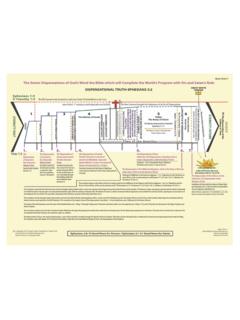
2 Law Grace pre-Fall Adam, Noah Abraham Moses Christ Key question What are the two most pervasive frameworks in Protestantism for harmonizing the Old and New Testaments and where do these frameworks agree and how do they differ? Key text John 1:17 For the law was given through Moses; grace and truth were realized through Jesus Christ. COVENANTS and DISPENSATIONS 2 The dispensational system sees a distinction between God s dealing with His people Israel and His church (the Body of Christ). The Law as a covenant was temporary and distinct from the New covenant , which was initiated with the crucifixion, resurrection, and Pentecost. In this system the Old Testament is applied directly to the Jewish people but not the Church of Christ. pre-Fall Adam Noah Abraham (Moses) Christ 2nd coming Innocence Conscience Human Government Promise (Law) Grace Kingdom 2. Dispensatonal and Covenantal systems are contrasted in the following chart.
3 ISSUE covenant POSITION dispensational POSITION Pattern Of History covenant of Works with Adam: covenant of Grace with Christ on behalf of elect (some distinguish between covenant of Redemption with Christ and covenant of Grace with the elect.) Divided into DISPENSATIONS (usually seven); , Innocence (pre-Fall), Conscience (Adam), Human Government (Noah), Promise (Abraham), Law (Moses), Grace (Christ s First Coming), Kingdom (Christ s Second Coming.) View Of History Optimistic: God is extending His kingdom. Pessimistic: the Last Days are marked by increasingly worse wickedness in the world and by apostasy in the church. God's Purpose In History There is a unified redemptive purpose. There are two distinct purposes, one earthly (Israel), one heavenly (church). View Of The Biblical COVENANTS They are different administrations of the covenant of Grace. They mark off periods of time during which God s specific demands of man differ. Relationship Of Old Testament to New Testament Acceptance of Old Testament teaching required unless specifically abrogated by New Testament.
4 Old Testament prescriptions are not binding unless reaffirmed in New Testament. Relationship Between Israel And The Church The church is spiritual Israel, in continuity with true Israel of Old Testament. The church is the spiritual people of God, distinct from Israel, the physical people of God. Old Testament Prophecy Refers to God s people, the church. Refers to ethnic Israel. Church Age God's redemptive purpose continued to unfold. There is a parenthesis between past and future manifestations of the kingdom. Role Of The Holy Spirit The Holy Spirit indwells God s people throughout history. The Holy Spirit indwells God s people only from Pentecost to the Rapture. Baptism Unifies covenant generally used to support infant baptism. Israel/church distinction often (but not always) used to support believers' baptism. COVENANTS and DISPENSATIONS 3 Social Implications Emphasizes cultural mandate. The only way to save the world is to save individuals; therefore evangelism takes precedence over "social action.
5 " Eschatology Usually amillennial; occasionally postmillennial or premillennial. Premillennial, usually pretribulational. Millennium Symbolic, often identified with present age. Literal, earthly 1000-yr reign after Second Coming. B. The dispensational systems examined. 1. Rational for the dispensational system. a. Definition: A dispensation is a period of time during which man is tested in respect of obedience to some specific revelation of the will of God. Scofield Reference Bible A dispensation is a distinguishable economy in the outworking of God s purpose. Charles Ryrie b. All dispensationalists agree on three distinctives of dispensationalism. 1. A distinction between the church and Israel. 2. A literal or normal hermeneutic for Scripture. 3. The purpose of God for all DISPENSATIONS being the glory of God. NOTE: Dispensationalism is not so much a systematic theology as a commitment to a consistently literal method of interpretation of the OT as it relates to Israel.
6 C. Common features of the dispensational tradition. 1. The authority of Scripture defined in terms of verbal inerrancy. Dispensationalists tend to have a very conservative view of inerrency. 2. DISPENSATIONS marking the differing ways God and humans relate to each other over time. Dispensationalists tend to see God s working with Israel as distinct from His working with the church. 3. Uniqueness of the church defined by the Baptism with the Holy Spirit beginning at Pentecost. Dispensationalists tend to equate the church with the present age (not including Old Testament Israel). 4. Practical significance of the universal church which transcends denominations and local congregations. Dispensationalists tend to be nondenominational. 5. The importance of Biblical prophecy is stressed. Dispensationalists tend to give a lot of attention to the prophetic visions in Scripture of end time events. 6. An emphasis on a literal 1000 year reign of Christ on earth after His second coming is common.
7 Dispensationalists are usually premillenialists. 7. The imminent return of Christ for His church is taught. Dispensationalists believe that Christ could return at any moment. 8. A national future for Israel as a people is stressed. Dispensationalists tend to support a mild form of Zionism (the right of the Jewish people to the land of Palestine). d. Texts used to support dispensationalism. 1. In :2 ( :25-26) the term OIKONOMIA is used to refer to two DISPENSATIONS : the present age and the age to come. COVENANTS and DISPENSATIONS 4 2. Other texts suggest a distinction between a period of law and grace. :17 For the law was given through Moses; grace and truth were realized through Jesus Christ. ( :12; :4-7; II :7-11). See notes on Law & Grace under Salvation. 3. A third dispensation is suggested in :15-19 where the promise to Abraham ( :1-3) is described as preceding the Law of Moses and fulfilled in Christ. 4. Acts 11:15 suggests that the coming of the Spirit was the beginning (of a new era).
8 E. Forms of dispensationalism. 1. Classical dispensationalism Lewis Sperry Chafer, the Scofield Reference Bible a. Each dispensation is seen as a test of faith and obedience for those living at that time in redemptive history. The earthly people of past DISPENSATIONS failed to realize God s earthly purpose. Instead the saved will be included in God s heavenly purpose when that purpose is fulfilled. b. A grammatical historical method of interpretation is advocated by classical dispensationalists. By historical they do not mean historical critical but rather the reading the text in the context of its relationship to the theological and especially dispensational context. They also put a lot of emphasis on typology in reading the Old Testament. c. God has two purposes. The heavenly people would go to heaven and the earthly people would go to the new earth for ever. (the following charts are modified from Progressive Dispensationalism by Darrell L. Bock, BridgePoint, 1993) Heavenly purpose and people (Church) Heavenly purpose and people fulfilled in heaven forever.
9 (Resurrected Church and saints) Earthly purpose and people (Israel/Gentiles) Earthly purpose and people resumed. (Israel/Gentiles) Earthly purpose and people fulfilled on the New Earth forever. (Israel/Gentiles) Past dispensation Present dispensation Future dispensation Eternity d. The church was seen primarily in terms of a private, individual, spiritual, relationship between God and Christians. The social, political aspects of the church were not emphasized. The church age was seen as a heavenly, spiritual, parenthesis in classical dispensationalism. Heavenly purpose (Ahistorical, Individual, Spiritual) Heavenly purpose (Realized forever) Earthly purpose (Historical, Political, Social) Earthly purpose resumed. Earthly purpose realized forever Past dispensation (Present dispensation) Future dispensation Eternity e. The Abrahamic covenant under classical dispensationalism is the foundational covenant which provides a context for the other Biblical COVENANTS .
10 The covenant made with Abraham in has both a spiritual and physical aspect. COVENANTS and DISPENSATIONS 5 Abrahamic covenant Heavenly spiritual aspect Earthly physical aspect Tutor for Gospel Mosaic covenant Conditions for life Symbolic of church Palestinian covenant Promise of land Present reign of Christ Davidic covenant Political reign of Christ The church (Jew and Gentile together) New covenant Jewish revival at end of age f. Scofield s view of the Kingdom of God and of Heaven in classical dispensationalism can be illustrated in the following chart. The Kingdom of God (in Heaven) Kingdom of God in heaven Davidic Kingdom The Kingdom of Heaven (on Earth) at hand Mystery form (Christendom) Prophetic (Millennial) Past Dispensation Jesus Christ Present Dispensation Future Dispensation Kingdom of God on the New Earth 2. Revised dispensationalism Charles Ryrie, the New Scofield Reference Bible a.