Transcription of CRCT Study - Douglas County School District
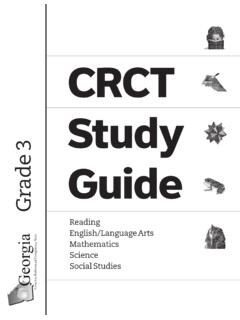
1 CRCT Study GuideGrade 3 Reading English/Language Arts Mathematics Science Social Studies To be available 2008 09 Table of ContentsUsing the CRCT Study guide 1 About the CRCT Overview of the CRCT 2 What is the CRCT? What does the CRCT measure? How are CRCT questions scored? Preparing for the CRCT 3 Test-Taking Strategies Related LinksChapter 1 Reading 9 Reading Skills and Vocabulary Acquisition Reading for Literary Comprehension Reading for Information Practice Quiz SolutionsChapter 2 English/Language Arts 27 Grammar/Sentence Construction Research/Writing Process Practice Quiz SolutionsChapter 3 Mathematics 39 Number and Operations Measurement Geometry Algebra Data Analysis Practice Quiz SolutionsChapter 4 Science 59 Earth Science Physical Science Life Science Practice Quiz Solutions1U s i n g t h e C R C T S t u d y G u i d eThis Study guide
2 Focuses on the knowledge and skills that are tested on the Georgia criterion - referenced competency tests (CRCT). It is designed for teachers to use with their students and for parents to use with their children. Go to to find further information about and support for the the following section of this guide , About the CRCT, for an overview of the CRCT and for test-taking strategies to review with your content tested on the CRCT is based on the Georgia Performance Standards, which describe what all students should know, understand, and be able to do. The chapters of this guide are organized by subject.
3 In each chapter you can explore the skills needed to succeed in a specific, tested domain (grouping of similar content standards). The subject chapters include a snapshot of each domain, instructional Activities that address covered skills, and a Practice Quiz with annotated Solutions to help assess student v e r v i e w o f t h e C R C TA b o u t t h e C R C TWhat is the CRCT?The CRCT is a series of state-mandated achievement tests for students in Grades 1 through 8. In Grades 3 through 8, the subject areas of reading, English/language arts, mathematics, science, and social studies are does the CRCT measure?
4 The CRCT measures how well students have learned the knowledge and skills covered by the state curriculum for their grade level. A new statewide curriculum, known as the Georgia Performance Standards (GPS), sets academic standards and expectations for all students in Georgia s public schools. The CRCT corresponds to the new tests accomplish the following:Ensure that students are learning Provide data to teachers, schools, and School districts so they can make better instructional decisionsMeasure accountability, including Adequate Yearly Progress (AYP) as measured by the federal No Child Left Behind ActCRCT results measure the academic achievement of students, classes, schools, School systems, and the state.
5 This information can be used to identify individual student strengths and weaknesses, or, more generally, to measure the quality of education throughout are CRCT questions scored?The CRCT currently uses only selected-response (multiple-choice) questions. There are four choices for each question, labeled A, B, C, and D. Students are not compared to each other. Each is measured on his or her achievement in meeting the standards. Scores are reported according to three performance levels: Does Not Meet the Standard, Meets the Standard, and Exceeds the Standard. For more information, go to the website and click the link for 2007 CRCT Interpretive guide .
6 Since the spring of 2006, performance on the reading portion of the CRCT has been linked to the Lexile scale. Visit for more information on this national reading r e p a r i n g f o r t h e C R C TA b o u t t h e C R C TTest-Taking StrategiesWeeks Before the TestSet academic goals with students for the upcoming weeks and months (short and long term). Write down and post students goals where they can be seen at least once a day. Help students gather Study materials ahead of time. Set up a place to work that is free of distractions. Build in time to review what was learned in the last Study session.
7 Divide assignments into manageable chunks. Studying for a long time non-stop is not productive! Model and have students marks the main idea of each paragraph with a pencil as they read. This will help them focus on what they are reading. Have students ask questions that arise while they are studying and encourage them to find the answers. At the end of each Study session, review what they have learned. 4 Day Before the TestRemind students to get a good night s students that they can talk to a teacher or parent if they are feeling nervous about the students that this test is only one measure of their the TestRemind students of the following strategies to use during the test: Relax by taking slow, deep the directions carefully.
8 Make sure you understand what you need to do. If you are not sure, ask the each question carefully. When you use scratch paper, make sure that you copy the problem correctly from the test onto your can underline and make marks on your test to help you while you work, but the only answers that will be scored are those in the correct locations on your answer in the corresponding circle fully when you choose your answer. Erase any marks outside of the your time wisely. Leave a question blank if you are unsure of the answer, then return to it at the end. Don t spend too much time on one sure to answer all of the your answers when you have finished the to stay calm during the test.
9 This is a chance for you to show what you know. Do the best you can!About the CRCTP reparing for the CRCT5 About the CRCTP reparing for the CRCTR elated LinksBelow are links to important resources that contain information related to the Performance CRCT Content Lexile Framework for practices in education indicate that teachers should first model new skills for students. Next, teachers should provide opportunities for guided practice. Only then should teachers expect students to successfully complete an activity independently. The activities in this guide are no exception. They are designed to be used by teachers and parents to help students with the skills on the Georgia CRCT.
10 Since different students have different strengths and needs, the activities in this Study guide can be scaffolded for students who need more support, extended to challenge advanced students, or presented as is (with appropriate modeling) for grade-level Grade 3, students are making the transition from learning to read, to reading to learn. They read much more widely on a variety of topics. Grade 3 students increase their ability to read aloud with fluency and comprehension. They read more thoughtfully, discover more details, extract deeper meaning in what they read, and read more complex texts.