Transcription of GA Studies CRCT Study Guide - ANSWER KEY
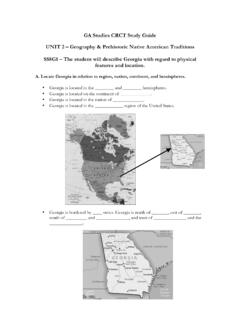
1 GA Studies CRCT Study Guide UNIT 2 Geography & Prehistoric Native American Traditions SS8G1 The student will describe Georgia with regard to physical features and location. A. Locate Georgia in relation to region, nation, continent, and hemispheres. Georgia is located in the northern and western hemispheres. Georgia is located on the continent of North America Georgia is located in the nation of the United States of America. Georgia is located in the southeastern region of the United States. Georgia is bordered by five states. Georgia is north of Florida, east of Alabama, south of Tennessee and North Carolina, and west of South Carolina and the Atlantic Ocean. 2 B. Describe the five physiographic regions of Georgia; include the Blue Ridge Mountains, Valley and Ridge, Appalachian Plateau, Piedmont, and Coastal Plain.
2 A - The smallest of the five regions C - The site of the first gold rush D - The most populated region A - GA s only source of a fossil fuel C - The highest peak, Brasstown Bald D - Contains Georgia s peaches A - Includes only Dade and Walker County D - The industrial/business heart of Georgia E - The largest physiographic region B - Contains most of the state s textile industry B - Contains ridges with valleys between D - Contains Atlanta, the state s largest city C - Highest amount of annual rainfall E - Contains most of Georgia s peanut & cotton farms D - Contains soil made up of Georgia red clay; means foot of the mountains C. Locate and evaluate the importance of key physical features on the development of Georgia; include the Fall Line, Okefenokee Swamp, Appalachian Mountains, Chattahoochee and Savannah Rivers, and Barrier Islands.
3 A B C D E Fall Line Savannah River Chattahoochee River Barrier Islands Okefenokee Swamp 3 The dramatic drop in elevation dividing the Coastal Plain from the Piedmont is the Fall Line. This feature is believed to represent Georgia s coastline from millions of years ago. The second largest freshwater marsh in the United States is the Okefenokee Swamp. The northern regions of Georgia represent the southern end of the great Appalachian Mountain Range. Here, the most important industry is tourism. Georgia s most important river, representing Georgia s border with Alabama is the Chattahoochee River. Georgia s border with South Carolina is the Savannah River. It was an early source of transportation for the colonial settlers.
4 The dramatic drop in elevation caused by the Fall Line causes the rivers to form waterfalls. Once serving as a protective line against Spanish invaders and pirates, the Barrier Islands now protect Georgia s mainland from inclement weather. D. Evaluate the impact of climate on Georgia s development. Conditions on a particular day ( , snow, rain, thunderstorms, etc.) are called weather. Conditions over an extended period of time are called climate. Georgia and its neighbor states are part of a warm region of the United States called the Sun Belt. In which of Georgia s regions would tourists most likely go hiking? Blue Ridge What region attracts people who like to go to the beach? Coastal Plain 4 Why does Georgia have a longer growing season than northern states?
5 Georgia is located within the Sun Why do peanuts and cotton grow well in Georgia? Because of GA s soil and climate. SS8H1 The student will evaluate the development of North American cultures and the impact of European exploration and settlement on the Native American cultures in Georgia. A. Describe the evolution of Native American cultures (Paleo, Archaic, Woodland, and Mississippian) prior to European Paleo-Indian Archaic Woodland Mississippian Time Period 10,000 8,000 8,000 1,000 1,000 1,000 1000- 1600 Technological Advancements ( , tools, weapons, pottery, etc.) Clovis point atlatl; crude pottery decorative pottery; bow & arrow highly ornate pottery, clothing, jewelry Food Sources large game large game; small game; fish; nuts & berries small game; small-scale farming small game; large-scale farming Organization ( , nomadic bands, cities, etc.)
6 Small nomadic bands small nomadic bands small, permanent villages cities; nations; chiefdoms Evidence of Religion NA NA small burial mounds; artistic expression great mounds; artistic expression A man-made relic is called an artifact. Examples include: arrowhead; diary; pottery A natural relic is called an ecofact. Examples include: shark s teeth; bones; fossils 5 UNIT 3 Exploration & Colonization SS8H1 The student will evaluate the development of North American cultures and the impact of European exploration and settlement on the Native American cultures in Georgia. B. Evaluate the impact of European contact on Native American cultures including Spanish missions along the barrier islands, and the exploration of Hernando de Soto.
7 During the Age of Exploration, European explorers were attempting to find a water route to the Indies When Columbus arrived in North America, he believed he was in India. Because of this, he called the Native Americans Indians Because Spanish explorers were conquerors, they were called conquistadors. Spain claimed all of the New World and called it La Florida The Spanish explorer, who led an expedition into the American southeast, becoming the first European to look upon Georgia, was Hernando De Soto. In order to convert the Native Americans to Catholicism, the Spanish established missions along the southeastern coast of North America. Though the Spanish explorers brought weapons and horses to the New World, the thing most responsible for the death of thousands of Native Americans was disease.
8 C. Explain reasons for European exploration and settlement of North America, with emphasis on the interests of the French, Spanish, and British in the southeastern area. The three goals of Spanish exploration in the New World were God, gold, and glory: God refers to the religious motivation to convert the Natives to Catholicism. Gold refers to the economic motivation of discovering new sources of wealth for the Spanish Empire. Glory refers to the military motivation of conquering new lands for the Spanish Empire. 6 The French explorer who established the city of Quebec (in Canada), along with a prosperous fur trade there, was Samuel de Champlain. The French explorer who founded New Orleans was Sieur de La Salle. Under the English king, King Henry VIII, the Catholic Church was replaced with the Anglican Church (Church of England).
9 In 1588, Spain launched the Spanish Armada in an attempt to conquer England and force its return to the Catholic Church. The result was disastrous for Spain, and the Spanish Empire never recovered. In 1607, England established its first permanent North American colony at Jamestown. By the 1660s, England had established 12 colonies in North America. The final English colony to be founded was Georgia, and it was established by a Charter in the year 1732. Name Approx. Date Nation Description Christopher Columbus 1492 Spain Chose to sail westward in his effort to find an all-water route to India; discovered the islands off the coast of North America; believing he was in India, he described the natives as Indians Pope Alexander VI 1494 Roman Catholic Church Drew the Line of Demarcation, diving the world between the Catholic powers of Spain and Portugal; Portugal was guaranteed their routes around Africa; Spain was guaranteed all western routes to the Indies (and all newly discovered lands in between) Conquistadors 1500 Spain Spanish explorers almost always explored as officers of the Spanish Imperial Army.
10 Their explorations, therefore, were conquests Hernando de Soto 1540 Spain Spanish conquistador who became the first European to explore the interior of what would become the southeastern United States; he was the first European to enter Georgia and the first to look upon the Mississippi River. Three G s 1500s Spain The motivations of Spanish exploration (God religious motivation; Gold economic motivation; Glory military motivation) Spanish Missions 1500s Spain Established in the coast of La Florida to convert Native Americans to Roman Catholicism (by force if necessary) 7 Name Approx. Date Nation Description Sieur de La Salle 1682 France Explored the Mississippi basin, naming it La Louisiane, and claimed it in the name of France.