Transcription of Criminal Procedure Code Act - The Bahamas
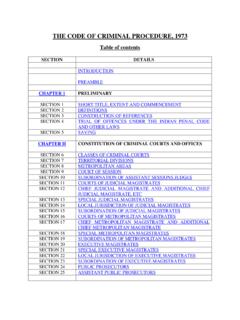
1 Criminal Procedure code [ 1 LRO 1/2010 STATUTE LAW OF THE Bahamas Criminal Procedure code CHAPTER 91 Criminal Procedure code LIST OF AUTHORISED PAGES 1 2 LRO 1/2010 73 80 LRO 1/2008 3 6 Original 81 92 Original 7 8 LRO 1/2006 93 96 LRO 1/2010 9 10 LRO 1/2010 97 100 LRO 1/2006 11 12 LRO 1/2002 101 106 Original 13 20 Original 107 108 LRO 1/2006 21 24 LRO 1/2006 109 116 Original 25 40 Original 117 118 LRO 1/2006 41 42 LRO 1/2006 119 120 Original 43 72 Original 121 122 LRO 1/2010 ARRANGEMENT OF SECTIONS PART I PRELIMINARY SECTION 1. Short title. 2. Interpretation. 3. Inquiry into and trial of offences. PART II POWER OF COURTS 4. General power to try offences. 5. Cases in which jurisdiction is specifically conferred by certain laws. 6.]
2 Sentences which the Supreme Court may pass. 7. Sentences which magistrates court may pass. 8. Combination of sentences. 9. Sentences in cases of conviction of several offences. 10. Sentencing guidelines. PART III GENERAL PROVISIONS RELATING TO ARREST, RECOGNISANCES AND SURETIES 11. Arrest. 12. Search of place entered by person sought to be arrested. 13. Power to break out of house or other place for purpose of liberation. 14. No unnecessary restraint. 15. Search of arrested persons. 16. Mode of searching women. 2] Criminal Procedure code STATUTE LAW OF THE Bahamas LRO 1/2010 17. Power to seize offensive weapons. 18. Disposal of persons arrested without warrant by peace officer. 19. Detention of accused persons during investigations. 20. Arrest by person other than peace officer. 21. Offence committed in presence of magistrate.
3 22. Recapture of person escaping. 23. Particulars to be contained in recognisances. 24. Notice of recognisances. 25. Proof of sufficiency. 26. Estreating recognisances conditioned for appearance. 27. Estreating recognisances conditioned for keeping the peace or doing some act or thing. 28. Payment of sums forfeited. 29. Rules as to securities. 30. How forfeited security is to be realised in the case of a surety. 31. How forfeited security given by a principal on conviction to be recovered. 32. Surety may recover as civil debt from principal any sum paid under security. 33. Securities to be realised before other steps are taken. 34. Recognisance taken out of court. PART IV GENERAL PROVISIONS RELATING TO Criminal INVESTIGATIONS AND PROCEEDINGS 35. Authority of Supreme Court and magistrates court and general validity of judicial processes.
4 36. Powers of Supreme Court in certain cases. 37. Place and dates of sessions of the Supreme Court. 38. Ordinary place of inquiry or trial by magistrate s court. 39. Accused person may be sent to the district in which offence alleged to have been committed. 40. Removal of accused persons under warrant. 41. Trial or inquiry at place where act done or where consequences of offence ensue. 42. Trial or inquiry where offence is connected with another offence. 43. Trial or inquiry where place of offence is uncertain. 44. Offence committed on a journey. 45. Supreme Court to decide in cases of doubt. 46. Court to be open. 47. Hearing in camera. 48. Transfer of complaint to another magistrate s court. 49. Procedure when a magistrate considers that he ought not to hear a case brought before him. 50. Transfer of complaint. 51.
5 Power of a judge to order transfer of proceedings. 52. Power of Attorney-General to enter nolle prosequi. 53. Notice of nolle prosequi to be given by Registrar. 54. Delegation of powers by Attorney-General. 55. Authority to conduct prosecutions on behalf of the Crown, etc. 56. Ultimate control of conduct of all prosecutions vested in Attorney-General. 57. Conduct of private prosecutions. 58. Complaint and charge. 59. Issue of summons or warrant. Criminal Procedure code [ 3 [Original Service 2001] STATUTE LAW OF THE Bahamas Criminal Procedure code 60. Form, validity and execution of warrants of arrest. 61. Court may direct security to be taken. 62. Procedure when arrest is made out of district. 63. Service of summons. 64. Service on company.]
6 65. Proof of service of summons. 66. Special Procedure in respect of certain offences. 67. If summons disobeyed, warrant may issue. 68. Power to take bond for appearance. 69. Court may order prisoner to be brought before it. 70. Search warrants. 71. Execution of search warrants. 72. Retention and disposal of property seized under search warrant. 73. Offence to be specified in charge or information. 74. Joinder of counts in charge or information. 75. Joinder of two or more accused in one charge or information. 76. Rules for the framing of charges and information. 77. Persons convicted or acquitted not to be tried again for same offence. 78. A person may be tried again for separate offence. 79. Consequences supervening or not known at time of former trial. 80. Where original court was not competent to try subsequent charge.
7 81. Proof of previous conviction. 82. Summons for witness. 83. Warrant for witness who disobeys summons. 84. Warrant for witness in first instance. 85. Mode of dealing with witness arrested under warrant. 86. Power of court to order prisoner to be brought up for examination. 87. Penalty for non-attendance of witness. 88. Power to summon material witness or examine person present. 89. Evidence to be given on oath. 90. Refractory witness. 91. Calling of husband or wife as witness. 92. Issue of commission for examination of witness. 93. Parties may examine witnesses. 94. Return of commission. 95. Adjournment of trial or inquiry. 96. Competency of witnesses in Criminal cases. 97. Procedure where person charged is the only witness called. 98. Right of reply. 99. Court to inquire into suspected incapacity of accused. 100.
8 Procedure when accused found insane during proceedings. 101. Defence of lunacy at preliminary investigation. 102. Resumption of proceedings if accused ceases to be incapable. 103. Prima facie evidence of accused may be given by certificate. 104. Provisions relating to the taking of evidence. 105. Recording of evidence. 106. Mode of delivering judgment. 4] Criminal Procedure code STATUTE LAW OF THE Bahamas [Original Service 2001] 107. Magistrate may deliver judgment prepared by predecessor. 108. Contents of judgment in summary trial. 109. Accused person entitled to copy of judgment on application. 110. Costs in Criminal cases. 111. Order of magistrate for payment for costs appealable. 112. Property found on accused person. 113. Restitution of stolen property after conviction. 114. Conviction in case of variance between evidence and offence charged.
9 115. Accused persons entitled to be present at trial and may be represented by legal practitioner. PART V PROVISIONS RELATING TO PRELIMINARY INQUIRIES INCLUDING THE USE OF EXPERT DOCUMENTARY EVIDENCE THEREAT AND IN OTHER Criminal PROCEEDINGS 116. Power to commit for trial. 117. Court to hold preliminary inquiry. 118. Magistrate to read charge to accused and explain purpose of the proceedings. 119. Taking of depositions. 120. Admission or evidence of certain reports and plans. 121. Variance between evidence and charge. 122. Remand. 123. Provisions as to taking statements or evidence of accused persons. 124. Evidence and address of defence. 125. Discharge of accused persons. 126. Summary adjudication in certain cases. 127. Committal for trial. 128. Complainant and witnesses to be bound over. 129. Refusal to be bound over.
10 130. Accused person entitled to copy of depositions. 131. Binding over of witnesses conditionally. 132. Deposition of witness who is ill or about to leave The Bahamas . 133. Notice to be given. 134. Magistrate to deal with the deposition like any other deposition. 135. Such deposition to be admissible in evidence. 136. Accused to have same privileges as prosecutor under section 135. 137. Transmission of records to Supreme Court and Attorney-General. 138. Power for the Attorney- General to refer case back to magistrate for further preliminary inquiry. 139. Power for the Attorney-General to refer back case to be dealt with summarily. 140. Further provisions as to referring back of case. 141. Mode of trial upon committal to the Supreme Court and preferment of information. 142. Notice of trial. 143. Service of copy of information and notice of trial.