Transcription of Culturally Responsive Practice Guide - Community Services
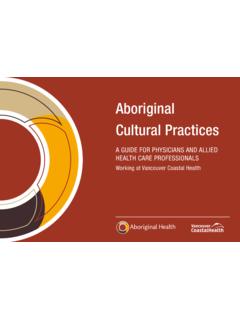
1 working with . aboriginal AND. torres strait . ISLANDER families : PROVIDING Culturally . Responsive Practice . SUPPORTING GOOD Practice . Child and Youth Protection Services September 2019. CH. YOU ILD AN. TH. CEN D. TR. REL ATIONSHIP ED. BASED. STIC ASSESSMENT. HOLI. AND PL ANNING. TION. O RA G RISK. AB ARIN. LL SH. CO. E. O NSIV. SP ES. Y RE D TORR. L. AL AL ANANDER. S. UR I N SL. LT ORIG AIT I. N. U. C A B S TR N. IO. EN RK. IO N. TAT. DOC SEWO. IS T. RV EC. IO. Y. LL E. PE FL. IV. SU E. UM. C A ON A. D LR. SP UR. CA. LD S. AN ICA. RE ULT. OUR. C. IT. CR. ND. Practice . IP. EXPERTISE A. LEADERSH. STANDARDS. We will work respectfully with aboriginal and torres strait Islander families and partner with them in making decisions.'. ACKNOWLEDGEMENT OF COUNTRY.
2 The ACT Government acknowledges the traditional custodians of the Canberra region, the Ngunnawal people. We acknowledge and respect their continuing culture and contribution they make to the life of this city and its surrounding region. THE PURPOSE OF THIS Guide . The purpose of this Guide is to provide Child and Youth Protection Services (CYPS) staff, and its partners, with information about what it means to be Culturally Responsive , and how to embed this standard in day-to-day Practice when working with aboriginal and torres strait Islander families . Specifically, this Guide will tell you about: >> the full scope of the aboriginal and torres strait Islander Child Placement Principle (ATSICPP). >> what is meant by active efforts' and Culturally Responsive Practice '.
3 >> core considerations when working with aboriginal and torres strait Islander families >> what Culturally Responsive Practice looks like across various CYPS processes >> connections with legislation, national principles and CYPS Practice standards. By providing this information you will be better equipped to understand, recognise and implement effective Practice through a cultural lens, and in turn provide stronger outcomes for aboriginal and torres strait Islander children and families . This Guide has been informed by various publications, but most notably by: >> SNAICC, (2017). Understanding and Applying the aboriginal and torres strait Islander Child Placement Principle. >> Curijo, (2018). Implementing the aboriginal and torres strait Islander Child Placement Principle (ATSICPP) into casework Practice .
4 READING THIS Guide . In reading this Guide , the terms child' and children' also refer to young person' and young people'. The term children in care' refers to children in out of home care'. The term parent' also refers to a person who holds daily care or long-term parental responsibility. The term Act' refers to the Children and Young People Act 2008. aboriginal AND torres strait ISLANDER PEOPLE. In reading this Guide , an aboriginal or torres strait Islander person' means a person who identifies as an aboriginal and/or torres strait Islander person. They are generally: >> a descendant of an aboriginal person or a torres strait Islander person, and/or >> accepted as an aboriginal person or a torres strait Islander person by an aboriginal or torres strait Islander Community .
5 CYPS recognises the impact colonisation has had on the aboriginal and torres strait Islander Community and understands some children may not know they are of aboriginal or torres strait Islander background. Some families may choose not to identify their cultural background to CYPS. As such, we acknowledge and respect a person's right to privacy and choice to identify or not as an aboriginal and/or torres strait Islander person. Self-identification by a child or the child's family is the only requirement for you to begin applying the ATSICCP in your work with children and families . working with aboriginal AND torres strait ISLANDER families : PROVIDING Culturally Responsive Practice | iii WHAT'S INSIDE. THE PURPOSE OF THIS Guide .. III. READING THIS Guide .
6 III. aboriginal AND torres strait ISLANDER PEOPLE III. OUR COMMITMENT IN working with aboriginal AND torres strait ISLANDER families .. 1. working IN CONTEXT.. 2. THE aboriginal AND torres strait ISLANDER CHILD PLACEMENT PRINCIPLE 2. OUR CYPS Practice STANDARDS 5. LEGISLATION 6. ACTIVE EFFORTS 7. IN Practice .. 10. INTAKE 10. APPRAISAL 13. SUPPORT RESPONSE 16. FAMILY PRESERVATION 19. CARE ORDER APPLICATIONS 23. PLACEMENT 26. CASE MANAGEMENT GOAL OF RESTORATION 29. CASE MANAGEMENT GOAL OF PERMANENCY 32. TRANSITION FROM CARE 34. CASE CLOSURE 35. APPENDIX: REFLECTION FLOWER .. 37. Practice TOOL AND PROMPTS 38. GLOSSARY .. 42. COVER ARTWORK. The aboriginal artwork incorporated on the cover and throughout this Guide was created by local aboriginal Yuin woman, Marrilyn Kelly-Parkinson.
7 Child and Youth Protection Services extends its thanks to Ms Kelly-Parkinson for her time in producing this artwork and allowing CYPS. to feature it in this Guide . The full artwork is featured here. iv | working with aboriginal AND torres strait ISLANDER families : PROVIDING Culturally Responsive Practice . OUR COMMITMENT IN working . with aboriginal AND torres . strait ISLANDER families . We commit to use Culturally Responsive Practice and active efforts to help us strive for cultural proficiency. We will work respectfully with aboriginal and torres strait Islander families and partner with them in making decisions. In a context where aboriginal and torres strait Islander children continue to be significantly over-represented in the child protection, youth justice and out of home care systems, it is critical we acknowledge that the impact of past government policies and intergenerational trauma, particularly in relation to the removal of Indigenous children, is strongly reflected in the disadvantage experienced by aboriginal and torres strait Islander people today.
8 It is important to be sensitive to this history and focus our efforts on building trust and rapport with aboriginal and torres strait Islander families and communities and seek to address the underlying causes of social disadvantage. Culturally Responsive ' Practice values cultural differences, seeks to become Culturally informed and demonstrates this in action. It seeks to assure the safety and wellbeing of children, while recognising cultural diversity may be reflected in differences, such as the concepts of family and kinship, and child-rearing and parenting practices. As CYPS staff, you are expected to use a Culturally appropriate lens when assessing the strengths and needs of families . This includes addressing potential barriers to relationship building and engagement and seeking the advice and assistance of people knowledgeable in the person's culture and language, including the CYPS Cultural Services Team and aboriginal and torres strait Islander Practice Leader.
9 working with aboriginal AND torres strait ISLANDER families : PROVIDING Culturally Responsive Practice | 1. working IN CONTEXT. When working with aboriginal or torres strait Islander children and families , your work must be guided by: >> the aboriginal and torres strait Islander Child Placement Principle >> our CYPS Practice standards >> legislation >> active efforts. When considered in tandem, these principles enable you to effectively embed Culturally Responsive best Practice case management into your daily work. address the growing disproportionate rate of aboriginal THE aboriginal AND torres and torres strait Islander children being adopted by strait ISLANDER CHILD or placed in care with non-Indigenous carers, and to PLACEMENT PRINCIPLE prevent past practices from continuing or being repeated.
10 The ATSICPP recognises the importance of connections The ATSICPP is not simply about where or with to family, Community , culture and country in child whom a child lives if placed in care. The history and and family welfare legislation, policy and Practice , and intention of the ATSICPP is about keeping aboriginal asserts self-determining communities are central to and torres strait Islander children connected to their supporting and maintaining those connections. family, Community , culture and country. The ATSICPP. includes five inter-related elements, being: The ATSICPP aims to: >> Prevention >> ensure an understanding that culture underpins >> Partnership and is integral to safety and wellbeing for aboriginal and torres strait Islander children >> Placement and is embedded in policy and Practice >> Participation >> recognise and protect the rights of aboriginal and >> Connection.