Transcription of Data Governance and Classification Policy
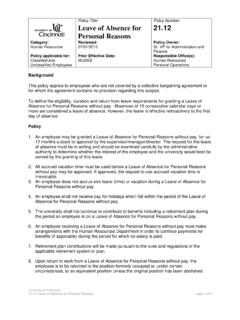
1 Data Governance and Classification Policy Page 1 of 4 Policy Title: Policy Number: Data Governance & Classification Category: Effective Date: Policy Owner: Information Technology 09/03/2021 VP & CIO, UC Information Technologies Policy applicable for: Prior Effective Date: 09/25/2019 Responsible Office(s): Faculty/Staff/Students/ Affiliates Office of Information Security Background The University of Cincinnati uses a variety of data in support of its teaching, research and outreach missions.
2 Data is a valued resource the university must govern, classify and protect. In addition, federal and state laws require that the university must limit access to certain categories of data to protect the privacy of employees, students, subjects, affiliates and patients. Policy The purpose of this Policy and suite of accompanying resources is to help ensure the Governance , Classification and protection of university data from unauthorized access, damage, alteration or disclosure while preserving the ability of authorized users to access and use institutional data for appropriate university purposes.
3 This Policy refers to all university data, electronic as well as paper. This Policy is applicable to all data storage locations and is applicable to all university data used for administration, research, teaching or other purposes. Data Governance is a discipline for assessing, managing, using, improving, monitoring, maintaining and protecting university data. Data Governance is used by organizations to exercise control over processes and methods used by their Data Stewards and Data Custodians in order to improve data quality and integrity.
4 When data is created the Data Trustee must classify the data and establish a Governance framework for the data that corresponds to the university rules for that data type and applicable federal and state laws. Data Classification and Data Types This Policy describes the actions necessary to secure and protect university data defined as Controlled Unclassified Information, R estricted data, Controlled data and Data Governance and Classification Policy Page 2 of 4 Public data.
5 See Data Classification and Data Types for additional information and examples. Controlled Unclassified Information (CUI): Controlled Unclassified Information (CUI) is information that requires safeguarding or dissemination controls pursuant to and consistent with applicable law, regulations, and government-wide policies but is not classified under Executive Order 13526 or the Atomic Energy Act. Export Controlled data is a subset of CUI. Export Controlled data often comes as a specific clause within the Defense Federal Acquisition Regulation Supplement (DFARS ) Restricted: Data is classified as Restricted when the unauthorized disclosure, alteration or destruction of that data could cause a significant level of risk to the university or its affiliates.
6 Users of Restricted data must follow all safeguards for Controlled data plus additional safeguards identified for Restricted data. High levels of security safeguards must be applied to Restricted data. Controlled: Data is classified as Controlled when the unauthorized disclosure, alteration or destruction of that data could result in a moderate level of risk to the university or its affiliates. By default, all institutional data that is not explicitly classified as CUI, Restricted or Public data must be treated as Controlled data.
7 A reasonable level of security safeguards must be applied to controlled data. Public: Data that is readily available to the public. This data requires no confidentiality or integrity protection. Public data needs no additional protection. Minimum Safeguards The responsibility of protecting university data is shared by everyone that uses, accesses or stores such data. Required safeguards depend on the data Classification . See Minimum Safeguards f or more information. Roles and Responsibilities There are four data user roles with differing levels of responsibilities.
8 See Roles and Responsibilities for more information. Trustees: Senior university officials or their designees who have planning and Policy level responsibility for data within their functional areas and management responsibility for defined segments of institutional data. Stewards: University officials having direct operational-level responsibility for the management of one or more types of institutional data. Data Stewards in coordination with Data Custodians must implement and apply safeguards that meet or exceed the Minimum Safeguards of each data Classification .
9 Data Governance and Classification Policy Page 3 of 4 Custodians: Central or distributed university units or computer system administrators responsible for the operation and management of systems and servers which collect, manage and provide access to institutional data. Users: University units or individual university community members who have been granted access to institutional data in order to perform assigned duties or in fulfillment of assigned roles or functions within the university.
10 Collectively these parties are responsible for identifying and implementing safeguards for the different data types. Many university activities involve multiple departments; for such activities that involve access to, or storage of, university data, the procedures and safeguards must be coordinated by all Trustees, Stewards, Custodians and Users involved. Compliance and Remediation Incidents involving CUI data must be immediately reported to the Office of Information Security (OIS)