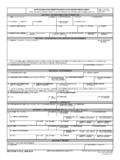
Transcription of DD FORM 254 Preparation Guide
1 Headquarters, Department of the Army, G-2 DD form 254 Preparation Guide FY-10 FOREWORD Within The Department of Defense, Industrial Security is identified as the portion of information security concerned with the protection of classified information in the custody of industry. The purpose of the Industrial Security Program is to safeguard classified information that may be or has been released to current, prospective or former contractors. The purpose of this Guide is to provide guidance in the Preparation of a DD form 254, Contract Security Classification Specification. This Guide contains step-by-step procedures for completing the DD form 254. The instructions in this Guide correspond to the numbered items on the form . The intention of a DD form 254 is to convey security requirements, classification guidance and provide handling procedures for classified material received and/or generated on a classified contract. The DD form 254 is a resource for providing security requirements and classification guidance to a contractor.
2 The DD form 254 is a publication referenced in the DFAR and applied to contracts involving access to classified information by contractors. If the contract is with non-US Industry (foreign governments, cleared foreign companies or international organizations) additional guidance is on a case-by-case basis. The Industrial Security Implementing Agreement (to the General Security of Military Information Agreement) is the overarching authority for the bilateral protection of classified information with foreign governments. Any guidance provided to contractors to explain protection requirements for classified information exchanged under bilateral agreements must be conveyed through security contract clauses, and not a DD form 254. NOTE: Industry is any company, educational institution, commercial association/organization or other entity established and operating as a legitimate business or enterprise and granted a Facility Security Clearance (FCL) by a cognizant security agency (CSA).
3 Any misconduct/wrongdoing of a contractor, modification to the contract or changes to the company ownership status, which could have an adverse impact upon national security, the Army program and/or information, must be reported immediately to the Contract Officer (KO) or a Contract Officer Designated Representative. (Note: For purposes of this handbook, the term Contract Officer (KO) is used inclusively for the terms: Contracting Officer Representative (COR), Alternate COR (ACOR) or Contracting Officer Technical Representative (COTR)). The KO must be notified on all contract matters through the COR/ACOR/COTR. 2 TABLE OF CONTENTS Page DD form 254 Preparation Chapter 1. Chapter 2. Point of Contacts ..6 Chapter 3. Pre-award Chapter 4. Instructions ..9 Chapter 5.. 35 Chapter 6. Chapter 7. Additional 3 CHAPTER 1 INTRODUCTION: The Federal Acquisition Regulation (FAR) requires that a DD form 254, Contract Security Classification Specification, be integrated in each classified contract.
4 The DD form 254 provides the contractor (or a subcontractor) security requirements and the classification guidance that is necessary to execute a classified contract. This handbook has been prepared from the Defense Security Service (DSS) Guide , Federal Acquisition Regulations (FAR), Defense Federal Acquisition Regulations Supplement (DFARS), Army Federal Acquisition Regulations Supplement (AFARS), and National Industrial Security Program Operating Manual (NISPOM). The Security Agreement (DD form 441), executed between the government and all cleared facilities under the NISP, obligates the Government to provide the contractor appropriate classification guidance for the protection of the classified information, furnished to or generated by, the contractor in the performance of a classified contract. The Government fulfills this obligation by incorporating a Security Requirements Clause ( clause ) and a DD form 254 in each classified contract. The clause identifies the contract as a classified contract and the DD form 254 provides classification guidance and the specific security requirements.
5 The DD form 254 is a contractual specification. It is as important as any other specification in a contract. It is the vehicle that provides the contractor with the security classification guidance necessary for the classified information to be received and generated under the contract. It also identifies the level and specific types of classified information authorized on the contract. It was developed as a contractual document to capture in one place the security requirements for a classified contract. By checking the blocks for the preprinted items on the DD form 254, the Contracting Office (KO), Contracting Officer Representative (COR)/Contract Monitor (CM) provides the contractor with a brief summary of the security requirements that apply to the contract. The key personnel in the Preparation of the DD form 254 are the program and Industrial Security Specialist (ISS), technical/subject matter expert personnel, and contracting personnel. The program and ISS recognizes the security requirements that the contractor will need to follow.
6 The technical/subject matter expert personnel understand what information or equipment in the program requires protection, and the technical aspects of the requirements, the KO must ensure the contractor complies with the DD form 254 and any special clauses into the contract. The DD form 254 is required to be reviewed every two years. The program and ISS should conduct this review in coordination with the program manager of the requiring activity and KO to ensure that existing security requirements are consistent with the contract requirements. 4 If the review is performed and no changes are required, the program and ISS will provide the KO with a copy of the review. The KO will then send to the contractor, in writing, notification that the DD form 254 remains valid until the next review or a change occurs in the program. If the review is performed and changes are required the program and ISS must provide the KO with a revised copy. The KO will then prepare a bi-lateral modification to the contract incorporating the new DD form 254.
7 The Defense Security Service (DSS) is designated by DoD Directive , National Industrial Security Program (NISP), as the Cognizant Security Office (CSO) to administer industrial security on behalf of the Cognizant Security Agency (CSA). The CSAs are: the Department of Defense (DoD), Department of Energy (DOE), Central Intelligence Agency (CIA), and the Nuclear Regulatory Commission (NRC). The designation of DSS as the CSO for the Department of Defense does not relieve the Government Contracting Activity (GCA) of the responsibility to protect and safeguard classified information disclosed to or generated by contractors under the NISP or from visiting the cleared contractor to review the security aspects/requirements of the contract. Revisions to the DD form 254 will be completed whenever the security guidance or pertinent information changes, when a change in mission occurs impacting the contract, when a contract is modified or an option year is utilized, to ensure security requirements remain current and relevant throughout the contract lifecycle.
8 This includes contractor address changes if they are performing classified work at their facility. 5 CHAPTER 2 POINTS OF CONTACT: * HQDA, G-2 Industrial Security Lisa Gearhart 703-601-1565 Or HQDA, G-2 Industrial Security Pamela Y. Spilman 703-601-1567 Mailing Address: HQDA, G-2 ATTN: DAMI-CDS 1000 Army Pentagon RM 2D350 Washington, DC 20310-1000 Facsimile number: 703-601-0733 E-Mail Address: * Defense Security Services Mailing Address: Defense Security Service 1340 Braddock Place Alexandria, VA 22314 Telephone number: 1-888-282-7682 Website: 6 * Army Intelligence and Security Command (INSCOM)/Contractor Support Element (For all Army SCI contracts) Mailing Address United States Army Intelligence and Security Command Contractor Support Element (CSE) 4552 Pike Road, MS 5820 Fort Mead, MD 20755-5820 Facsimile number: 301-677-2901 E-Mail Address: * Technology Management Office (For SAP contracts) Mailing Address Office of Chief of Staff of the Army ATTN: Technology Management Office, DACS-ZDV-TMO Attn: D.
9 Scott Magnino, Security Manager 200 Army Pentagon, RM 2A528 Washington, DC 20310-0200 Telephone number: 703-695-4056 Facsimile number: 703- 697-4009 E-Mail Address: 7 CHAPTER 3 Pre-Award Considerations Before the KO or prime contractor issues a solicitation for a classified contract, a determination should be made as to whether or not access to classified information is required during the solicitation process. If access to classified information is not required during the solicitation process, prospective contractors do not have to possess facility clearances to bid on the solicitation. However, the successful bidder must have a facility clearance to perform on the contract. The contracting team should make every effort to develop a solicitation package that does not require access to classified information. The solicitation DD form 254 will be marked For Planning Purposes Only and provided to the supporting KO for review and incorporation into the requirements package.
10 The preliminary DD form 254 includes the what, why, when, and where for a contractor that will need classified information or access to classified information. The contractor should staff any changes to the security requirements through the program, COR/CM if one has been appointed, and ISS and back to the KO for incorporation into the solicitation. If access to classified information is required during the solicitation process, all prospective contractors must possess the appropriate facility clearance and safeguarding capability in order to access the classified information within the solicitation package. If a reading room is provided by the Army to review the classified information for the solicitation, then the contractor s clearance eligibility must be verified prior to the review. To determine the current clearance status of prospective contractors, contact the DSS Central Verification Activity at 1-888-282-7682 or log on to the DSS web site ( ) and follow the instructions.