Transcription of DEFINITION OF PROGRAM, PROJECT, AND ACTIVITY
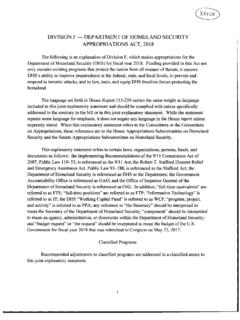
1 explanatory STATEMENT SUBMITTED BY MR. FRELINGHUYSEN, CHAIRMAN OF THE HOUSE COMMITTEE ON APPROPRIATIONS REGARDING The following is an explanation of the effects of this Act, which makes appropriations for the Department of Defense for fiscal year 201 7. Unless otherwise noted, references to the House and Senate reports are to House Report 114-577 and Senate Report 114-263, respectively. The language contained in the Ho use and Senate reports warrant full compliance and carry the same weight as language included in this explanatory statement unless specifically addressed to the contrary in the bill or this explanatory statement. While repeating sorne language from the House or Senate reports for emphasis, this explanatory statement does not intend to negate the language referred to above unless expressly provided herein. DEFINITION OF PROGRAM, PROJECT, AND ACTIVITY For the purposes of the Balanced Budget and Emergency Deficit Control Act of 1985 (Public Law 99-1 77), as amended by the Balanced Budget and Emergency Deficit Control Reaffirma ti on Act of 1987 (Public Law 1 00-119), and by the Budget Enforcement Act of 1990 (Public Law 10 1-508), the terms "pro gram, project, and ACTIVITY " for appropriations contained in this Act shall be defined as the most specifie lev el of budget items identified in the Department of Defense Appropriations Act, 201 7, the related classified annexes and explanatory statements, and the P-1 and R-1 budget justification documents as subsequently modified by congressional action.
2 The following exception to the above DEFINITION shall apply: the mi1itary personnel and the operation and maintenance accounts, for which the term "program, project, and 1 ACTIVITY " is defined as the appropriations accounts contained in the Department of Defense Appropriations Act. At the time the President submits the budget request for fiscal year 2018, the Secretary of Defense is directed to transmit to the congressional defense committees budget justification documents to be known as the "M-1" and the "0-1" which shall identify, at the budget ACTIVITY , ACTIVITY group, and sub- ACTIVITY group level, the amounts requested by the President to be appropriated to the Department of Defense for military personnel and operation and maintenance in any budget request, or amended budget request, for fiscal year 2018. REPROGRAMMING GUIDANCE The Secretary of Defense is directed to continue to follow the reprogramming guidance for acquisition accounts as specified in the report accompanying the House version of the Department of Defense Appropriations bill for Fiscal Year 2008 (House Report 110-279).
3 For operation and maintenance accounts, the Secretary of Defense shall continue to follow the reprogramming guidelines specified in the conference report accompanying 3222, the Department of Defense Appropriations Act, 2008. The dollar threshold for reprogramming funds shall remain at $10,000,000 for military personnel; $15,000,000 for operation and maintenance; $20,000,000 for procurement; and $10,000,000 for research, development, test and evaluation. Also, the Under Secretary of Defense (Comptroller) is directed to continue to provide the congressional defense committees annual DD Form 1416 reports for titles I and II and quarterly, spreadsheet-based DD Form 1416 reports for Service and defense-wide accounts in titles III and IV of this Act. Reports for titles III and IV shall comply with guidance specified in the explanatory statement accompanying the Department of 2 Defense Appropriations Act, 2006. The Department shall continue to follow the limitation that prior approval reprogrammings are set at either the specified dollar threshold or 20 percent of the procurement or research, development, test and evaluation line, whichever is less.
4 These thresholds are cumulative from the base for reprogramming value as modified by any adjustments. Therefore, if the combined value of trans fers into or out of a military personnel (M-1 ), an operation and maintenance (0-1), a procurement (P-1), or a research, development, test and evaluation (R-1) line exceeds the identified threshold, the Secretary of Defense must submit a prior approval reprogramming to the congressional defense committees. In addition, guidelines on the application of prior approval reprogramming procedures for congressional special interest items are established elsewhere in this statement. FUNDING INCREASES The funding increases outlined in the tables for each appropriation account shall be provided only for the specifie purposes indicated in the tables. CONGRESSIONAL SPECIAL INTEREST ITEMS Items for which additional funds have been provided or items for which funding is specifically reduced as shown in the project level tables or in paragraphs using the phrase "only for" or "only to" are congressional special interest items for the purpose of the Base for Reprogramming (DD Form 1414).
5 Each ofthese items must be carried on the DD F orm 1414 at the stated amount, as specifically addressed in the explanatory statement. 3 anne x. CLASSIFIED ANNEX Adjustments to classified programs are addressed in the accompanying classified BUDGET LIAISON SUPPORT TO THE HOUSE AND SENA TE DEFENSE APPROPRIATIONS SUBCOMMITTEES The Bouse and Senate Defense Appropriations Subcommittees rely heavily on offices within the Comptroller organizations of the military departments and the Office of the Secretary of Defense to conduct the ir oversight responsibilities and make fun ding recommendations for the Department of Defense. Established in the 1970s in accordance with a recommendation of the Blue Rib bon Defense Panel, the se offices facilitate the appropriate flow of information between the Bouse and Senate Defense Appropriations Subcommittees and the Comptroller of the respective department or agency. In the early 1990s, the Bouse and Senate Defense Appropriations Subcommittees restated the support these organizations provide to the Committees and noted that "while the various offices of legislative affairs offer great assistance to DoD and the Congress, they do not pro vide the expertise and the direct relationship to the Comptroller organizations which are essential to the effective communication between DoD and the Committees on Appropriations.
6 " Further, the explanatory statement accompanying the Department of Defense Appropriations Act, 2016 echoed the imperative to main tain the existing liaison structure to achieve the highest level of communication and trust between the Department of Defense and the Bouse and Senate Defense Appropriations Subcommittees. The Bouse and Senate Defense Appropriations Subcommittees repeat this support for the budget liaison organizations and reiterate previously stated concems that efforts to 4 incorporate these organizations into the military and Office of the Secretary of Defense legislative affairs offices would be deleterious to the appropriations process and to the utility of the budget liaison operation. Therefore, the agreement retains a provision in title II of this Act from previous years that prohibits the use of funds in this Act to plan or implement the consolidation of a budget or appropriations liaison office of the Office of the Secretary of Defense, the office of the Secretary of a military department, or the Service headquarters of one of the Armed Forces into a legislative affairs or legislative liaison office.
7 CYBERSPACE ACTIVITIES The agreement full y funds the fiscal year 2017 base budget requirement of $6,734,000,000 for the Army, Navy, Marine Corps, Air Force, and the defense agencies cyberspace activities, an increase of $992,000,000 over the fiscal year 2016 enacted level. While the Service and defense-wide budget justification material, as weil as the Department of Defense classified cyberspace activities information technology investments budget justification materials, pro vide sorne lev el of detail, much of the funding is encompassed within larger programs and funding lines, which limits visibility and congressional oversight of requested funding for cyberspace activities specifically. Beginning in fiscal year 2018, the Department ofDefense Chief Information Officer is directed to modify the cyberspace activities exhibit in order to provide increased visibility and clarity into the cyberspace activities funding requirements and changes to funding requirements from the previous fiscal year enacted levels, to segregate civilian and military pay, and to provide a crosswalk between the cyberspace activities justification books and the Services and defense-wide budget justification material.
8 5 Further, in order to provide additional clarity and to enhance oversight, the Department ofDefense Chief Information Officer, in coordination with the Under Secretary of Defense (Comptroller) and the Service Secretaries, is directed to conduct a review ofthe budget justification material and provide a proposai to the Bouse and Senate Appropriations Committees not later than September 1, 2017, for how to clearly delineate the Department of Defense cyber investment activities requested in the operation and maintenance, procurement, and research, development, test and evaluation accounts as part of the budget justification material beginning with the fiscal year 2019 budget submission. The Under Secretary of Defense (Comptroller) and the Chief Information Officer are encouraged to consider establishing a unique cyber sub- ACTIVITY group for operation and maintenance accounts and individual cost codes, projects, or program elements for procurement and research, development, test and evaluation accounts as part of this review.
9 The Department of Defense cyberspace activities table provided shows the amount of funding provided to each Service and defense-wide account in fiscal years 2016 and 201 7. Fun ding appropriated therein may be used only for cyberspace activities as defined by the classified cyberspace activities information technology investment budget request for fiscal year 201 7. The Secretary of Defense is directed to use normal prior approval reprogramming procedures to transfer funding out of any operation and maintenance, procurement, or research, development, test and evaluation accounts as identified in the table titled "Department of Defense Cyberspace Activities" for any purpose other than cyberspace activities. The Department of Defense Chief Information Officer shall submit to the Bouse and Senate Appropriations Committees two reports not later than May 30, 2017, and November 30,2017, which provide the mid-year and end of fiscal year financial obligation and execution data for cyberspace activities of each year.
10 6 This language replaces the language included under the heading "Cyberspace Operations" in Bouse Report 114-577. 4'INSERT cYBERSPAGB TABLE) ser+ =t!P 7 DEPARTMENT OF DEFENSE CVBERSPACE ACTIVITIES (lncludes cybersecurity, cyberspace operations, and research and development) [ln thousands of dollars] Fiscal Vear 2016 Fiscal Vear 2017 DEPARTMENT OF ARMV Military Personnel Operation and Maintenance Procurement Research, Development, Test and Evaluation TOTAL, DEPARTMENT OF ARMV DEPARTMENT OF NAVV Working Capital Fund, Defense Military Personnel Operation and Maintenance Procurement Research, Development, Test and Evaluation TOTAL, DEPARTMENT OF NAVV DEPARTMENT OF AIR FORCE Military Personnel Operation and Maintenance Procurement Research, Development, Test and Evaluation TOTAL, DEPARTMENT OF AIR FORCE DEFENSE-WIDE Working Capital Fund, Defense Operation and Maintenance Procurement Research, Development, Test and Evaluation TOTAL, DEFENSE-WIDE TOTAL, CVBERSPACE OPERATIONS Enacted Recommended 159,366 163,409 606,353 760,989 94,268 233,789 85,131 171,389 945,118 1,329,576 116,954 127,484 220,828 263,388 395,951 452,003 150,890 104,228 65,580 91,057 950,203 1,038,160 257,054 286,464 766,756 1,020,518 268,253 326.