Transcription of House Appropriations Committee
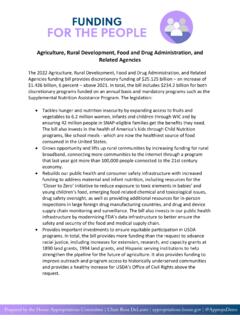
1 1 House Appropriations Committee Chairman Rodney Frelinghuysen Website address: Fiscal Year 2018 Transportation, Housing and Urban Development Funding Bill Legislation targets funding to essential infrastructure that will help keep the nation moving, and supports community development and housing programs. The fiscal year 2018 Transportation, Housing and Urban Development Appropriations bill includes funding for the Department of Transportation, the Department of Housing and Urban Development, and other related agencies. The bill includes $ billion in net discretionary spending $ billion above the fiscal year 2017 level. This large increase in funding, agreed to as part of the recent budget caps agreement, makes critical investments in transportation infrastructure.
2 The bill also includes funding for important community development and housing programs that will help our economy grow and thrive. Infrastructure Funding The bill provides an increase of $ billion above the fiscal year 2017 enacted level to begin to rebuild the nation s aging infrastructure. This funding is targeted to our nation s airports, roads, bridges, rail, and community development, and will create jobs and spur economic growth. Department of Transportation (DOT) The bill includes $ billion in discretionary Appropriations for the Department of Transportation for fiscal year 2018. This is $ billion above the fiscal year 2017 enacted level. In total budgetary resources, including offsetting collections, the bill provides $ billion to improve and maintain our nation s transportation infrastructure.
3 The bill targets funding to projects that will increase efficiency, safety, reliability, and quality of life for the traveling public, and that will help improve commerce and increase economic growth. Air The bill includes $18 billion in total budgetary resources for the federal Aviation Administration (FAA) $ billion above the fiscal year 2017 enacted level. These investments will help ease future congestion and help reduce delays for travelers in airspace. This includes full funding for all air traffic control personnel, including 14,500 air traffic controllers, 7,400 safety inspectors, and operational support personnel. In addition, this provides $ billion for NextGen investments, an increase of $239 million above the fiscal year 2017 enacted level. These investments will accelerate the modernization of the air traffic control system to ensure safe and reliable travel for the flying public, and to provide more certainty for the aviation industry.
4 The bill provides $165 million for the Contract Tower program and language to ensure that towers ready to enter the program are not delayed further. 2 The agreement provides an additional $1 billion in airport discretionary grants for airports with the greatest need for infrastructure improvements, particularly targeting small and rural airports. Highways The bill provides $45 billion from the Highway Trust Fund to be spent on the federal -aid Highways Program, which is $1 billion above the fiscal year 2017 enacted level. This funding mirrors the FAST Act authorized levels and will provide much needed growth and improvements within America s highway system. In addition, the bill provides an extra $ billion in discretionary highway funding a total increase of $ billion for roads and bridges over fiscal year 2017.
5 TIGER (National Infrastructure Investments) The multimodal TIGER program is funded at $ billion, a $1 billion increase over the fiscal year 2017 enacted level. This program will fund states and local communities most critical transportation projects, and language is included in the bill to ensure that at least 30% of these funds go to rural communities. Rail federal investments in rail infrastructure and safety programs are funded at $ billion, which is $ billion over the fiscal year 2017 enacted level. The bill provides a total of $ billion for Amtrak, of which $650 million is for Northeast Corridor grants and $ billion is to support the national network. The bill also continues to require overtime limits for Amtrak employees to reduce unnecessary costs.
6 Also included is funding for the federal -State Partnership for State of Good Repair grants at $250 million, which is $225 million above the fiscal year 2017 enacted level. This funding will address critical rail investments nationwide and on the Northeast Corridor needs that must be addressed to sustain current rail services. Rail safety and research programs are funded at $287 million, $29 million over the fiscal year 2017 enacted level. This will fund inspectors and training, plus maintenance and safety investments to the physical rail infrastructure, to help ensure the safety of passengers and local communities. Consolidated Rail Infrastructure and Safety Improvements grants are funded at $593 million, an increase of $525 million from the fiscal year 2017 enacted level, to fund capital and safety improvements, planning, environmental work, and research.
7 The bill also includes $250 million for grants to rail operators to install positive train control (PTC) technologies, which will significantly improve the safety of our rail system. Transit The bill provides $ billion in total budgetary resources for the federal Transit Administration (FTA) $1 billion above the fiscal year 2017 enacted level and $ billion above the request. Transit formula grants total $ billion consistent with the FAST Act to help local communities build, maintain, and ensure the safety of their mass transit systems. Within this amount, $ billion is included for Capital Investment Grants transit projects. New Starts projects are funded at $ billion, Core Capacity projects at $716 million, and Small Starts projects at $400 million. These programs provide competitive grant funding for major transit 3 capital investments including light rail, bus rapid transit, and commuter rail that are planned and operated by local communities.
8 The bill limits the federal match for New Starts projects to 51 percent. The bill provides an additional $834 million in transit infrastructure grants compared to the fiscal year 2017 level. This includes $400 million to help communities modernize their bus systems, and $400 million for capital assistance to transit systems across the country to maintain a state of good repair. Maritime The bill includes $980 million for the Maritime Administration, $457 million above the fiscal year 2017 enacted level. This funding will continue to increase the productivity, efficiency, and safety of the nation s ports and intermodal water and land transportation. The Maritime Security Program is funded at the full authorized level of $300 million. In addition, the bill provides $300 million for a new national security multi-mission vessel, and provides $121 million for the United States Merchant Marine Academy, including $52 million for capital improvements and repairs.
9 Road Safety The bill contains funding for the various transportation safety programs and agencies within the Department of Transportation. This includes $947 million in total budgetary resources for the National Highway Traffic Safety Administration, an increase of $36 million over the fiscal year 2017 enacted level, and $845 million for the federal Motor Carrier Safety Administration, $201 million above the fiscal year 2017 enacted level. Also included is $272 million for the Pipeline and Hazardous Materials Safety Administration, an increase of $8 million over the fiscal year 2017 enacted level. Within these amounts, the bill provides more than $100 million for research and demonstrations of automated vehicles, a technology that has the potential to save tens of thousands of lives.
10 In addition, the bill prohibits enforcement of the Electronic Logging Device regulation in the case of livestock and insect haulers for the remainder of fiscal year 2018. Housing and Urban Development (HUD) The legislation includes a net discretionary total of $ billion for the Department of Housing and Urban Development, an increase of $ billion above the fiscal year 2017 enacted level. Section 8 and Public and Native American Housing Included in the bill is $ billion for Public and Indian Housing. This is an increase of $ billion above the fiscal year 2017 enacted level, to continue assistance to all families and individuals currently served by these programs and to add thousands of new units for veterans and persons with disabilities. Funding for Native American Housing is also increased by $100 million.