Transcription of Definitions and abbreviations - KOOS
1 EWA ROOS3 OutcomeSomething that follows as a result1 Outcomes researchThe study of the end result of health services thattakes patients experiences, preferences, and valuesinto account2 QuestionnaireA set of questions for obtaining statistically useful orpersonal information from individuals; a survey madeby the use of a questionnaire. It includes standardizedquestions and response choices. Synonyms are mea-sure, test, tool, survey, or instrument3 ItemA single question or statement and its standardizedset of responses4 Generic measuresA category of health measures that are valued by alltypes of patients as well as general populations, andthat have reliability and validity to measure health inpopulations with diverse characteristics3 Disease-specific measuresFocus on particular complaints attributable to thedisease or condition of interest3, 4 Observer-administeredQuestions answered by respondents about themselvesmeasuresby responding to an interviewer s questionPatient-administeredRespondents read and answer the questions by themmeasures or Self-selves.
2 Without assistanceadministered measuresTest-retest reliabilityStability over time5 Internal consistencyBased on the average inter-item correlation andnumber of items5 Face validityExtent to which a measure looks like what it isintended to measure; whether respondents understand a measure s questions and find the answersappropriate3, 4 Content validityThe extent to which measures represent functions oritems of relevance given the purpose and matter atissue5 Criterion validityThe extent to which a measure corresponds to anDefinitions and abbreviations4 KNEE INJURY AND KNEE OSTEOARTHRITIS accurate or previously validated measure of the sameconcept4 Concurrent validityA form of validity in which the measure being testedand the comparison measure are administered at thesame point in time3 Construct validityThe degree to which an instrument measures thetheoretical construct it was designed to measure5 Convergent validitySeeing whether a measure displays the pattern ofconverging relationships it
3 Should5 WOMACW estern Ontario and MacMaster UniversitiesOsteoarthritis IndexKOOSKnee injury and Osteoarthritis Outcome ScoreSF-36 Short Form 36-item questionnaire derived from theMedical Outcome StudyACLA nterior Cruciate LigamentOAOsteoarthritisPost-traumatic OAOsteoarthritis that follows as a result of injury1 Webster s New Encyclopedic Dictionary, CM and Eisenberg JM, Science 1998; 282: 245 KM and Ware JE. Measuring and Monitoring Health-Related Quality of , MI: The Upjohn Company; AL and Ware JE, eds. Measuring Functioning and Well-being: The Medical Out-comes Study Approach. Durham, NC: Duke University Press; MV et al., Arch Phys Med Rehabil 1992; 73: S3 ROOS5 Knee injury and knee OAKnee osteoarthritis is common.
4 Joint disease, causing pain and functional limita-tions, is the most common chronic disease in the elderly, more common thanhigh blood pressure, heart disease, diabetes, etc (Havlik et al. 1986). The treat-ment of knee osteoarthritis is focused on pain control, initially by drugs or othermodalities, and at later stages by surgical replacement of the affected joint. InSweden more than 5,000, and in the USA more than 250,000 knee arthroplastiesare carried out yearly (Knutson et al. 1994).Although OA is primarily a disease of the older, knee OA is common at young-er age. It can be estimated that more than 5% of subjects between 35 and 54 yearsold have radiographic signs of knee OA (Tzonchev et al.)
5 1968, Hernborg andNilsson 1973, HANES 1 1979, Williams et al. 1994). In a Swedish populationstudy, including subjects between 35 and 54 years old without known knee inju-ry, the prevalence of radiographic tibiofemoral knee OA was % (Petersson etal. 1997). Knee injury is a known risk factor of radiographic as well as symptom-atic knee OA. Injury to the menisci or the anterior cruciate ligament causes 6/10,000 and 3/10,000 individuals, respectively, to seek medical care every year inDenmark (Hede et al. 1990, Buhl-Nielsen 1991). Approximately half of thesepatients have radiographic signs of knee OA after 10 15 years (Lohmander andRoos 1994, Roos et al. 1995, Roos et al. 1998b).
6 The majority of subjects underthe age of 50 undergoing tibial osteotomy because of symptomatic knee OA,have a previous injury to the anterior cruciate ligament or menisci (Odenbring etal. 1989). A high proportion of the population, in an age group with high de-mands on physical activity, is at risk of developing symptoms of knee OA. Thetreatment offered to these relatively young and active patients is symptom mod-ifying. This far, no treatment has been shown to modify the disease process ofosteoarthritis in measuresTraditionally, process measures like radiographs, laxity and other clinical findingshave been used to evaluate knee injury and knee OA. Clinical trials have usedthese measures as their primary dependent variables.
7 Seldom have patients pref-erences for outcomes been used to evaluate treatment; they have often been per-ceived as important but subjective and unreliable. However, we need to identifysources of cost without benefit, and the best treatment. Clinicians need to selectIntroduction6 KNEE INJURY AND KNEE OSTEOARTHRITIS effective treatments, and patients want to make informed treatment concerns have stimulated researchers in the clinical, quantitative, behav-ioral, and social sciences to expand the methods and metrics used to evaluate theeffects of health services. The number of valid patient-centered measures has in-creased dramatically, and the use of both generic and disease-specific patient-centered measures is recommended in clinical trials of OA (Altman et al.)
8 1996,Bellamy et al. 1997). It is well recognized that process measures and patient-related measures evaluate different aspects of knee injury and knee OA. Weakcorrelations and frequent discordance is found when comparing process mea-sures like radiographic findings and laxity to patient-relevant outcomes such aspain, function and activity level (Hadler 1992, Lethbridge-Cejku et al. 1995,Cicuttini et al. 1996, Snyder-Mackler et al. 1997).In summary, patient-relevant outcome measures are now promoted in generalhealth care, orthopedics, and sports medicine, and should be considered the pri-mary outcome measure in clinical trials (Amadio 1993, Johnson 1994, Altman etal.
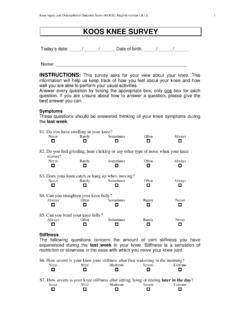
9 1996, Bellamy et al. 1997, Clancy and Eisenberg 1998).EWA ROOS7 GeneralThe overall purpose of the present study was to evaluate patient-relevant out-comes in patients with knee injury and post-traumatic osteoarthritis of the to evaluate short-term and long-term symptoms and function after meniscec-tomy, to validate the WOMAC Osteoarthritis Index for use in Sweden, to determine the sensitivity of the WOMAC Osteoarthritis Index for post-traumatic osteoarthritis, to develop a self-administered instrument, the Knee injury and OsteoarthritisOutcome Score (KOOS), to be used in the acute phase and over time, forassessment of patient-relevant outcomes in patients with anterior cruciate defi-ciency, meniscus injury, and cartilage damage or post-traumatic osteoarthritis, to evaluate the KOOS with regard to reliability, validity, and responsiveness, to evaluate the KOOS for use with assessment of reconstruction of the anteriorcruciate ligament, knee arthroscopy, and physical therapy, to validate the KOOS for use in North America and Sweden, to compare the KOOS to other instruments used for similar purposes anddiagnostic INJURY AND KNEE OSTEOARTHRITISI.
10 Roos E, stenberg A, Roos H, Ekdahl C, Lohmander LS. Long-term resultsof meniscectomy symptoms, function, and performance tests in patientswith or without radiographic osteoarthritis compared to matched Roos E, Roos H, Lohmander LS. WOMAC Osteoarthritis Index addition-al dimensions for use in post-traumatic osteoarthritis of the knee. Osteoar-thritis and Cartilage 7(3): 00 00, Roos E, Kl ssbo M, Lohmander LS. WOMAC Osteoarthritis Index reli-ability, validity, and responsiveness in patients with arthroscopically assessedosteoarthritis. Roos E, Roos H, Lohmander LS, Ekdahl C, Beynnon B. Knee injury andOsteoarthritis Outcome Score (KOOS) development of a self-adminis-tered outcome measure.