Example: dental hygienist
Delving Deep into Rectifiers: Surpassing Human-Level ...
method for deep rectifier networks (Sec. 2.2). 2.1. Parametric Rectifiers We show that replacing the parameter-free ReLU by a learned activation unit improves classification accuracy2. Definition. Formally, we define an activation function: f(yi)= yi, if yi > 0 aiyi, if yi ≤ 0. (1) Here yi is the input of the nonlinear activation f on ...
Tags:
Information
Domain:
Source:
Link to this page:
Documents from same domain

Convolutional Neural Networks at Constrained Time Cost
www.cv-foundation.orgConvolutional neural networks (CNNs) [15, 14] have re-cently brought in revolutions to the computer vision area. Deep CNNs not only have been continuously advancing the image classification accuracy [14, 21, 24, 1, 9, 22, 23], but also play as generic feature extractors for various recogni-tion tasks such as object detection [6, 9], semantic ...
Deep Convolutional Neural Fields for Depth Estimation From ...
www.cv-foundation.orgvolutional neural networks (CNN). CNN features have been setting new records for a wide variety of vision applica-tions [13]. Despite all the successes in classification prob-

Hierarchical Convolutional Features for Visual Tracking
www.cv-foundation.orgVisual representations are of great importance for object tracking. Numerous hand-crafted features have been used to represent the target appear-ance such as subspace representation [24] and color his-tograms [37]. The recent years have witnessed significant

Learning Spatiotemporal Features With 3D Convolutional ...
www.cv-foundation.orgthe networks lose their input’s temporal signal after the first convolution layer. Only the Slow Fusion model in [18] uses 3D convolutions and averaging pooling in its first 3convo-lution layers. We believe this is the key reason why it per-forms best …
Image Style Transfer Using Convolutional Neural Networks
www.cv-foundation.orgImage Style Transfer Using Convolutional Neural Networks Leon A. Gatys Centre for Integrative Neuroscience, University of Tubingen, Germany¨ Bernstein Center for Computational Neuroscience, Tubingen, Germany¨
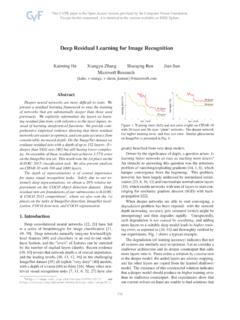
Deep Residual Learning for Image Recognition
www.cv-foundation.orgthe residual learning principle is generic, and we expect that it is applicable in other vision and non-vision problems. 2. Related Work Residual Representations. In image recognition, VLAD [18] is a representation that encodes by the residual vectors with respect to a dictionary, and Fisher Vector [30] can be
Single-Image Crowd Counting via Multi-Column …
www.cv-foundation.orgSingle-Image Crowd Counting via Multi-Column Convolutional Neural Network Yingying Zhang Desen Zhou Siqin Chen Shenghua Gao Yi Ma Shanghaitech University {zhangyy2,zhouds,chensq,gaoshh,mayi}@shanghaitech.edu.cn Abstract ... column CNN is adaptive to (hence the overall network

Unsupervised Visual Representation Learning by Context ...
www.cv-foundation.orghigh-resolution natural images. Unsupervisedrepresentation learning can also be formu-lated as learning an embedding (i.e. a feature vector for each image) where images that are semantically similar are close, while semantically different ones are far apart. One way to build such a representation is to create a supervised

Predicting the Future Behavior of a Time-Varying ...
www.cv-foundation.orgPredicting the Future Behavior of a Time-Varying Probability Distribution Christoph H. Lampert IST Austria chl@ist.ac.at Abstract We study the problem of predicting the future, though

NTU RGB+D: A Large Scale Dataset for 3D Human Activity ...
www.cv-foundation.orgMultiview 3D event [43] and Northwestern-UCLA [40] datasets used more than one Kincect cameras at the same time to collect multi-view representations of the same ac-tion, and scale up the number of samples. It is worth mentioning, there are more than 40 datasets specifically for 3D human action recognition [47]. Al-
Related documents

DeCAF: A Deep Convolutional Activation Feature for …
proceedings.mlr.pressDeCAF: A Deep Convolutional Activation Feature for Generic Visual Recognition (a) LLC (b) GIST (c) DeCAF 1 (d) DeCAF 6 Figure 1. This figure shows several t-SNE feature visualizations on the ILSVRC-2012 validation set. (a) LLC , (b) GIST, and features derived from our CNN: (c) DeCAF 1, the first pooling layer, and (d) DeCAF
Image Style Transfer Using Convolutional Neural Networks
www.cv-foundation.orgcent advance of Deep Convolutional Neural Networks [18] ... tent in generic feature representations that generalise across datasets [6] and even to other visual information processing tasks [19, 4, 2, 9, 23], including texture recognition [5] and ... ij is the activation of the ith filter at position j in layer l.

Learning Deep Features for Discriminative Localization
cnnlocalization.csail.mit.eduweights of the output layer on to the convolutional feature maps, a technique we call class activation mapping. As illustrated in Fig. 2, global average pooling outputs the spatial average of the feature map of each unit at the last convolutional layer. A weighted sum of these values is used to generate the final output. Similarly, we compute a

SuperPoint: Self-Supervised Interest Point Detection and ...
openaccess.thecvf.comlearning problem, and the Scale-Invariant Feature Trans-form, or SIFT [15], is still probably the most well-known traditional local feature descriptor in computer vision. Our SuperPoint architecture is inspired by recent ad-vances in applying deep learning to interest point detection and descriptor learning. At the ability to match image sub-
Siamese Neural Networks for One-shot Image Recognition
www.cs.cmu.edubetween the twin feature vectors h 1 and h 2 combined with a sigmoid activation, which maps onto the interval [0;1]. Thus a cross-entropy objective is a natural choice for train-ing the network. Note that in LeCun et al., they directly learned the similarity metric, which was implictly defined by the energy loss, whereas we fix the metric as ...
![ABSTRACT arXiv:1409.1556v6 [cs.CV] 10 Apr 2015](/cache/preview/d/2/a/9/a/d/7/f/thumb-d2a9ad7f8b909a1967014d58c0440543.jpg)
ABSTRACT arXiv:1409.1556v6 [cs.CV] 10 Apr 2015
arxiv.orgarXiv:1409.1556v6 [cs.CV] 10 Apr 2015 Published as a conference paper at ICLR 2015 VERY DEEP CONVOLUTIONAL NETWORKS FOR LARGE-SCALE IMAGE RECOGNITION Karen Simonyan∗ & Andrew Zisserman+ Visual Geometry Group, Department of Engineering Science, University of Oxford

SuperPoint: Self-Supervised Interest Point Detection and ...
arxiv.orgcoder consists of convolutional layers, spatial downsam-pling via pooling and non-linear activation functions. Our encoder uses three max-pooling layers, letting us define H c = H=8 and W c = W=8 for an image sized H W. We refer to the pixels in the lower dimensional output as “cells,” where three 2 2 non-overlapping max pooling op-

Deep Image Prior - CVF Open Access
openaccess.thecvf.commation contained within the activations of deep neural net-works. For this, we consider the “natural pre-image” tech-nique of [21], whose goal is to characterize the invariants learned by a deep network by inverting it on the set of nat-ural images. …
Squeeze-and-Excitation Networks
openaccess.thecvf.comSqueeze-and-Excitation Networks Jie Hu1∗ Li Shen2∗ Gang Sun1 hujie@momenta.ai lishen@robots.ox.ac.uk sungang@momenta.ai 1 Momenta 2 Department of Engineering Science, University of Oxford Abstract Convolutional neural networks are built upon the con-