Transcription of DEMONSTRATING
1 DDDDDEMONSTRAEMONSTRAEMONSTRAEMONSTRAEMO NSTRATINGTINGTINGTINGTINGYYYYYOUROUROURO UROURPPPPPROGRAM SROGRAM SROGRAM SROGRAM SROGRAM SWWWWWORTHORTHORTHORTHORTHA Primer on Evaluation for ProgramsA Primer on Evaluation for ProgramsA Primer on Evaluation for ProgramsA Primer on Evaluation for ProgramsA Primer on Evaluation for Programsto Prevent Unintentional Injuryto Prevent Unintentional Injuryto Prevent Unintentional Injuryto Prevent Unintentional Injuryto Prevent Unintentional InjuryNancy J. Thompson, PhDHelen O. McClintockNational Center for Injury Prevention and ControlAtlanta, Georgia1998 Second Printing (with revisions), March 2000 DEMONSTRATING Your Program s worth is a publication of the National Center forInjury Prevention and Control, Centers for Disease Control and Prevention:Centers for Disease Control and PreventionJeffrey P.
2 Koplan, MD, MPH, DirectorNational Center for Injury Prevention and ControlStephen B. Thacker, MD, MSc, DirectorDivision of Unintentional Injury PreventionChristine M. Branche, PhD, DirectorProduction services were provided by the staff of the Office of Health CommunicationResources, National Center for Injury Prevention and Control:Graphic DesignMarilyn L. KirkCover DesignBeverly ChardayMary Ann BraunText Layout and DesignSandra S. EmrichSuggested Citation: Thompson NJ, McClintock HO. DEMONSTRATING Your Program sWorth: A Primer on Evaluation for Programs To Prevent Unintentional : Centers for Disease Control and Prevention, National Center for InjuryPrevention and Control, wrote this book to show program managers how todemonstrate the value of their work to the public, to theirpeers, to funding agencies, and to the people they other words, we re talking about how to evaluateprograms a scary proposition for some managers.
3 Ourpurpose is to reduce the scare factor and to show thatmanagers and staff need not be apprehensive about whatevaluation will cost or what it will that there are two ways an injury-preventionprogram can be successful. The obvious way is if it reducesinjuries and injury-related deaths. The other way is if it showsthat a particular intervention does not work. A program istruly worthwhile if it implements a promising interventionand, through evaluation, shows that the intervention does notreduce injuries. Such a result would be of great value to theinjury prevention community: it would save you and otherprograms from wasting further resources and time on thatparticular this book, we show why evaluation is worth the resourcesand effort involved.
4 We also show how to conduct simpleevaluation, how to hire and supervise consultants for complexevaluation, and how to incorporate evaluation activities intothe activities of the injury prevention program itself. Bylearning to merge evaluation and program activities, managerswill find that evaluation does not take as much time, effort, ormoney as they acknowledge and appreciate the contributions of several colleagues:Dr. Suzanne Smith saw the need for this primer and began the project;Drs. Terry Chorba and David Sleet enumerated the various types ofinjury programs (page 73); and Dr. Jeffrey Sacks, Dr. Katherine Miner,Dr.
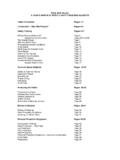
5 David Sleet, Ms. Susan Hardman, and Mr. Roger Trent reviewed thecontent and provided invaluable 1 How This Primer Is Organized 3 Section 1: General Information 5 Section 2: Stages of Evaluation 19 Section 3: Methods of Evaluation 35 References 69 Appendix A: Examples of Questions to Ask, Events to Observe, and Who or What to Count 71 Appendix B: Sample Forms 107 Appendix C: Checklist of Tasks 113 Appendix D: Bibliography 117 Appendix E: Glossary 121 Comment Form 125 IIIIINTRODUCTIONNTRODUCTIONNTRODUCTIONNT RODUCTIONNTRODUCTIONAll too often public health programs do wonderful work thatis not properly recognized by the public, by other health careprofessionals, or even by the people who benefit directlyfrom the program s accomplishments.
6 Why should this be? Inmost cases, it is because program managers and staff stronglybelieve that their work is producing the desired results buthave no solid evidence to demonstrate their success to peopleoutside their program. In other words, such programs aremissing one key component: , without objective evaluation, programmanagers and staff cannot show that their work is having abeneficial effect, and other public health programs cannotlearn from their addition, without adequate evaluation, programs cannotpublish the results of their work in medical, scientific, orpublic health journals, and they cannot show fundingagencies that their work is successful.
7 Obviously programsthat produce facts and figures to prove their success are morelikely to publish the results of their work and more likely toreceive continued funding than are programs that cannotproduce such here is another important point about evaluation. Itshould begin while the program is under development,not after the program is complete. Indeed, evaluation isan ongoing process that begins as soon as someone has theidea for a program; it continues throughout the life of theprogram; and it ends with a final assessment of how wellthe program met its must evaluation begin so early? Consider, for example,if you were to set up a program to provide free smokedetectors to low socioeconomic households.
8 You put flyersin the mail boxes of people you want to reach, inviting themto come by your location for a free detector. Many peoplerespond but not as many as you expected. Why?To find out, you evaluate. Perhaps you learn that yourlocation is not on a bus line and many people in your targetpopulation do not own cars. Or, perhaps, the language in Introduction - 12 - Introductionyour flyer is too complex to be easily understood by the peopleyou want to read it. So you rewrite your flyer or move yourlocation. Would it have been better to test the language in theflyer for readability and to assess the convenience of yourlocation before beginning the program?
9 Yes. It would havesaved time and money not to mention frustration for theprogram , the moral is this: evaluate, and evaluate early. The earlierevaluation begins, the fewer mistakes are made; the fewermistakes made, the greater the likelihood of success. In fact,for an injury prevention program to truly show success,evaluation must be an integral part of its design and opera-tion: evaluation activities must interweave with andsometimes merge into program activities. If a program iswell designed and well run, evaluating the final results canbe a straightforward task of analyzing information gatheredwhile the program was in operation.
10 In all likelihood, theresults of such an analysis will be extremely useful, not onlyto your own program but to researchers and to other injuryprevention help program managers avoid difficulty with evaluation,we produced this primer. Its purpose is to help injuryprevention programs understand 1) why evaluation is worththe resources and effort involved, 2) how evaluation is con-ducted, and 3) how to incorporate evaluation into programsto prevent unintentional injuries. This primer can also helpprogram managers conduct simple evaluation, guide them inhow to hire consultants for more complex evaluation, andallow them to oversee the work of those consultants in aninformed we want to practice what we preach, we ask that youhelp us with our evaluation of this book.