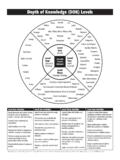
Transcription of Depth of Knowledge (DOK) Levels
1 Depth of Knowledge (DOK) Levels Draw Identify List De ne Label Memorize Calculate Illustrate Arrange Who, What, When, Where, Why Measure State Name Repeat Tabulate Report Infer Tell Use Design Recall Quote Recognize Categorize Recite Match Collect and Display Connect Level Identify Patterns Synthesize One Graph Organize (Recall) Classify Construct Apply Concepts Level Level Separate Describe Modify Four Explain Two Cause/Effect (Extended Interpret (Skill/ Predict Critique Estimate Thinking) Concept). Compare Interpret Level Distinguish Analyze Relate Three (Strategic Thinking) Use Context Cues Create Make Observations Revise Assess Develop a Logical Argument Summarize Prove Apprise Construct Use Concepts to Solve Non-Routine Problems Show Critique Compare Explain Phenomena in Terms of Concepts Formulate Investigate Draw Conclusions Hypothesize Differentiate Cite Evidence Level One Activities Level Two Activities Level Three Activities Level Four Activities Recall elements and details of story Identify and summarize the major Support ideas with details and Conduct a project that requires structure, such as sequence of events in a narrative.
2 Examples. specifying a problem, designing and events, character, plot and setting. conducting an experiment, analyzing Use context cues to identify the Use voice appropriate to the its data, and reporting results/. Conduct basic mathematical meaning of unfamiliar words. purpose and audience. solutions. calculations. Identify research questions and Solve routine multiple-step problems. Apply mathematical model to Label locations on a map. design investigations for a illuminate a problem or situation. Describe the cause/effect of a scienti c problem. Represent in words or diagrams a particular event. Analyze and synthesize scienti c concept or relationship. Develop a scienti c model for a information from multiple sources. Identify patterns in events or complex situation. Perform routine procedures like behavior. Describe and illustrate how common Determine the author's purpose themes are found across texts from measuring length or using Formulate a routine problem given and describe how it affects the different cultures.
3 Punctuation marks correctly. data and conditions. interpretation of a reading Describe the features of a place or selection. Design a mathematical model to Organize, represent and interpret inform and solve a practical people. data. Apply a concept in other contexts. or abstract situation. Webb, Norman L. and others. Web Alignment Tool 24 July 2005. Wisconsin Center of Educational Research. University of Wisconsin-Madison. 2 Feb. 2006. < >. DOK Question Stems DOK 1 DOK 2. Can you recall_____? Can you explain how ____ affected ____? When did ____ happen? How would you apply what you learned Who was ____? to develop ____? How can you recognize____? How would you compare ____? What is____? Contrast_____? How can you find the meaning of____? How would you classify____? Can you recall____? How are____alike? Different? Can you select____? How would you classify the type of____?
4 How would you write___? What can you say about____? What might you include on a list How would you summarize____? about___? How would you summarize___? Who discovered___? What steps are needed to edit___? What is the formula for___? When would you use an outline to ___? Can you identify___? How would you estimate___? How would you describe___? How could you organize___? What would you use to classify___? What do you notice about___? DOK 3 DOK 4. How is ____ related to ____? Write a thesis, drawing conclusions from What conclusions can you draw _____? multiple sources. How would you adapt____to create a Design and conduct an experiment. different____? Gather information to develop How would you test____? alternative explanations for the results of Can you predict the outcome if____? an experiment. What is the best answer? Why? Write a research paper on a topic.
5 What conclusion can be drawn from Apply information from one text to these three texts? another text to develop a persuasive What is your interpretation of this text? argument. Support your rationale. What information can you gather to How would you describe the sequence support your idea about___? of____? DOK 4 would most likely be the writing of What facts would you select to a research paper or applying information support____? from one text to another text to develop Can you elaborate on the reason____? a persuasive argument. What would happen if___? DOK 4 requires time for extended Can you formulate a theory for___? thinking. How would you test___? Can you elaborate on the reason___? From Depth of Knowledge Descriptors, Examples and Question Stems for Increasing Depth of Knowledge in the Classroom Developed by Dr. Norman Webb and Flip Chart developed by Myra Collins Depth of Knowledge Level 3 Depth of Knowledge Level 4.
6 Students provide support for reasoning, apply complex and Students make connections, related ideas within the content or abstract thinking, and make decisions. among content areas, and devise one approach among alternatives on how a situation can be solved. Engagement Prompts Engagement Prompts What makes ____better than/superior to_____? Investigate and draw conclusions about how _____ impacts the world Explain or connect ideas using supporting evidence to _____. today. Analyze/synthesize information within one data source or text. How would you adapt ____to create _____that would be applicable What is the recurring theme in _____? in the real world? Provide supporting details. Support your rationale. Analyze and explain multiple perspectives/issues within or across time Evaluate and provide rationale. periods, events, or cultures. Verify the reasonableness of _____.
7 Analyze how similar themes or ideas are developed in multiple texts. What is your interpretation of _____? Evaluate for real-world occurrence. Cite evidence and develop a logical argument for _____. Design ___to improve___. How is _____ related to _____? Justify your choice. How would you adapt _____to_____? Gather, organize, and interpret information from multiple sources. How would your test _____? Write a research report. What would happen if _____? Strategic thinking Extended thinking DOK Level 3 requires higher cognitive demands than the previous DOK Level 4 requires complex reasoning and time to research, plan, Levels . Students explain/justify thinking and provide supporting and problem solve, and think. Tasks involve investigation or evidence for reasoning or conclusions drawn. Level 3 tasks typically application to the real world and include none-routine manipulations require reasoning, complexity, developing a plan or sequence of steps, or connections with and across discipline, content areas, and multiple and have more than one possible response or solution.
8 Sources. Students select one approach among many alternatives. Tasks usually occur over an extended period of time *From Dept-of Knowledge Levels for Four Content Areas by Webb, N. Revised Bloom's Taxonomy Revised Bloom's Taxonomy Revised Bloom's Taxonomy Level 4 Apply Level 5 Analyze Level 6 Create The student makes use of information in a The student breaks learned information into The student creates new ideas, context different from the one in which it was parts to explore understandings and products, or viewpoints from previously learned. relationships. learned information. Engagement Prompts Engagement Prompts Engagement Prompts Which other way would you choose to Determine if the information is based on fact or What changes could you make to _____? opinion. revise_____? Use other attributes/characteristics to group/sort Explain what must have happened when_____.
9 What theory can you propose for _____? _____. What conclusions can you draw_____? Develop a plan/proposal that _____? Explain another situation where _____. Which events could not have happed? What might be a solution to _____? Which factors would you change if _____? What is similar to or different from_____? How many ways can you _____? What questions would you ask of _____? What is the motive/underlying How could you improve_____? Which actions would you take if _____? them/message_____? Devise your own way to _____. What would the result be if _____? What are other possible outcomes? What might happen if _____? Why does _____Work? Distinguish between _____. Generate hypotheses _____. What is the relationship_____? What are the alternatives? Design a _____to _____. Apply (level 4) Analyze (level 5) Create (Level 6). Carry out or use a procedure in a given situation Break down a concept or idea into parts and Combine elements or ideas to form a whole.
10 Determine the relationships among the parts. reorganized elements or ideas into new patterns or structures. Cognitive Processes Cognitive Processes Cognitive Processes Carrying out Differentiation Discrimination Construction Executing Distinguishing Finding Coherence Hypothesizing Implementing Focusing Integrating Designing Using Attributing Deconstruction Planning Outlining Organizing Generating Producing *From Dept-of Knowledge Levels for Four Content Areas by Webb, N. Making Connections Grades 6-12.