Transcription of Developing an American Credentials Framework: Learning ...
1 International Qualifications Frameworks September 2014 Page 1 Developing an American Credentials framework : Learning from International Experiences and Re-Examining the Credentialing System Since the late 1990s, the development of national Qualifications Frameworks (NQFs)1 has been a major international trend in reforming national education and training credentialing systems, initially mostly among English-speaking developed countries. To date, over 150 countries throughout the world have recognized their value to economic competiveness and the desire to attract skilled talent to their economy. While there are a number of potential benefits, as many studies attest to, the international experience suggests that the development of an NQF can also be technically, institutionally and financially demanding.
2 Establishing an NQF, in a mechanical sense, may be a relatively quick exercise. However, it takes time to achieve results in terms of more people participating in training or improving the quality of training. It is important to understand both the preconditions and potential pitfalls and how it can be developed, especially the technical and institutional complexity. While an NQF can be a useful tool in addressing a number of the skills challenges, there is no single or universal form of NQF which can solve all skills problems. Its implementation needs to be fit-for-purpose with clear objectives in mind. Without clear objectives and an understanding of how an NQF can best be developed, NQF implementation can be a lengthy and costly investment.
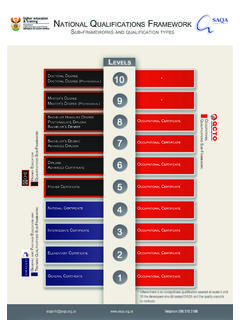
3 In their most basic sense NQFs can be understood as classifiers specifying the relationship horizontally and vertically- between different qualifications. This is not a new idea. For many centuries the trade organizations in many countries have exercised control over the right to practice in relation to explicitly defined hierarchies of skills within the trades. Parallel hierarchies were developed by universities and have been widely accepted as regulators of academic progression - within and between countries. These well-known arrangements can be seen as forerunners of the national and international qualifications frameworks currently being developed and implemented. What is new about the modern national qualification frameworks is the interest of governments in Developing comprehensive frameworks that incorporate qualifications from different education and training sectors (general, vocational and academic).
4 The new frameworks are thus often linked to lifelong Learning strategies and are also in many cases open to the Learning taking place outside formal education and training, at work and in leisure. These modern NQFs potentially go beyond the role of classifiers ( qualification grids ) and aim at a redefinition of the way qualifications are related to each other, how they are valued and eventually put into use in our societies. Modern NQFs can thus be described as instruments with a vision questioning current education and training practices and challenging existing professional and sectoral interests. 1 Internationally, the word qualifications is the primary term used to describe the competencies an individual has attained or that a credential represents.
5 In the United States, the term Credentials is used instead. Throughout this discussion, both terms will be used depending on the domestic or international context. International Qualifications Frameworks September 2014 Page 2 Designing an NQF is thus something more than agreeing one set of technical features (a hierarchy of levels of Learning ); it is about creating a platform for cross-institutional and cross-sectoral dialogue and eventually mutual trust. A comprehensive national Qualifications framework is something distinct from overarching frameworks. It covers all levels and parts of education. Many of the national qualifications frameworks that have been developed so far are comprehensive.
6 The European Qualifications framework (EQF) is a comprehensive and overarching framework , since it covers several systems and all levels and kinds of education. The QF-European Higher Education Area (EHEA) is overarching, since it covers several education systems, but, similar to the DQP, it is not comprehensive, since it covers only higher education. Reflecting the above vision of comprehensive NQFs, the last few years have seen a dramatic increase in interest and activity. What are Qualifications Frameworks and what are their Benefits? 1. A framework provides a common language and structure to understand and describe the underlying Learning outcomes and competencies represented by any credential. 2.
7 Qualifications Frameworks can assist us in answering two critical questions: Does our curriculum reflect the competences that a specific business/industry sector wants their employees to know and be able to do? And can our graduates at whatever credential level or point in the career pathway demonstrate that what they know and can do? 3. NQFs are mainly platforms for extensive cooperation and dialogue between national stakeholders, between users and providers of qualification and certification. Their added value very much depends on the quality of this cooperation. 4. NQFs can serve as an external and shared reference point. Whether the emerging NQFs in other countries should be understood as communication or reforming frameworks will depend on whether they actively inform and influence the definition and description of qualifications.
8 It will also depend on whether they take on the role of national gatekeepers, thus defining the scope and character of the overall national qualification system. 5. Qualifications Frameworks reflect global education and training trends including: A converging demand for a workforce with multi-skills and cross-functional competencies as appropriate problem solvers in work process; workers must be lifelong learners who have learned how to learn and apply knowledge and innovation to new ideas and methods (beyond the expert to adaptive expertise); promote our global competitiveness and increase our workers employability by assessing Learning of competencies and ensure up to date certified standards along with appropriate Learning content and training methods.
9 And respond to a growing demand for transparency of sector specific competencies and occupational qualifications to promote national and international mobility. 6. qualification Frameworks promote transparency, coordination and quality assurance among multiple higher education systems. In Europe, for example, the results have included: the award of comparable degrees based upon defined, criterion-referenced Learning outcomes; promotion of college access and student mobility; an embracing of the need for increased degree attainment; and shared approaches to ensure educational quality. In the decentralized educational and credentialing infrastructure of the US, Credentials of all types and forms are developed and conferred by multiple institutions and bodies without a common structure or standard.
10 While this approach is both market driven and supportive of International Qualifications Frameworks September 2014 Page 3 continued innovation, the actual content, Learning outcomes and quality of a credential are not clear or obvious to the individuals making educational or preparation choices, the educators that have to make educational decisions, or the employer that must interpret and rely on the evidence represented by a specific credential. Major Options in Developing Qualifications (Credential) Frameworks At the macro level, there are two types of frameworks and the international examples studied cover the entire spectrum of possibilities.