Transcription of DIBELS Next Benchmark Goals and Composite Score
1 DIBELS is a registered trademark of Dynamic Measurement Group, Inc. Next Benchmark Goals and Composite Score Dynamic Measurement Group, Inc. / December 1, 2010 Benchmark Goals DIBELS Benchmark Goals are empirically derived, criterion-referenced target scores that represent adequate reading prog-ress. A Benchmark goal indicates a level of skill where the student is likely to achieve the next DIBELS Benchmark goal or reading outcome. Benchmark Goals for DIBELS are based on research that examines the predictive validity of a Score on a measure at a particular point in time, compared to later DIBELS measures and external outcome assessments. If a student achieves a Benchmark goal, then the odds are in favor of that student achieving later reading outcomes if he/she receives research-based instruction from a core classroom Goal ResearchThe DIBELS Next Benchmark Goals , cut points for risk, and Composite Score were developed based upon data collected in a study conducted during the 2009 2010 school year.
2 The Goals represent a series of conditional probabilities of meet-ing later important reading outcomes. The external criterion was the Group Reading and Diagnostic Evaluation (GRADE; Williams, 2001). The 40th percentile on the GRADE assessment was used as an indicator that the student was making adequate progress in acquisition of important early reading and/or reading skills. Data for the study were collected in thirteen elementary and middle schools in five states. Data collection included administering the DIBELS Next measures to participating students in grades K 6 in addition to the GRADE. Participants in the study were 3816 students across grades K-6 from general education classrooms who were receiving English language reading instruction, including students with disabilities and students who were English language learners provided they had the response capabilities to participate.
3 The study included both students who were struggling in reading and those who were typically achieving. A subset of the total sample participated in the GRADE assessment (n = 1306 across grades K 6). Additional information about the study will be included in the DIBELS Next Technical Manual, which will be available in January, Points for RiskThe cut points for risk indicate a level of skill below which the student is unlikely to achieve subsequent reading Goals without receiving additional, targeted instructional support. Students with scores below the cut point for risk are identified as likely to need intensive support. Intensive support refers to interventions that incorporate something more or something different from the core curriculum or supplemental support. Intensive support might entail: delivering instruction in a smaller group, providing more instructional time or more practice, presenting smaller skill steps in the instructional hierarchy, providing more explicit modeling and instruction, and/or providing greater scaffolding and practiceBecause students needing intensive support are likely to have individual and sometimes unique needs, we recommend that their progress be monitored frequently and their intervention modified dynamically to ensure adequate progress.
4 Between a Benchmark goal and a cut point for risk is a range of scores where the student s future performance is harder to predict. To ensure that the greatest number of students achieve later reading success, it is best for students with scores in this range to receive carefully targeted additional support in the skill areas where they are having difficulty, to be moni-tored regularly to ensure that they are making adequate progress, and to receive increased or modified support if neces-sary to achieve subsequent reading Goals . This type of instructional support is referred to as strategic is a registered trademark of Dynamic Measurement Group, Inc. 1 provides the target or design odds of achieving later reading outcomes and labels for likely need for support for each of the Score levels. Benchmark Goals and cut points for risk are provided for the DIBELS Composite Score as well as for individual DIBELS 1.
5 Odds of Achieving Subsequent Early Literacy Goals , DIBELS Next Benchmark Goal Levels, and Likely Need for SupportOdds of achieving subsequent early literacy goalsVisual RepresentationScore LevelLikely need for support to achieve subsequent early literacy goals80% to 90%At or Above Benchmarkscores at or above the Benchmark goalLikely to Need Core Support40% to 60%Below Benchmarkscores below the Benchmark goal and at or above the cut point for riskLikely to Need Strategic Support10% to 20%Well Below Benchmarkscores below the cut point for riskLikely to Need Intensive SupportDIBELS Composite ScoreThe DIBELS Composite Score is a combination of multiple DIBELS scores and provides the best overall estimate of the student s early literacy skills and/or reading proficiency. Most data management services will calculate the DIBELS Com-posite Score for you. To calculate the DIBELS Composite Score yourself, see the DIBELS Next Composite Score Work-sheets.
6 In DIBELS 6th Edition, the Instructional Recommendations provided the best overall estimate of the student s early literacy skills and/or reading proficiency. The DIBELS Next Composite Score and the Benchmark Goals and cut points for risk based on the Composite Score replace the Instructional Recommendations on DIBELS 6th Goals and cut points for risk for the DIBELS Composite Score are based on the same logic and procedures as the individual DIBELS measures; however, since the DIBELS Composite Score provides the best overall estimate of a stu-dent s skills, the DIBELS Composite Score should generally be interpreted first. If a student is at or above the Benchmark goal on the DIBELS Composite Score , the odds are in the student s favor of reaching later important reading outcomes. Some students who Score at or above the DIBELS Composite Score Benchmark goal may still need additional support in one of the basic early literacy skills, as indicated by a below Benchmark Score on an individual DIBELS Next measure (FSF, PSF, NWF, DORF, or Daze), especially for students whose Composite Score is close to the Benchmark the scores used to calculate the DIBELS Composite Score vary by grade and time of year, it is important to note that the Composite Score generally cannot be used to directly measure growth over time or to compare results across grades or times of year.
7 However, because the logic and procedures used to establish Benchmark Goals are consistent across grades and times of year, the percent of students at or above Benchmark can be compared, even though the mean scores are not Asked Questions About DIBELS Next Benchmark Goals1. Why doesn t Letter Naming Fluency have Benchmark Goals ?Answer:Letter Naming Fluency (LNF) is an indicator of risk, rather than an instructional target. While the ability to recognize and name letters in preschool and at the beginning of kindergarten is a strong predictor of later reading achievement ( ,Badian, 1995; Walsh, Price, and Gillingham, 1988), studies have failed to show that teaching letter names to students enhances their reading ability ( , Ehri, 1983) and, in fact, have demonstrated that successful learning of letter-sound DIBELS is a registered trademark of Dynamic Measurement Group, Inc. that leads to reading acquisition can occur without knowledge of letter names (Bruck, Genesee, & Caravolas, 1997; Mann & Wimmer, 2002).
8 Because learning letter names is not a powerful instructional target, Benchmark Goals are not provided for LNF. LNF is a strong predictor of later reading, however, so it is included as a part of the DIBELS Composite Score in kindergarten and early first Why are the sixth grade Benchmark Goals lower than the fifth grade Goals ?Answer:The difficulty level of the passages used for DORF and Daze changes by grade, so Composite scores and Benchmark Goals can t be directly compared across grades. The difficulty level of the passages increases by grade in a roughly linear fashion. However, student performance increases in a curve, with the most growth occurring in the earlier grades, and slower growth in the upper grades. Between fifth and sixth grade, the difficulty level of the materials increases at a faster rate than student performance, so Benchmark Goals are lower in sixth grade than in , (1995).
9 Predicting reading ability over the long term: The changing role of letter naming, phonological awareness and orthographic processing. Annals of Dyslexia, 45, , M., Genesee, F., & Caravolas, M. (1997). A cross-linguistic study of early literacy acquisition. In B. Blachman (Ed.), Foundations of reading acquisition and dyslexia: Implications for early intervention (pp. 145-162). Mahwah, NJ: Lawrence Erlbaum , (1983). A critique of five studies related to letter-name knowledge and learning to read. In L. Gentile, M. Kamil, & J. Blanchard (Eds.), Reading research revisisited (pp. 143-153). Columbus, OH: , , & Wimmer, H. (2002). Phoneme awareness and pathways into literacy: A comparison of German and American children. Reading and Writing: An Interdisciplinary Journal, 15, , , Price, , & Gillingham, (1988). The critical but transitory importance of letter naming. Reading Research Quarterly, 23, , (2001).
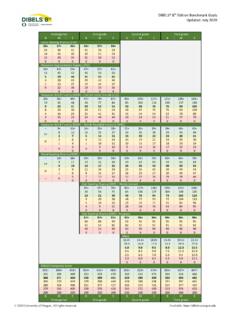
10 Group Reading Assessment and Diagnostic Evaluation (GRADE). New York: Next: Summary of Benchmark Goals and Cut Points for Risk261221191131301551411902382202853302 9033039135737241534435838013858997100111 1091451801802352802452903302583103402802 853241030520No Benchmark set for LNF204040102525 Correct Letter Sounds17282743585481518334735 Whole Words Read1813130366 Words Correct234752728770861009010311511112013 0107109120163237556555688070799596101105 909295 Accuracy78%90%90%96%97%95%96%97%96%97%98 %98%98%99%97%97%98%68%82%81%91%93%89%92% 94%93%94%95%95%96%97%94%94%96%Retell1516 2127202630273033333636272932081318101820 142024222525161824 Retell Quality of Response22223223233223111121121221128111 9151724182024181921571410122012131814141 5 BegMidEndBegMidEndBegMidEndBegMidEndBegM idEndBegMidEndBegMidEndKindergartenFirst GradeSecond GradeThird GradeFourth GradeFifth GradeSixth GradeThis is a summary of the DIBELS Next Benchmark Goals .