Transcription of Differentiation for Learning Profile - ASCD
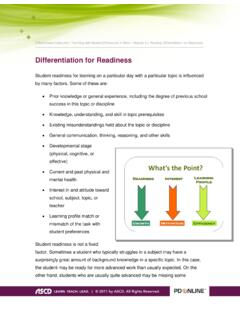
1 Differentiated Instruction: Teaching with Student Differences in Mind > Module 3 > Reading: Differentiation for Learning Profile _____ Differentiation for Learning Profile Good teachers have always known to vary their teaching style and combine modalities as often as possible to reach learners who are both like and unlike them in the classroom. When students are allowed to work in ways that are comfortable for them, they are more efficient in their Learning . Differentiation for Learning Profile goes beyond just providing variety over time. It is a proactive approach in which teachers sometimes design different options that reflect students Learning preferences, with all activities leading to the same outcomes. Differentiation for Learning Profile occurs when students are allowed to work in different ways simultaneously, rather than waiting for their turn in the Learning Profile rotation. Learning Profile refers to a wide variety of ways in which learners vary in how they prefer to deal with content, process, and product.
2 Learning Profile includes attention to intelligence preferences, Learning styles, and cultural and gender differences. Teachers new to Learning Profile Differentiation may focus on one aspect, such as visual, auditory, tactile/kinesthetic Learning styles or intelligences strengths outlined in the work of Howard Gardner or Robert Sternberg. As teachers become more experienced with Differentiation , they will Differentiated Instruction: Teaching with Student Differences in Mind > Module 3 > Reading: Differentiation for Learning Profile Page | 2 _____ The teacher s challenge when differentiating for Learning Profile is to Find ways of identifying student Learning preferences. Use that information to design Differentiation options. Ensure that all students reach the same KUDs no matter which task they choose or are assigned.
3 Balance opportunities for students to work in preferred modalities with less-preferred ones. branch out and consider a variety of aspects for addressing student Learning Profile . In this way, students are likely to work with a greater variety of classmates over time. What Does Differentiation for Learning Profile Look and Sound Like? When differentiating for student Learning Profile , teachers often vary one or more of the following: Topics or aspects of topics related to unit content Activities that students use to process or make sense of unit information Products or the ways students show what they have learned in the unit. One of the simplest ways to differentiate for Learning Profile is to give students a choice, when appropriate, of working alone or with a partner (process Differentiation ). Some students abhor working in groups, while others benefit from it. This preference may be influenced in part by gender or culture. If it doesn t matter to a teacher s goals whether or not students work alone or with someone else, why not make it a choice?
4 Remember that sometimes it is not appropriate to offer students a choice of Learning Profile preferences. For example, if a teacher is assessing whether students can measure volume using an appropriate tool, then all students must do so. They Differentiated Instruction: Teaching with Student Differences in Mind > Module 3 > Reading: Differentiation for Learning Profile Page | 3 _____ Student Learning profiles are not static. They may change over time and often vary according to the task and or the subject matter. shouldn t get a choice to measure or talk about measuring. If students vary a great deal in their measurement skills, then Differentiation for readiness may be called for. A teacher in a differentiated classroom should balance opportunities for students to work in both preferred and less-preferred ways.
5 When making this decision, it s important to consider The degree of students familiarity of the material The general difficulty of the material Whether it is early in the unit or later Affect the emotional aspect of the classroom or student that day Imagine you are outside a colleague s classroom, and you hear him giving instructions to the students. As you pass by, you realize that what he is saying is a good example of Differentiation for Learning Profile . Study the following examples of what the teacher says in column A, along with explanations of how each statement is indicative of the teacher responding to student Learning Profile (column B). Column C provides a possible common KUD. A: What you hear the teacher say B: What makes this an example of Differentiation for Learning Profile C: The KUD of this activity To get started with today s work on alliteration in poetry, you may choose to listen to poems using alliteration, read poems that use alliteration, or write a poem using alliteration.
6 This could be described as an example of differentiating students access to content or as differentiating the process in which student engage to make sense of the content. It is probably related to Learning style preferences (visual, auditory, kinesthetic). In this introductory lesson, the teacher wants all students to Know what alliteration is. Understand that figurative language is used by the author to attract the reader and focus attention on a part of the text. Differentiated Instruction: Teaching with Student Differences in Mind > Module 3 > Reading: Differentiation for Learning Profile Page | 4 _____ It is likely that there will be times in this teacher s classroom where everybody reads poetry, everybody writes poetry and everybody listens to poetry. But today his goal is to introduce alliteration and its power so the method through which students experience this is less important to him.
7 Be able to identify alliteration in poetry and its effect on the reader. To prepare for the debate on the causes of the latest recession, you may watch a brief video, read the article from your text, or take part in a practice debate with a partner. This is an example of differentiating process for Learning Profile via Learning styles. If the teacher had unlimited time for this unit, it would likely be helpful for most students to prepare for their debate by doing two or all three of these activities. But if there is limited time, it might make more sense for students to choose the activity that would be most helpful to their preparation. The teacher wants all students to Know causes of the latest recession. Understand that situations in history are usually caused by multiple events. Different people will have different thoughts about the cause of an event based on their perspective. Be able to debate the causes of the latest recession. To make your alphabet book, you will need someone who is a good artist, someone who is a good writer, and someone who is a good organizer.
8 This is an example of differentiating the process via Learning Profile . Its design is most likely influenced by theories of Learning styles or intelligence preferences. In this case, the teacher puts students in heterogeneous groups so that several intelligence preferences are represented. The goal is for everyone in the group to play an important role in the final product. A related KUD might be Know ABCs and sound symbol correspondence. Understand that each letter has one or more sounds associated with it. Be able to link each letter of the alphabet to the sound(s) it represents. Last week we broke into teams to see which team knew the most math facts. Today, you may This is an example of differentiating process via Learning Profile . Some students enjoy competing against others; others The students move toward the following KUD: Know math facts. Differentiated Instruction: Teaching with Student Differences in Mind > Module 3 > Reading: Differentiation for Learning Profile Page | 5 _____ compete against another student or work by yourself to improve your score or your time.
9 Are very uncomfortable with competition. This preference may be related to gender or cultural preferences for working competitively or collaboratively. Understand that knowing your math facts can improve the speed with which you solve problems. Be able to increase proficiency and speed with math facts. It doesn t matter to me how you show me that you know the parts of a plant and how they work together to keep a plant healthy. You could prepare a speech or museum exhibit commentary, give a demonstration, design a PowerPoint presentation, write an essay, or film a cartoon. Choose something that you enjoy doing, but make sure that by looking at your product, I have a clear sense that you have met our unit goals for this chapter. This is an example of differentiating a final product via Learning Profile . Choices are likely influenced by multiple intelligences theory. Note that the teacher is clear that all versions must lead to the same KUD: Know parts of a plant and their functions.
10 Understand that all parts of a plant must be healthy and fulfill their role for the whole plant to be healthy. Be able to identify parts of plants and their function in keeping a plant healthy. The examples above were designed to be snapshots of teachers differentiating for student Learning Profile using fairly low-prep strategies. The term low-prep strategies does not refer to low in value but rather less in terms of the time and energy a teacher might need to create the Learning experiences to meet different learner needs. Conversely, high-prep strategies are those that often require more time to plan and generally involve more complex thought on the part of the teacher and student. A more involved strategy that responds to Learning Profile is Sternberg intelligences. You ll learn more about it in the video that follows this reading. Differentiated Instruction: Teaching with Student Differences in Mind > Module 3 > Reading: Differentiation for Learning Profile Page | 6 _____ To differentiate for student Learning Profile , teachers collect formal or informal data about student preferences in terms of one or more of the following: Preferred Learning styles Intelligence preferences Comfort level with competition Preference for individual or group work Preference for whole-to- part or part-to-whole Learning Whether they tend to be more introverted or more extraverted.