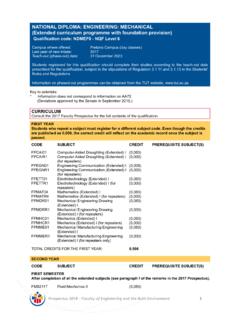
Transcription of DIPLOMA IN ELECTRICAL ENGINEERING Dip (Electrical ...
1 1 Faculty of ENGINEERING and the Built EnvironmentDIPLOMA IN ELECTRICAL ENGINEERINGDip ( ELECTRICAL ENGINEERING ) - NQF Level 6 (360 credits)Qualification code: DPEE20 SAQA ID: 100953, CHE NUMBER: H16/14240/HEQSF Campus where offered: Pretoria CampusREMARKS a. Admission requirement(s) and selection criteria: APPLICANTS WITH A SENIOR CERTIFICATE OBTAINED BEFORE 2008: Admission requirement(s):A Senior Certificate or an equivalent qualification, with a C symbol at Standard Grade or a D symbol at Higher Grade for English, and B symbols at Standard Grade or C symbols at Higher Grade for Mathematics and Physical Science. Recommended subject(s) criteria: To be considered for this qualification, applicants must have an Admission Point Score (APS)of at least 28. APPLICANTS WITH A NATIONAL SENIOR CERTIFICATE OBTAINED IN OR AFTER 2008:Admission requirement(s):For 2022: A National Senior Certificate or an equivalent qualification, with a bachelor s degree or a DIPLOMA endorsement, or an equivalent qualification, with an achievement level of at least4 for English (home language or first additional language), 4 for Mathematics or Technical Mathematics, and 4 for Physical Sciences or Technical Sciences.
2 As from 2023: A National Senior Certificate or an equivalent qualification, with a bachelor s degree or a DIPLOMA endorsement, or an equivalent qualification, with an achievement level of at least 4 for English (home language or first additional language), 5 for Mathematics or Technical Mathematics, and 5 for Physical Sciences or Technical Sciences. Recommended subject(s): ELECTRICAL Technology and ENGINEERING Graphics and Design. Selection criteria:To be considered for this qualification, applicants must have an Admission Point Score (APS) of at least 28 (excluding Life Orientation). APPLICANTS WITH A NATIONAL CERTIFICATE (VOCATIONAL) AT NQF LEVEL 4:Admission requirement(s):A National Certificate (Vocational) at NQF Level 4, with a bachelor s degree or a DIPLOMA endorsement, issued by the Council for Quality Assurance in General and Further Education and Training (Umalusi) with at least a 50% (APS of 4) for English, 50% for Life Orientation (excluded for APS calculation), and 60% (APS of 5) for Mathematics and Science, and 50% (APS of 4) for any two compulsory vocational subject(s): ELECTRICAL Principles and Practice, ELECTRICAL Systems and Construction ELECTRICAL Workman-ship, Electronic Control and Digital Electronics.
3 2 Faculty of ENGINEERING and the Built EnvironmentSelection criteria:To be considered for this qualification, applicants must have an Admission Point Score (APS) of at least 28 (excluding Life Orientation). APPLICANTS WITH A NATIONAL N CERTIFICATE/NATIONAL SENIOR CERTIFICATE AS PUBLISHED IN REPORT 191: N3 (NQF LEVEL 4):Admission requirement(s):A National Senior Certificate or a National N Certificate with languages as published inReport 191: N3 (NQF Level 4) issued by both the Department of Higher Education and Training(DHET) and the Council for Quality Assurance in General and Further Education and Training(Umalusi), with at least 50% for English, Mathematics N3, ENGINEERING Sciences N3 and anyother two additional subject(s): ELECTRICAL Trade Theory, Electro Technology, ENGINEERING Drawing and Industrial Electronics. APPLICANTS WITH A N4 CERTIFICATE IN A RELATED ENGINEERING FIELD AS PUB-LISHED IN REPORT 191: N4:Admission requirement(s):A N6 Certificate in a related ENGINEERING field as published in Report 191: N6 issued byboth the Department of Higher Education and Training (DHET) and the Council for Quality Assurance in General and Further Education and Training (Umalusi), with an average of at least 60% for the qualification, and successful completion of an English Language Proficiency Assessment (done by the University).
4 Recommended subject(s):None. APPLICANTS WITH QUALIFICATIONS ON THE HIGHER EDUCATION QUALIFICATION SUB-FRAMEWORK (HEQSF) OFFERED BY UNIVERSITIES OF TECHNOLOGY:The applicant will be considered for admission to the programme, if any of the following qualifications has been completed: - Higher Certificate in ELECTRICAL ENGINEERING (NQF Level 5 - 140 credits). - Advanced Certificate in ELECTRICAL ENGINEERING (NQF Level 6 - 140 credits). b. Assessment procedure(s): No further assessment will be done (except for candidates with a N4 Certificate). Applicants who achieve the minimum APS will be considered until the programme complement is full. All completed applications received within the published due dates will be ranked. After consideration of the Departmental Student Enrolment Plan, only the top ranking applicants will be selected. Once a programme is full, a waiting list will be in place to provide an opportunity for applicants to fill places of those who did not register on time.
5 Applicants will be informed of their status per official letter from the Office of the Registrar, alternatively, they can check their application status on the TUT website, Applicants who do not meet the minimum requirements, might be transferred to the Higher Certificate in ELECTRICAL ENGINEERING , provided that he/she meets the minimum requirements. c. Recognition of Prior Learning (RPL), equivalence and status:See Chapter 30 of Students' Rules and Intake for the qualification:January and of ENGINEERING and the Built Environmente. Presentation:Day Minimum duration:Three Exclusion and readmission:See Chapter 2 of Students' Rules and Experiential Learning I (Work-Integrated Learning): See Chapter 5 of Students Rules and FIRST YEAR CODE MODULE NQF-L CREDIT PREREQUISITE MODULE(S) FIRST SEMESTER COL115X Computer Literacy (5) (5)COS115X Communication Skills (5) (5)DSA115D Digital Systems IA (5) (12)EEA115D ELECTRICAL ENGINEERING IA (5) (12)ETA115D Electronics IA (5) (12)LFS125X Life Skills (block module) (5) (2)MHA115D Mathematics IA (5) (12)TOTAL CREDITS FOR THE SEMESTER: 60 SECOND SEMESTEREEB115D ELECTRICAL ENGINEERING IB (5) (12) ELECTRICAL ENGINEERING IAETB115D Electronics IB (5) (12) Electronics IAMEC115D Mechanics (5) (12)MHB115D Mathematics IB (5) (12) Mathematics IASFD115D Software Design (5) (12) Computer Literacy TOTAL CREDITS FOR THE SEMESTER: 60 TOTAL CREDITS FOR THE FIRST YEAR.
6 120 SECOND YEARM odules must be taken in the combinations and in the sequence indicated. The following rule will apply: ELECTRICAL ENGINEERING II and Workshop Practice must be taken concurrently, or ELECTRICAL ENGINEERING II should be completed before a student will be permitted to register for Workshop Practice. CODE MODULE NQF-L CREDIT PREREQUISITE MODULE(S) FIRST SEMESTER DSB215D Digital Systems IB (5) (12) Digital Systems IAEGT216D ENGINEERING Management (6) (12)ELE216D ELECTRICAL ENGINEERING II (6) (12) ELECTRICAL ENGINEERING IBMAT216D Mathematics II (6) (12) Mathematics IBWSP215D Workshop Practice (5) (12) TOTAL CREDITS FOR THE SEMESTER: 604 Faculty of ENGINEERING and the Built EnvironmentSECOND SEMESTERAUT216D Automation (6) (12) Software DesignCNS216D Control Systems (6) (12) Mathematics IIEMH216D ELECTRICAL Machines (6) (12) ELECTRICAL ENGINEERING IIPJT215D Projects (5) (12) Digital Systems IB ELECTRICAL ENGINEERING II Electronics IB plus one of the following specialisation modules.
7 CLE216D Clinical ENGINEERING I (6) (12) Electronics IBEAP216D Electronic Application I (6) (12) Electronics IBEBS216D Embedded Systems I (6) (12) Digital Systems IBECM216D Electronic Communication I (6) (12) Electronics IBPCI216D Process Instrumentation I (6) (12) MechanicsPWS216D Power Systems I (6) (12) ELECTRICAL ENGINEERING IITOTAL CREDITS FOR THE SEMESTER: 60 TOTAL CREDITS FOR THE SECOND YEAR: 120 THIRD YEARM odules must be taken in the combinations and in the sequence indicated. The following rule will apply: Specialisation modules must be taken concurrently with the Design Projects or the specialisation modules should be passed before a student will be permitted to register for Design Projects. CODE MODULE NQF-L CREDIT PREREQUISITE MODULE(S) FIRST SEMESTERDPE316D Design Projects (6) (12) ProjectsPWE316D Power Electronics (6) (12) Control SystemsREN316D Renewable Energy (6) (12) ELECTRICAL ENGINEERING II plus one of the following specialisation modules:CLE316D Clinical ENGINEERING II (6) (24) Clinical ENGINEERING IEAP316D Electronic Application II (6) (24) Electronic Application IEBS316D Embedded Systems II (6) (24) Embedded Systems IECM316D Electronic Communication II (6) (24) Electronic Communication IPCI316D Process Instrumentation II (6) (24) Process Instrumentation IPWS316D Power Systems II (6) (24) Power Systems I SECOND SEMESTERWEE316D Experiential Learning (6) (60) Design ProjectsTOTAL CREDITS FOR THE SECOND YEAR.
8 120 TOTAL CREDITS FOR THE QUALIFICATION: 360 5 Faculty of ENGINEERING and the Built EnvironmentMODULE INFORMATION (OVERVIEW OF SYLLABUS)The syllabus content is subject to change to accommodate industry changes. Please note that a more detailed syllabus is available at the Department or in the study guide that is applicable to a particular module. At time of publication, the syllabus content was defined as follows:AAUTOMATION (AUT216D) 1 X 3-HOUR PAPER (Module custodian: Department of ELECTRICAL ENGINEERING )Flow sheet symbols and functional diagramming for process instrumentation diagrams; Measurement; Ma-nipulation; Hierarchical control; Programmable logic controllers (PLC); Distributed control systems (DCS); Su-pervisory control and data acquisition (SCADA); and an introduction to networks in process automation. (Total notional time: 120 hours)CCLINICAL ENGINEERING I (CLE216D) 1 X 3-HOUR PAPER (Module custodian: Department of ELECTRICAL ENGINEERING )Knowledge and understanding of the basic concept of Anatomy and Physiology as it relates to the levels of Organisation of the human body.
9 Knowledge and understanding of the organ systems responsible for support and movement, integration and coordination, transport and immunity and absorption and excretion in the human body.(Total notional time: 120 hours)CLINICAL ENGINEERING II (CLE316D) 1 X 3-HOUR PAPER (Module custodian: Department of ELECTRICAL ENGINEERING )Safety in the medical environment. Performance of systems and fault finding. Operational procedure for a work-shop. Ionising radiation: Production and detection. Non-ionizing radiation: Production and detection. Medical Equipment. (Total notional time: 240 hours)COMMUNICATION SKILLS (COS115X) 1 X 2-HOUR PAPER(Module custodian: Department of ELECTRICAL ENGINEERING )To identify and apply basic competencies related to communicating in a technical or ENGINEERING environment. These competencies include presenting technical information to a variety of audiences, preparing technical reports, participating constructively in formal meetings and preparing a variety of business and technical documents.
10 (Total notional time: 50 hours)COMPUTER LITERACY (COL115X) CONTINUOUS ASSESSMENT(Module custodian: End User Computing Unit)This module provides foundational knowledge in computing fundamentals, essential digital skills in key applications based on MS Office Suite and network basics ( MS Outlook and Internet). Online exams are mapped with End-User Computing: SAQA 49077 (61591) Core Element as well as Internet and Computing Core Certification. (IC3). (Total notional time: 50 hours)CONTROL SYSTEMS (CNS216D) 1 X 3-HOUR PAPER (Module custodian: Department of ELECTRICAL ENGINEERING )Control system basics; modelling in the frequency domain; time response; reduction of multiple subsystems; stability; steady state errors; root locus techniques; frequency response techniques. (Total notional time: 120 hours)DDESIGN PROJECTS (DPE316D) PROJECT ASSESSMENT (Module custodian: Department of ELECTRICAL ENGINEERING )This module covers the concepts and implementation of the design of ELECTRICAL ENGINEERING systems.