Transcription of Distaph - Medicines
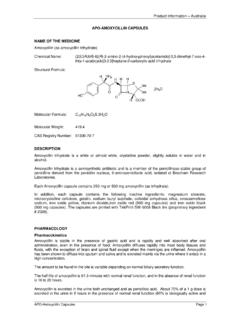
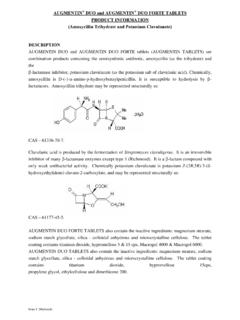
1 Distaph Dicloxacillin (sodium). PRODUCT INFORMATION. Name of the Medicine Active ingredient: dicloxacillin (as dicloxacillin sodium). Chemical name: (6R)-6-[3-(2, 6-dichlorophenyl)-5-methylisoxazole-4-ca rboxamido]-penicillanate. Structural formula: Molecular Formula: C19H16Cl2N3 NaO5S,H2O Molecular Weight: CAS Registry No: 13412-64-1. Description Dicloxacillin sodium is an antibiotic and a member of the isoxazolyl penicillins. Dicloxacillin sodium is a white or almost white, crystalline powder. It is hygroscopic, freely soluble in water, soluble in alcohol and in methanol. Each capsule contains dicloxacillin sodium equivalent to 250 mg or 500 mg dicloxacillin. The inactive ingredients present are colloidal anhydrous silica, magnesium stearate, gelatin, titanium dioxide, purified water and TekPrint SW-9008 (ARTG No: 2328). Pharmacology Pharmacokinetics Absorption. Dicloxacillin is resistant to destruction by acid. Absorption from the gastrointestinal tract is rapid, in fasting adults, 50% to 94% of an oral dose was absorbed with peak levels occurring to 2 hours.
2 The bioavailability of dicloxacillin is decreased in the presence of food. Serum levels after oral administration are directly proportional to dosage at unit doses of 125 mg, 250 mg, and 500 mg as measured at the 2-hour level. Single oral doses of dicloxacillin 500 mg produced peak serum concentrations of 10 to 18 microgram/mL. Distribution. Dicloxacillin is 95 - 99% bound to serum proteins, mainly albumin. Dicloxacillin is distributed into bone, bile, pleural fluid, and synovial fluid. Only minimal concentrations are attained in the cerebrospinal fluid. Metabolism and Excretion. The elimination half-life of dicloxacillin is approximately hours. Dicloxacillin is partially metabolised to microbiologically active (5-hydroxymethyl derivative of dicloxacillin) and inactive metabolites. Dicloxacillin and its metabolites are rapidly excreted in the urine by glomerular filtration and tubular secretion, approximately 50% of the absorbed dose is excreted unchanged in the urine. The drug is also Distaph Product Information 2.
3 Partially excreted in the faeces via biliary elimination. Reduced plasma concentrations have been reported in patients with cystic fibrosis. This is attributed to enhanced elimination of the drug in these patients. In patients with severe renal impairment, the half life of dicloxacillin has been reported to increase two to three fold, however, extra renal elimination prevents significant drug accumulation in these patients (see Dosage and Administration). Dicloxacillin is not dialysable. Only minimal amounts are removed by haemodialysis or peritoneal dialysis. Pharmacological Actions Dicloxacillin sodium is a semisynthetic penicillin that resists inactivation by staphylococcal -lactamase (penicillinase). Penicillinase resistant penicillins exert a bactericidal action against penicillin-susceptible microorganisms during active multiplication. All penicillins inhibit the biosynthesis of the bacterial cell wall. Dicloxacillin is a narrow spectrum antibiotic with activity against the following Gram-positive organisms:susceptible staphylococci, Streptococcus pyogenes, "Viridans" group streptococci, Streptococcus pneumonia.
4 Because of its resistance to the enzyme penicillinase, it is active against penicillinase producing staphylococci. Dicloxacillin is not active against methicillin-resistant Staphylococcus aureus. Disc susceptibility Tests The most precise estimates of antibiotic susceptibility are given by quantitative methods that require measurement of zone diameters. The results of agar diffusion sensitivity tests for methicillin determined in accordance with NCCLS^ M100-S6, M2-A5, can be applied to other -lactamase-resistant penicillins including dicloxacillin. The NCCLS Zone Interpretative Standards and Equivalent Minimum Inhibitory Concentrations (MIC) Breakpoints for organisms other than Haemophilus spp, Neisseria gonorrhoea, and Streptococcus, . gives sensitivity results for methicillin against various staphylococcal bacteria, which are as follows:- Bacteria Methicillin discs 5 microgram Zone diameter, Nearest Whole mm Equivalent MIC breakpoints (microgram/ mL). Susceptible Intermediate Resistant Susceptible Resistant staphylococci 14 10-13 9 8 16.
5 ^ Available from NCCLS, Lancaster avenue, Villanova, Pensylvannia 19085, USA. A report of susceptible' indicates the infecting organism is likely to response to therapy. A report of intermediate' suggests the organism would be susceptible if high dosage is used or if the infection is confined to tissues in which high concentrations of dicloxacillin are obtained, for example in urine. A report of resistant'. indicates that the infection is unlikely to response to therapy with the antibiotic. Indications Treatment of confirmed or suspected staphylococcal and other Gram positive coccal infections, including skin and skin structure and wound infections, infected burns, cellulitis, osteomyelitis and pneumonia (note: benzylpenicillin is the drug of choice for the treatment of streptococcal pneumonia). Distaph Product Information 3. Bacteriological studies should be performed to determine the causative organisms and their susceptibility to dicloxacillin. Dicloxacillin has less intrinsic antibacterial activity and a narrower spectrum than benzylpenicillin.
6 Dicloxacillin should therefore not be used in infections due to organisms susceptible to benzylpenicillin. Important Note: When it is judged necessary that treatment is initiated before definitive culture and sensitivity results are known, if the microbiology report later indicates that the infection is due to an organism other than a benzylpenicillin resistant staphylococcus sensitive to dicloxacillin, the physician is advised to continue therapy with a drug other than dicloxacillin or any other penicillinase-resistant penicillin. Contraindications A history of a previous hypersensitivity reaction to any penicillins, or to any component of the formulation. Precautions Anaphylaxis. Serious, and occasionally fatal, hypersensitivity (anaphylactoid) reactions have occurred in patients receiving penicillin. Serious anaphylactic reactions require immediate emergency treatment with adrenaline, Although anaphylaxis is more frequent following parenteral therapy, it has occurred in patients on oral penicillins.
7 Before commencing therapy with any penicillin, a careful enquiry about sensitivity or allergic reactions to penicillins, cephalosporins or other allergens should be made before dicloxacillin is prescribed. There is clinical and laboratory evidence of cross-allergenicity among among bicyclic -lactam antibiotics including penicillins, cephalosporins, cephamycins, 1-oxa- -lactams and carbapenems. Should an allergic reaction occurduring therapy, the drug should be discontinued and appropriate measures taken. Pseudomembranous colitis. Antibiotic associated pseudomembranous colitis has been reported with many antibiotics including dicloxacillin. A toxin produced with Clostridium difficile appears to be the primary cause. The severity of the colitis may range from mild to life threatening. It is important to consider this diagnosis in patients who develop diarrhoea or colitis in association with antibiotic use (this may occur up to several weeks after cessation of antibiotic therapy).
8 Mild cases usually respond to drug discontinuation alone. However, in moderate to severe cases appropriate therapy with a suitable oral antibacterial agent effective against Clostridium difficile should be considered. Fluids, electrolytes and protein replacement should be provided when indicated. Drugs which delay peristalsis, opiates and diphenoxylate with atropine ( Lomotil), may prolong and/or worsen the condition and should not be used. Cholestatic hepatitis. Dicloxacillin has been associated with cholestatic hepatotoxicity and jaundice. The patterns of liver function test results and biopsy histology are similar to those with flucloxacillin. In the period 1981 to 1994, the Swedish Adverse Drug Reactions Advisory Committee (SADRAC) received 20. reports of adverse hepatic reactions which were possibly or probably related to dicloxacillin. During this period, million defined daily doses (DDD) of dicloxacillin were prescribed in Sweden, giving a frequency of reactions per million DDD.
9 Over the same period, SADRAC received 127 adverse hepatic reaction reports (77. possible, 47 probable, 3 unclassified) related to flucloxacillin, giving a frequency of reactions per million DDD. Although the limitations of retrospective data reliant on spontaneous physician reporting are obvious, the SADRAC figures suggest that adverse hepatic events occur, or at least are reported, less frequently with Distaph Product Information 4. dicloxacillin than with flucloxacillin. Despite the reduced frequency of hepatic reactions to dicloxacillin, dicloxacillin should only be used in older patients (55 years or more) when such use is clearly justifiable on clinical grounds. Bacteriological studies to determine the causative organisms and their susceptibility to the penicillinase resistant penicillins should be performed. In the treatment of suspected staphylococcal infections, therapy should be changed to another active agent if culture tests fail to demonstrate the presence of staphylococci.
10 As with any potent drug, periodic assessment of organ-system function, including hepatic, renal and haematopoietic, should be made during prolonged therapy. White blood cell counts and differential cell counts should be obtained prior to initiation of therapy with dicloxacillin. Periodic urinalysis should be performed, and serum urea, creatinine, AST and ALT concentrations should be determined during therapy with dicloxacillin. Dosage alterations should be considered if these values become elevated. Dicloxacillin should be discontinued if abnormal liver function tests develop whilst on therapy. The use of antibiotics may result in the overgrowth of nonsusceptible organisms. Should superinfection occur, appropriate treatment should be initiated and discontinuation of dicloxacillin therapy should be considered. This oral preparation should not be relied upon in patients with severe illness or with nausea, vomiting, gastric dilatation, cardiospasm, intestinal hypermotility. Rare reports have been received during postmarketing surveillance of oesophageal burning, oesophagitis and oesophageal ulceration, particularly after ingestion of dicloxacillin capsules with an insufficient quantity of water and/or before going to bed.