Example: dental hygienist
Distraction Techniques - Cornell University
exercises to aid relaxation. • Concentrate on something that makes you happy: good friends, good times, laughter, etc. Release Your Frustrations • Break old dishes. • Rip apart an old cassette tape, smash the casing. • Throw ice cubes at a brick wall. • Throw eggs in the shower. • Rip apart an old phone book.
Tags:
Information
Domain:
Source:
Link to this page:
Documents from same domain

Distraction Techniques and - Cornell University
www.selfinjury.bctr.cornell.eduChew slowly, noticing how the texture and even the taste of the raisin change as you chew it. • Choose an object in the room. Examine it carefully and then write as detailed a description of it as you can. • Choose a random object, like a twist-tie, and try to list 30 different uses for it. • Pick a subject and research it on the web.

The Neurobiology of Non-suicidal Self-injury (NSSI): A review
www.selfinjury.bctr.cornell.eduSuicidology Online 2012; 3:24-32. ISSN 2078-5488 proposes that these behaviours function as a method of regulation of both affective experience and social situations in the occurrence of a stressful event.

www.selfinjury.bctr.cornell.edu
www.selfinjury.bctr.cornell.eduCHILDHOOD ABUSE (ESPECIALLY SEXUAL ABUSE) PTSD EATING DISORDERS SEVERE ABUSE/ABUSE BY A FAMILY MEMBER ANXIETY DISORDERS DANCERS Self-injury can become habitual and hard to stop Self-injury can be contagious esp. in teen peer groups Broad consensus that self- injury is rising in prevalence SELF-INJURY The Idea of self-in.ury can be

Information for parents
www.selfinjury.bctr.cornell.eduFathers spend only 3 minutes. Understanding the Role of Relationships No, no person causes another person to act in a certain way. Like most negative behaviors, however, self-injury is often a result of two things. That is, a person's belief that he or she
Adolescent Non-Suicidal Self-Injury (NSSI) Interventions
www.selfinjury.bctr.cornell.edufor suicidal adolescent inpatients. Journal of the American Academy of Child and Adolescent Psychiatry, 43(3), 276–282. DBT on a pediatric inpatient unit Reduced parasuicidal behavior at 1-year F/U Quasi-experimental trial of DBT versus TAU in 62 suicidal adolescents No difference between groups III Taylor, L. M. W., Oldershaw, A., Richards ...
Coping Stress Management - Cornell University
www.selfinjury.bctr.cornell.edu• Tight muscles • C ol dr swe atyhn • Back or neck problems • Sleep disturbances • Stomach distress • More colds and infections • Fatigu R ap idb rethngo ... deadlines m Major personal injury or illness m Managing learning or other disabilities m Change in living conditions m Argument with instructor
ELIZABETH LLOYD-RICHARDSON, PHD What ... - Cornell …
www.selfinjury.bctr.cornell.eduto a deep need to dosomething that will stop the intensity. Self-injury can serve as a short-term fix to stop t h eov r w lm ing- s f– a . The role of emotions and how they contribute to self-injury is discussed in greater detail on an Information Brief here on this website (see Prussien, Rosenblum & Whitlock). The purpose of our conversation ...

The Brief Non-Suicidal Self-Injury Assessment Tool (BNSSI-AT)
www.selfinjury.bctr.cornell.eduThe Brief Non-Suicidal Self-Injury Assessment Tool (BNSSI-AT) Developed by: Janis Whitlock and Amanda Purington The Cornell Research Program on Self-Injury and Recovery www.selfinjury.bctr.cornell.edu Revised: March 15, 2013 How to Interpret this Document: This document shows main questions as well as sub-

The Non-Suicidal Self-Injury Assessment Tool (NSSI-AT)
www.selfinjury.bctr.cornell.eduThe Non-Suicidal Self-Injury Assessment Tool (NSSI-AT) Developed by: Janis Whitlock and Amanda Purington The Cornell Research Program on Self-Injury and Recovery www.selfinjury.bctr.cornell.edu Revised: March 15, 2013 How to Interpret this Document: This document shows main questions as well as sub-
ELIZABETH LLOYD-RICHARDSON, PHD What is emotion …
www.selfinjury.bctr.cornell.eduALL OF US FEEL AND EXPERIENCE EMOTIONS – negative and positive – each and every day. Emotions are a normal part of our everyday lives. Everyone experiences them. For some though, feeling these emotions can seem overwhelming, like an out-of-control roller coaster. It is common for one or more strong emotions
Related documents
Stress Less: Relaxation Enhancement Group Therapist …
www.mirecc.va.govRelaxation Enhancement (RE) protocol. Our goal is to improve Veteran adherence to the practice of relaxation to reduce short-term anxiety and stress. The RE protocol includes: 1) a standard rationale for using relaxation techniques that is discussed in group, with a copy provided to Veterans for reference, based
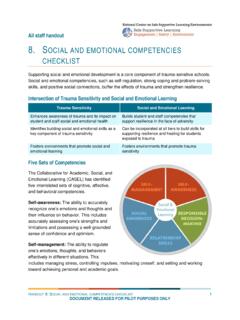
8. SOCIAL AND EMOTIONAL COMPETENCIES CHECKLIST
safesupportivelearning.ed.govI incorporate emotional and behavioral regulation techniques that include breathing exercises; muscle relaxation; journaling; mindfulness exercises; and use of nonverbal means of expression such as music, art, dance, and yoga.
Distraction Techniques and - Cornell University
www.selfinjury.bctr.cornell.edu• Learn some breathing exercises to aid relaxation. • Concentrate on something that makes you happy: good friends, good times, laughter, etc. R Y+1 f.1/0.˛0%+*/ • Break old dishes. • Rip apart an old cassette tape, smash the casing. • Throw ice cubes at a brick wall. • Throw eggs in the shower. • Rip apart an old phone book.
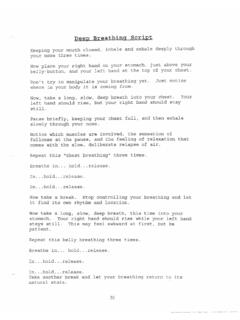
Relaxation Scripts - TR Connections
www.trconnections.comRelaxation techniques By Dr. Steven Blair, Dr. Brenda Wright, Walter Ettinger Everyone feels tense from time to lime. When you do. practice one of these relaxation techniques, As with any new habit, you must practice these techniques to get a benefit. o Deep-breathing exercises-You've heard this before: Take a deep breath and relax. Taking more ...
Relaxation Techniques - National Institutes of Health
files.nccih.nih.govMay 31, 2016 · Relaxation techniques include a number of practices such as progressive relaxation, guided imagery, biofeedback, self-hypnosis, and deep breathing exercises. The goal is similar in all: to produce the body’s natural relaxation response, characterized by
Introduction to Mindfulness Exercises
sf-act.comMindfulness in Action Techniques These techniques are useful for bring mindfulness into the activities of everyday life. They also are a good place to start with clients who have very low impulse control and distress tolerance. Linehan (2003 pp170-171 & 174-175) describes a number of these techniques as a way of developing
for Relaxation Imagery - Whole Person
wholeperson.comRelaxation, Imagery & Inner Healing. This volume, like the first, contains relaxation and imagery scripts that focus on relaxing the body and mind, connecting with nature, discovering and learning from wise inner guides, healing physical and emotional injuries, and discovering more about yourself. I also included a cross-reference index,
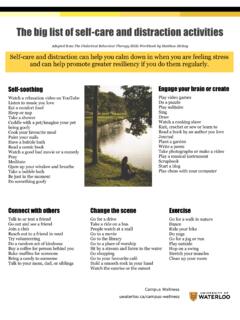
The big list of self-care and distraction activities
uwaterloo.caWatch a relaxation video on YouTube Listen to music you love Eat a comfort food Sleep or nap Take a shower Cuddle with a pet/imagine your pet being goofy Cook your favourite meal Paint your nails Have a bubble bath Read a comic book Watch a good bad movie or a comedy Pray Meditate Open up your window and breathe Take a bubble bath

Iterative Methods for Sparse Linear Systems Second Edition
www-users.cs.umn.edu13.4.3 V-cycles and W-cycles . . . . . . . . . . . . . . . 443 13.4.4 Full Multigrid . . . . . . . . . . . . . . . . . . . 447 13.5 Analysis for the two-grid cycle ...