Example: confidence
Distraction Techniques - Cornell University
unreal: • Squeeze ice. • List the many uses for a random object. (For example, what are all the things you can do with a twist-tie?) • Interact with other people. • Put a finger into a frozen food (like ice cream). • Bite into a hot pepper or chew a piece of ginger root. • Rub liniment under your nose. • Slap a tabletop hard.
Tags:
Information
Domain:
Source:
Link to this page:
Documents from same domain

The Neurobiology of Non-suicidal Self-injury (NSSI): A review
www.selfinjury.bctr.cornell.eduSuicidology Online 2012; 3:24-32. ISSN 2078-5488 proposes that these behaviours function as a method of regulation of both affective experience and social situations in the occurrence of a stressful event.

www.selfinjury.bctr.cornell.edu
www.selfinjury.bctr.cornell.eduCHILDHOOD ABUSE (ESPECIALLY SEXUAL ABUSE) PTSD EATING DISORDERS SEVERE ABUSE/ABUSE BY A FAMILY MEMBER ANXIETY DISORDERS DANCERS Self-injury can become habitual and hard to stop Self-injury can be contagious esp. in teen peer groups Broad consensus that self- injury is rising in prevalence SELF-INJURY The Idea of self-in.ury can be

Distraction Techniques and - Cornell University
www.selfinjury.bctr.cornell.eduChew slowly, noticing how the texture and even the taste of the raisin change as you chew it. • Choose an object in the room. Examine it carefully and then write as detailed a description of it as you can. • Choose a random object, like a twist-tie, and try to list 30 different uses for it. • Pick a subject and research it on the web.

Information for parents
www.selfinjury.bctr.cornell.eduFathers spend only 3 minutes. Understanding the Role of Relationships No, no person causes another person to act in a certain way. Like most negative behaviors, however, self-injury is often a result of two things. That is, a person's belief that he or she
Adolescent Non-Suicidal Self-Injury (NSSI) Interventions
www.selfinjury.bctr.cornell.edufor suicidal adolescent inpatients. Journal of the American Academy of Child and Adolescent Psychiatry, 43(3), 276–282. DBT on a pediatric inpatient unit Reduced parasuicidal behavior at 1-year F/U Quasi-experimental trial of DBT versus TAU in 62 suicidal adolescents No difference between groups III Taylor, L. M. W., Oldershaw, A., Richards ...
Coping Stress Management - Cornell University
www.selfinjury.bctr.cornell.edu• Tight muscles • C ol dr swe atyhn • Back or neck problems • Sleep disturbances • Stomach distress • More colds and infections • Fatigu R ap idb rethngo ... deadlines m Major personal injury or illness m Managing learning or other disabilities m Change in living conditions m Argument with instructor
ELIZABETH LLOYD-RICHARDSON, PHD What ... - Cornell …
www.selfinjury.bctr.cornell.eduto a deep need to dosomething that will stop the intensity. Self-injury can serve as a short-term fix to stop t h eov r w lm ing- s f– a . The role of emotions and how they contribute to self-injury is discussed in greater detail on an Information Brief here on this website (see Prussien, Rosenblum & Whitlock). The purpose of our conversation ...

The Brief Non-Suicidal Self-Injury Assessment Tool (BNSSI-AT)
www.selfinjury.bctr.cornell.eduThe Brief Non-Suicidal Self-Injury Assessment Tool (BNSSI-AT) Developed by: Janis Whitlock and Amanda Purington The Cornell Research Program on Self-Injury and Recovery www.selfinjury.bctr.cornell.edu Revised: March 15, 2013 How to Interpret this Document: This document shows main questions as well as sub-

The Non-Suicidal Self-Injury Assessment Tool (NSSI-AT)
www.selfinjury.bctr.cornell.eduThe Non-Suicidal Self-Injury Assessment Tool (NSSI-AT) Developed by: Janis Whitlock and Amanda Purington The Cornell Research Program on Self-Injury and Recovery www.selfinjury.bctr.cornell.edu Revised: March 15, 2013 How to Interpret this Document: This document shows main questions as well as sub-
ELIZABETH LLOYD-RICHARDSON, PHD What is emotion …
www.selfinjury.bctr.cornell.eduALL OF US FEEL AND EXPERIENCE EMOTIONS – negative and positive – each and every day. Emotions are a normal part of our everyday lives. Everyone experiences them. For some though, feeling these emotions can seem overwhelming, like an out-of-control roller coaster. It is common for one or more strong emotions
Related documents
LEARN COLLISION DETECTION IN UNREAL ENGINE
cdn2.unrealengine.comUsing Unreal Engine It is expected that students have some experience with the Unreal Engine interface prior to starting. To facilitate teaching with Unreal Engine, educators can familiarize themselves with the tool and how to use it in the classroom, using a short course we have developed for this purpose.
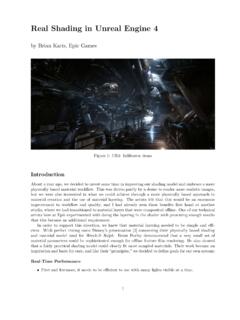
Real Shading in Unreal Engine 4
cdn2.unrealengine.comReal Shading in Unreal Engine 4 by Brian Karis, Epic Games Figure 1: UE4: Infiltrator demo Introduction About a year ago, we decided to invest some time in improving our shading model and embrace a more physically based material workflow. This was driven partly by a desire to render more realistic images,
深層強化学習と活用するためのコツ
www.ieice.orgUNREAL Generalized Advantage Estimator Advantage Q-Learning Prioritized Experience Replay SRASA. UNREAL [Jaderberg, et al., 2016] 38

Symptom Checklist 90-R - University of Pennsylvania
dmu.trc.upenn.eduStudy _____ ID _____ Date __ __ /__ __ /__ __ __ __