Transcription of Documentation Best Practices for Washington …
1 best Practices Summary 2016 Industrial Insurance Chiropractic Advisory Committee Documentation best Practices for Washington State Workers Compensation Table of Contents Summary Information Practical Application Points clinical Workflows and Documentation Needs clinical Resources L&I Documentation Checklist Work-R elatedness Checklist Documenting Work Ability Worksheet L&I Documentation Requirements Laws and Policies Related to clinical Documentation clinical Record Keeping best Practices Occupational Healthcare, Problem-Oriented Record Keeping Initial History Documentation CC/HPI, Occupational, Past History Initial clinical Examination Documentation Regional, general clinical Examination Documentation Special Studies, Imaging Diagnostic Assessment Documentation Problem List, Prognosis Workers Compensation Issues Documentation Treatment Plan Documentation Initial SOAP Note Treatment Documentation Routine, Reassessment, Discharge Non Face-to-Face Care (Phone Calls, Peer Consultation )
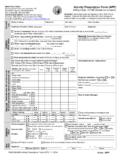
2 Workers Compensation Specific Reporting Report of Accident Activity Prescription Form Additional Materials Work-related Terminology Glossary Abbreviations & Acronyms Lifting Calculator State Laws Relevant for L&I Documentation Documentation Examples Evidence & Methodology Citations Purpose and Intended Use This resource was developed by the Industrial Insurance Chiropractic Advisory Committee (IICAC) of the Washington State Department of Labor & Industries (L&I). It provides concise summaries regarding Documentation standards and Practices based on published clinical and health education literature as well as key legal Documentation and reporting requirements for treating injured workers in Washington State.
3 Specific Documentation requirements exist for coding and billing purposes for various procedures and are found in the Medical Aid Rules and Fee Schedule (MARFS). Note that example chart entries included in this document illustrate Documentation of clinical information; they do not imply nor reflect specific Documentation requirements for coding and billing purposes. This practice resource does not change L&I coverage or payment. A comprehensive search of available literature on clinical Documentation was conducted by the Practice, Education and Outreach (PEO) Subcommittee of the IICAC and L&I staff during the Fall of 2015.
4 Additionally, relevant statutes, administrative rules, and department polices were identified and reviewed. Literature was reviewed and assessed for relevance and quality and summaries were drafted by consensus of the subcommittee with expert content input from consultants and reviewers, including L&I s Industrial Insurance Medical Advisory Committee during late 2015 and early 2016. An updated draft was approved for distribution in April 2016 by the IICAC. This resource is expected to be updated periodically by the IICAC. Interested parties are encouraged to submit new published reports for consideration in future revisions.
5 This and other practice resources are in the public domain and are available for download on L&I s website. Contact information for public input and submission of studies for future revisions is available on the website: Subcommittee Ron Wilcox, DC William Pratt, DC Lissa Grannis, DC Clay Bartness, DC Michael J. Dowling, DC L&I staff Robert D. Mootz, DC Jena Williams Acknowledgements IICAC and L&I thank David Folweiler, DC, Les White, DC, Sarah Martin OT, Paul Darby MD, PhD, MPH, and Gary Schultz, DC, DACBR for their contributions and assistance in reviewing drafts of this resource, but note that this assistance does not constitute an endorsement.
6 SUMMARY - Practical Application Points In addition to typical clinical Documentation requirements, Washington State workers compensation requires that work ability be addressed, the clinical rationale for the work-relatedness of the patient s condition is documented, and that progress demonstrating that care is curative and rehabilitative is indicated. Reports of findings and interpretation of special studies must be included in the chart, including written reports of in-office studies such as x-rays. Functional status and return to work (RTW) focus are central to care of injured workers and must be reflected in Documentation .
7 Occupational Healthcare Documentation clinical Documentation serves several basic roles including: 1. It codifies the clinical rationale for making a patient s diagnosis, documents what interventions are done, and how well they worked. 2. It reveals why a provider does what she does reflecting both clinical logic and procedural components of care which are critical for professional liability purposes. 3. It provides an explicit log of what was done which is increasingly necessary for billing accuracy in third party reimbursement. 4. Additionally, unique to workers compensation, clinical Documentation becomes the basis for determinations of benefits that workers receive.
8 general Documentation Standards and Requirements L&I requirements are generally consistent with standard clinical teaching and practice, licensure, and medicolegal expectations. The Medical Aid Rules and Fee Schedule (MARFS) includes Documentation requirements for coding and billing purposes. L&I additions involves work issues ( , work-relatedness, functional improvement) Templates in some electronic medical records (EMR) may improve quality, however, the use of copy forward and auto-fill features can be problematic and hazardous. Test and imaging results require full reports of findings and interpretation in the chart.
9 Charting must be chronological and completely capture all issues relevant to and/or under care. clinical elements are prescribed, but specific format terminology has flexibility. Problem-oriented records approaches are flexible enough for nearly all Documentation needs. Problem-Oriented Records (POR) POR format has become a standard clinical Documentation format that is required for workers compensation , 2 Elements include clinical findings and interventions in a SOAP format (Subjective, Objective, Assessment, Plan & Progress) and a problem list summarizing all of the patient s conditions being monitored or cared for in the practice.
10 The SOAP format aligns well with inpatient or outpatient Practices , can be tailored to any type of condition, evaluation, and intervention. A POR approach satisfied the needs of the patient for limited or continuing care and typically meets Documentation requirements for payers and professional liability protection. Specific Documentation requirements for coding and billing purposes may vary by payer and procedure. Occupational Health Additions Due to the volume of medical records submitted for workers compensation in Washington , it is required that the claim number appear in upper right of every page of the clinical record.